Wednesday morning - much refreshed, we rose with the lark (unless, indeed, that estimable bird rises before 7.30), and having had our usual substantial breakfast we went on our way without staying to inspect the lions of Farnham, or even to inquire if there were any.
"I'm sure we may congratulate ourselves on having good tempers," said the poet, as we stepped briskly along in the bright morning air, "because my father prophesied that we should all have quarrelled with each other before the first day was over, and should probably part and return to our respective homes on the second."
"But why should we quarrel any more than anyone else?" asked one.
"Well, I could not quite grasp his reason, but he said people always do on walking tours; it's a way they have, I suppose. They get so tired of each other's society after a day or two."
"Naturally, they do, when the pedestrians are of the male sex," said our artist, who is something of a man-hater, "and very likely we should have been no exception to the rule had there been any gentlemen with us, so I think we have clearly proved that our arrangement is the best." Of course we all agreed, and rather than let the prediction come true I forbore for the future to express my opinions with regard to the cooking-stove, since the others all seemed peculiarly impressed with the conviction that it was the secretary's duty to carry the obnoxious machine.
Exhilarated by the fresh air and bright sun, we walked at a fine pace towards the wild barren country round the Hind-head, intending to stay the night at Haslemere.
Tilford was soon reached, and here we paused to buy provisions and also to inspect a splendid old oak tree on the green.
"It is called the King's Oak," said the pathfinder, "and is one of the boundary marks of the Waverley Abbey lands. Years ago orders were given for it to be cut down; but the country people assembled from far and near to protect the tree, which they regarded with great respect and even affection. They nailed plates of tin round the trunk so that the axes could not take effect." Seeing what she took to be incredulous looks, she added - "There are the pieces of tin before your eyes, so it must be true."
Whether the pathfinder's pretty story were true or not, we could not but be glad that the hoary old tree had stood so long, and such as were able made some hasty sketches of it, whilst the others went on an expedition to the one shop of the village, and secured a heterogeneous collection of viands for dinner.
As we left Tilford with its pretty bridge and river behind us, the aspect of the country grew wilder, and cultivation began to give place to heather-clad hill and wide breezy moor. The road was very dusty and glaring white. The sun, mounting high in the heavens, blazed down upon us, making us pine for the sight of a tree or anything that would cast more shade than a small umbrella; but we pushed on bravely till the strange mounds called the "Devil's Jumps" were clearly visible.
At this point a very unexpected "ten minutes' interval" took place. It is superfluous to relate that we owed this halt to our president, who, spying a small lake lying placid among the heather a short distance from the road, insinuated how delightful a closer investigation of it would be. The pathfinder warned us of the distance still to be traversed, and expatiated on the beauties which would soon be unfolded to our wondering view; we looked at the hot white road, then at the clear cool water. Alas! The temptation was too strong, and, headed by the president, we set off at a run, away from the path of duty, feeling rather like Christian and Hopeful when straying into Bye-path meadow. We did not, however, like them, come to repent having strayed, for of all the delightful remembrances of our tour, none is looked back to with more pleasure than the rest beside that lonely lake.

We lay down on the springy heather, most luxurious of couches, revelling in the floods of sunshine, whilst a gentle breeze fanned our hot faces as we gazed up into the cloudless blue overhead. We drank from the transparent water, where a tiny waterfall rushed over the stones in mimic wrath. We watched the caddis-flies and other "strange creepy creature" cutting capers in the water, all unconscious of the curious eyes marking their every movement, whilst a lark, hidden from view in the clouds, trilled forth its glad song "thanking the Lord for a life so sweet." The babble of the fairy cascade, the sound of insects humming drowsily, and the bird's song just broke the stillness that otherwise would have been oppressive. All too swiftly the moments flew by, we each knew we must soon be moving onwards, and yet dreaded hearing the pathfinder give the signal. Suddenly, looking at her watch, she started to her feet and exclaimed -
"Oh, it's actually twelve o'clock! How could I let you waste so much time by this silly little pool! You must shoulder knapsacks instantly. Come, wake up, president. Now, secretary, I long to hear the cheerful jangle of the stove again."
With much regret we obeyed her behests. Leaving our lovely resting-place, we were soon marching along the fine country road, and shortly began the actual ascent of the Hind-head.
Two hours' walking brought us to a belt of firs on the road side, in the cool depths of which we lunched, getting water for tea from a well hard by, said to be 200 feet deep. No misadventures occurred, except the usual one of setting fire to the grass by the stove-lamp. As this happened almost every day, we became very expert at extinguishing conflagrations of this sort, and ceased to notice them much, though at first they proved rather exciting.
We were very expeditious over our repast, having already spent too much time on the road; indeed, we were all anxious to start again quickly, for the scenery through which we were passing became more and more grand, and we longed to be at the top of the hill to see the view which we knew was in store.
"How far is it to the Devil's Punch Bowl?" asked the pathfinder, of a rustic sitting astride a low stone wall.
"Dunno, never yeard tell on't," was the stolid answer.
"What ignorance!" murmured she, and hastened on to ask a woman approaching. This individual seemed to have the very vaguest ideas of distances, but hazarded in reply, "It moight be about three moile." The next pedestrian declared it to be a "good foive moile," whilst still another said even rather than that.
Our guide concluded not to ask any more questions, so we trudged on. The strange parallel valleys causing the road to make a wide detour, possibly accounted for the difference of opinion about the distance. At last we reached the celebrated Punch Bowl. No doubt every one who knows Surrey will be familiar with this spot - one of the finest in that beautiful county. Standing there, half way up the Hind Head, one sees range upon range of bleak rounded hills. Conspicuous among them are the three conical peaks mentioned before as marking the jumps taken by the individual said to own the Punch Bowl. Behind, the ascent is more abrupt and steeper than that of the road by which we have come. At our very feet is the great hollow scooped out in the bosom of the earth, so sudden and unexpected as readily to account for the superstition which gave its name.
On its brim is a tombstone, erected to the memory of an unknown sailor foully murdered on this spot, and whose tragic end is set forth in a curious inscription. Coiled about the base of the stone lay a viper recently killed, perhaps by some passer-by. This gave the finishing touch to the weird, unnatural character of the scene. Gazing, in a silence unbroken by voice of any living thing, it was with almost a sigh of relief that we heard the sound of sheep-bells tinkling faintly far below us. We then saw for the first time, dwarfed by distance, but still recognisable, a substantial and most unghostly farmhouse nestling amongst the trees in the very Punch Bowl itself.
With that, all our eerie feelings vanished, and then someone remembered that this place is mentioned by Nicholas Nickleby, he having stopped to rest here when on his way to Portsmouth with poor Smike.
Turning away from the melancholy scene, we were soon at the top of the hill, whence a wonderfully extensive view is obtained. From thence a picturesque lane, whose high hedges sent forth long trails of honeysuckle, clematis, and rose, led to Haslemere, our goal. We had, for some reason or other, all been filled with intense admiration for Haslemere, never having seen it. Perhaps we rather associated it with the poems of the Laureate who lives there. However, our expectations were high, and, as is nearly always the case when one expects much, we were disappointed.
The pathfinder and myself had gone to reconnoitre, and we read in each other's faces the tale of blighted hopes.
"Oh, pathfinder, we cannot stay here, it's so very tame after what we have come through," I exclaimed.
"It is; painfully so," said my companion; "and see, the sun is not thinking of setting yet, it won't be dark for hours. Do let us go on again."
"But where to? And what will the others say?"
"Oh, if we settle all before they arrive and then just say we are going on to such and such a place, they will take it quite calmly."
Consulting the map, we found the next village to be Fernhurst, which sounded charming to us, and some women standing near told us there was sure to be accommodation there, as there were two inns, which could not both be full. Thus encouraged, we went to meet the others, who, hearing it was only two miles to Fernhurst, were quite satisfied with the arrangements.

It was rather a dismaying discovery to find the "two inns" to be really nothing more than small public-houses, and quite impracticable, but hearing of a larger inn with a farm attached a mile away, we started on again, hopefully. The pathfinder and I feeling responsible in this matter, as we had been the ones to decide on leaving Haslemere, went quickly on, feeling a trifle anxious lest there should not be room at the "Old Ewe's Head." It proved to be indeed the beau ideal of an old-fashioned country inn, standing back from the road, with a little green in front, in the middle of the which was an immense patriarchal elm tree, whose branches, stretching out all round, nearly touched the trees on the other side of the road. Round the great gnarled trunk were seats ranged, on which doubtless, the lords of the creation resident in the neighbourhood would sit, when the day's work was done, smoking their evening pipe, and talking over the affairs of the nation.
The landlady, a buxom and highly good-natured dame, was really distressed to find re required more than one small room, which was all she could offer. This being the melancholy fact, my companion and I were, for the moment, plunged into a state of abject despair. The only information the landlord could give was that we were nine miles from anywhere. "Ah, yes," he said, "it's a good nine mile afore you'll come anywhere worth mentioning; and a lonely road, too, a very lonely road, it is. Well do I remember when I was a lad going down that road of a morning with the other lads to see the gibbet, and sometimes there'd be as many as three bodies hanging there all at once; just opposite that pond as you'll see, 'bout two mile from here, where the trees meets over your 'ead now, that's where them gibbets used for to stand. Yes, a very lonesome road it is, and no mistake." He continued in this strain for some time; we had gone out to consult him whilst the tea we had thought it prudent to have ready against the others' arrival, was being prepared. Happily, the landlady broke in upon his enlivening information by coming to say the kettle was "just on the boil" and that tea would be ready in a minute.
"What's my old man been telling you about nine miles from nowhere, ladies? I heard him through the window; but never you heed him; he was always such a one to put the worst side upmost. I'll set you on the road as'll bring you to Midhurst under five miles, so you'll get there 'fore it's dark if you go as quick as you was when you come here. And as for them gibbets, he knows as well as I do that they've been all took down and done away with these forty years; so don't you heed him, ladies."
This was reviving, and we felt ready to fall upon her neck and weep for joy, but refrained, and greeted our companions with a sprightly air, refusing to tell them anything till after tea. And what a tea that was! Such new-laid eggs and fresh butter, such cream and new bread, and the giant water-cress, home-made jam, and native honey, combined with all the other good things, made up a repast not soon to be forgotten. And how the eatables vanished! We might not have eaten for a week, to see how quickly the table was cleared. At last we were satisfied, and with many directions from the kind hostess and predictions of evil from her saturnine spouse, we set off on the last stage of that long day's journey.
A lovely walk it was. Through the roadside trees were seen distant hills bathed in the ruddy sunset glow, and the sky, where visible through the green roof overhead, was flecked with amber and crimson and gold. The sunset was a glorious one, but it reminded us that darkness would soon follow, and we must hurry on. And hurry we certainly did , too much so, perhaps, as it soon became evident that we had missed the way among the many short cuts recommended.
After floundering wildly about for a little, we were soon hopelessly lost, so we stopped, to hold a council of war. The pathfinder and I volunteered to scour the country round till we met with either a house or a person to ask. Climbing to the top of a five-barred gate, from whence a very extensive view is obtained, I surveyed the prospect o'er till I discovered - oh joyful spectacle! - a house. The guide and I hastened to it, and our thanks will be for ever due to the lady of that house, who, with the greatest kindness, put us in the right road, by which a mistake would be impossible.
"Putting our best foot foremost," we went along at a good pace, singing "Marching thro' Georgia," and other martial airs, when sure there was no one "around," till at last our long walk was over, and we were peacefully ensconced in our hotel at Midhurst, having come twenty-three miles.
Next morning our rule of early rising was, for the first time, broken, in fact I fear it was nearly nine o'clock before we gathered round the breakfast-table. We all felt rather stiff, and some of us even a little foot-sore, though our constant practice of bathing the feet in warm water, with a few drops of arnica therein, saved us from much suffering in that way.
After visiting the beautiful ruins of Cowdry, we crossed the park and gained the high road to Petworth. We were rather curious to see this little town, having heard a story of a regiment of soldiers which was ordered there. They marched what seemed to them to be more than the proper distance without apparently getting an nearer to the town; they then made inquiries and learned that they had already passed through the place, without being aware of the fact, and were marching back to London! I think the town must have considerably changed since this extraordinary thing took place.
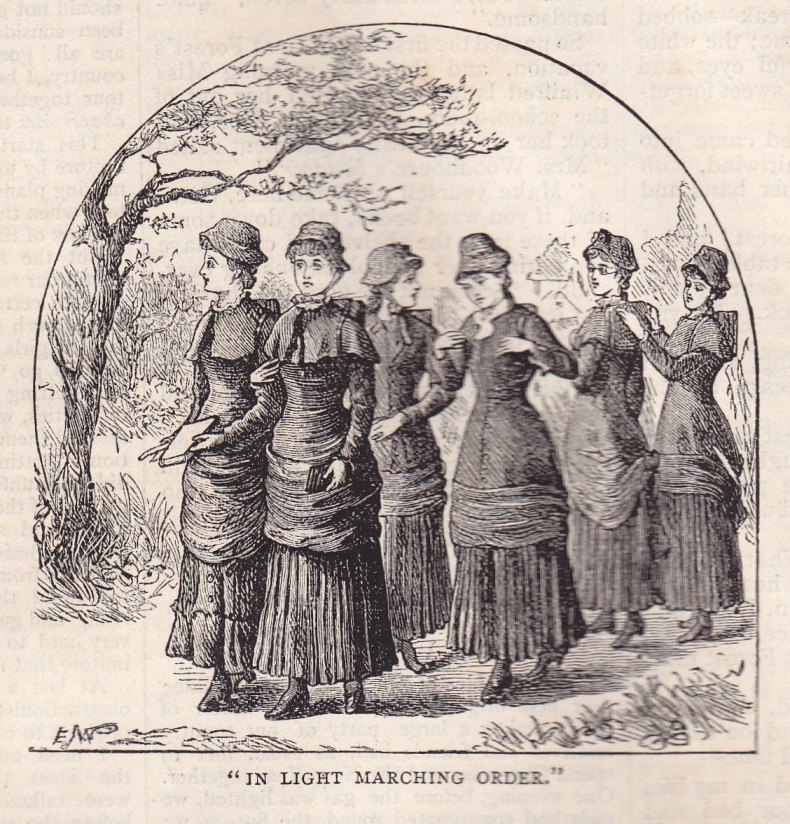
The inhabitants appeared to think the spectacle of six girls dressed alike, with knapsacks in their hands (we always carried them thus in the towns), a curious and interesting one. We bought our viands, however, in spite of the eyes staring through the shop window at the transaction, and the noble president presented herself and us with a tin can, which the shopman filled with water for us.
Leaving Petworth, we went on only till out of the range of vision of its denizens, and then turning up a lane, we seated ourselves on the grass, and leaning against a gate, with our feet on our knapsacks, we lunched as comfortably as we could have done in our own dining-room. We were just congratulating ourselves on our privacy, too, when a gate at the end of the lane was opened, and a carriage and pair dashed past, its occupants gazing with astonishment at the merry party, and the various component parts of the luncheon that lay scattered around us.
It was always found that we walked better and with more enjoyment after lunch than before, and to-day was no exception. Passing along the pleasant lanes and across the open heaths, singing and telling tales to beguile the way, stiffness and blistered feet might have been things to us unknown, and we could hardly believe our day's walk was done, when we arrived at Pullborough.
As we left the village next morning, we heard a party of villagers speculating about us, and the president's gift evidently supplied them with a clue to our pursuits.

"They'll be painters, I reck'n," said one. "See the can that one is carrying? That's to hold the co'ours, that is."
Our road was said to be the Roman Stone Street. We could well believe it for, as our poet remarked, "it needs a great deal of the iron determination attributed to the Romans to tramp along this straight undeviating road." A bend or turn here or there would have been quite a relief; but no such weak-minded deviation from the severe straightness occurred.
At Billinghurst we were dismayed on visiting the only bread-shop to hear the owner say she had none left; but after a search in the back regions of her establishment she emerged with one very small loaf, all she had, and with that we had to be content. We lunched in a somewhat marshy spot, but the damp had happily no ill effects, being counteracted, perhaps, by our usual drink of tea each.

The day was very warm, and the president's can proved a great comfort, for we refilled it on every opportunity so as to be able to quench our thirst as we went along. This night, the last of our tour, we spent in a comfortable hotel at Horsham.
Saturday morning broke gloomy and threatening, but as it did not actually rain we determined to start as usual, and it was not till we were beyond the region of railways that the storm began in earnest. It was trying to have to put up with very limited view of the pretty country which is obtainable from beneath an umbrella; but as it was the only wet day we had, we tried to persuade ourselves that it was quite a pleasant variety.
Our pathfinder had spent the previous evening in measuring on her maps and counting up the distances of each day. She now told us that, on our arrival at the starting-place, we should have walked altogether 96 miles, making an average of 16 miles a day, though, as will have been seen, we had generally been either above or below the average.
The treasurer, too, had been busy with her account-book, and it may be of interest to my readers to know exactly what our tour cost. The total expenditure for the six of us during six days and five nights was £8 4s 6d, which gives £1 7s 5d as to the share of each, or 4s 6d each per day. This included everything, excepting only the president's noble gift of a tin can, value 3d. Our treasurer said that our plan of having "high tea" in the evening instead of dinner was an economical one. And, of course, taking our midday meal in the open air cost much less than having it at a hotel would have done, besides being much more agreeable. We should all have been very sorry to have missed the pleasure and fun of our daily picnics.
As we neared home the clouds broke, and the drops became few and far between.
"Look!" cried the artist, "there is quite a bright gleam of sunshine; we shall reach home under smiling skies after all."
"I believe we shall," said another of the party. "What a time of great enjoyment we have had! Do you know, I can't help thinking of this verse all the time -
Oh, God, oh Good beyond compare,
If thus Thine earthly works are fair,
How glorious will those mansions be
Where Thin elect shall dwell with Thee!"
For a moment or two we were all silent; then the president, looking up, cried - "See, there is our own home in sight. Now for a spurt, so as to come in gaily at last!" And so, with happy faces and thankful hearts, we marched up to the door, feeling, as we received the hearty welcome awaiting us, that we should be richer and better all our lives for the delightful hours spent in our walking tour.