Showing posts with label platinum gop. Show all posts

Wednesday, 8 March 2017

9 July 1881 - 'The Duties of Servants' by Sophia F.A. Caulfield, Part Two

While the world lasts there will be the rich and the poor, the rulers and the ruled, the employer and the employed; each class enjoying its own rights, privileges, and responsibilities. Those employing your labour, be assured, are fellow-workers, even if not for hire, and have to bear the cares and anxieties which belong to their position, many of which are far heavier than your own, and with which you have little or no acquaintance. Do not wish to exchange your lot for theirs. You can elevate your position and gain the respect of your employers as well as your fellows by your propriety of conduct, manners and dress. Common, cheap finery is as little becoming as it is unsuitable, and those who wear it are not those who obtain first-class situations and become elevated to confidential positions amongst their employers. The common-looking, vulgar style of wearing what a low class of servant-girls in lodging-houses call a "flag" at the back of the head stamps them at once as belonging to the lowest grade of untrained and cheap servants. A real cap is pretty and becoming, and is suitable to those whose work must make their hair dusty, and the exposure to draughts disarrange it. That most respectable and high-class race of servants who used to live from twenty to fifty years, or for life, in the same family – dying in the home of their adoption, beloved and respected; or else were pensioned on the death of their employers, to enjoy independence in a home of their own – these were not people who wore a strap of crochet work on the back of a dusty head. They had no desire to look "shabby genteel" either. They wore good, plain dresses and pretty white caps. And so in the gentry, the maid servants are dressed as in olden times, following in the steps of those who rose to positions of competence and future independence. The lady's-maid alone is exempt from wearing a cap, simply because she is always about her mistress, and her work does not exposure her to any chance of looking dusty and disarranged. But as she advances in life she also adopts a cap, as the hair becomes grey and possibly thin.

It is said that "there is honour amongst thieves." If not influenced by better and more sacred motives, at least you might be ashamed to degrade yourself to a lower standard than theirs. Yet, rightly or wrongly, young servant girls are accused of being very dishonourable, in being much given to what is called "tittle-tattle," as well as charged with trying hopelessly to look like what they are not. It should be regarded as a point of honour amongst you never to repeat outside the house, nor even in the servants' hall nor kitchen, what you were trusted to hear at your master's table or in your mistress's apartments. Never stop to listen to their conversation (which you might misunderstand if you did), but give your whole attention to your own business. With reference to the respect due to them, to the duty of "not answering again," of abstaining from purloining, and "showing all fidelity," I refer you to the words of Divine inspiration, which have given no "Uncertain sound" in their directions both to masters and servants. Having known of several instances within the circle of my own family and connections of those who have lived from five-and-twenty to upwards of fifty years in the same family, deservedly beloved and respected, I know how to appreciate the faithful and high-principled amongst them, and am ready to believe in the extensive existence of such, in the class to which you, my readers, belong. Strive early to emulate such bright examples, and ever remember that amongst the most humble in birth and circumstances there is such a thing as "Nature's nobility" – the highest sentiments of honour and feelings of propriety, combined with the greatest humility and modesty of demeanour, and of that good sense which makes a man or woman know and live according to their natural position in life; and are placed in that position of trust and trial only as a temporary training for a state of far higher existence.

"Be thou faithful in a few things, and I will make thee ruler over many things."

To the mistresses of families I would now make two or three suggestions. The inefficiency of domestic servants, the rare examples of grateful and loving service rendered, the silly vanity which induces ignorant young girls to ape a position they can never attain and thus even throw a doubt on their moral character – all these points form subjects of perpetual fault-finding, sour your temper and prejudice you against the whole class.

Doubtless you cannot "make bricks without straw," and you have much cause for dissatisfaction. A servant professes to know all the duties and method of performing, for which she expects all the wages you may be induced to give, with all the comforts of a home, and you discover that she possesses but a very superficial idea of any of them. She wastes your provisions perhaps by bad cookery or forgetfulness of them; articles destroyed by neglect of repair, and every description of disaster and annoyance. We all suffer in a greater or less degree, paying honest wages for dishonest services. Alas! "That which is crooked cannot be made straight, and that which is wanting cannot be numbered."

But if we feel so keenly our own wrongs we should apply ourselves all the more zealously to redress them; and if we judge the shortcomings and misdoings of our maid-servants, let us take care that our own conduct be absolutely above reproach.

If, as a general rule, the young domestic servants of the present day are inferior as regards both their efficiency and manners, as well as devoted fidelity to their predecessors, the fault is not always and entirely to be laid to their charge. Those whether employ them very frequently show themselves utterly ignorant of their own duties towards them, and the great responsibility which lies on their own shoulders. Apart from all higher motives, the old saying, "Noblesse oblige" seems little to influence their deportment towards them. There is a petty and most vulgar meanness in the ostentatious way in which ladies of no real position in society themselves will order about their attendants as if they were only automatons, and not persons under their benevolent care and wise judicious training. The more or less uneducated need as careful and considerate training as children.

Every household should remember that by a Divine decree it is the mistress who is to "guide the house," and the duties which this sacred charge involves are to be gravely accepted and prayerfully carried out. It is not to be supposed that she has only to give her servants certain orders, and to scold or dismiss them if they be not fulfilled. In a very extended sense, she has the souls and bodies, health, training, and the present and eternal well-being of those under her authority placed in her charge; or, to say the least, within her influence – an influence for good or evil for which she will assuredly have one day to render an account.

The service which she buys with gold may be rendered for love. How often has this been realised when reverses have changed the order of the household, and the faithful servant has selected to share the scant necessaries of life with the beloved and revered heads of the family; not grudging the least extra service that seems to outweigh the gold in the balance set against it, but, thenceforth, as the tried and tested and deservedly trusted friend, clinging with affection and respect to her unfortunate master and mistress?

But money alone will not purchase fidelity like this. "If a man would give all the substance of his house for love, it would utterly be contemned." Of course there are the naturally high-principled, as well as the God-fearing, amongst little-educated people, as well as amongst those who have had the benefit of the best intellectual culture. Faithful service, even in little matters – out of sight, perhaps, and unappreciated – will sometimes be found here, even when mistress – who pays her servant, and gives her a home – is not to be classed among "the good and gentle." But "as a man sows so shall he reap" is a rule of very general application. If kindness and consideration, supplementing honest payment of service, do not always meet a just reward at the hands of our servants, so we have no right to expect a cordial, hearty, cheerful service for a cold return in money only.

To claim unquestioning obedience – a respectful address and answers – a suitable style of dress – a strict conformity to the hours and rules of the house – and of the performance of the work, in conformity with your own directions – are all requirements perfectly within the limits of your rightful authority. But be careful to give each servant, before her entrance into your family, the complete list of the rules by which she is to be guided; so that if she should demur at any of them, she may do so at once. In the same way, make her acquainted with the amount of rest and recreation you can allow her; and after her ready agreement to your proposals, then let her find that – strict as you may be on certain points – you are no niggard in kindly consideration for her, and that her pleasures are given with an ungrudging hand. Above all things, remember that if you lose your temper in speaking to her, you lower yourself in her estimation. Speak firmly, and gravely, if need be; but do not forget yourself for a moment, or lower your dignity by saying anything in haste that you would not like to hear repeated in the servants' hall as a specimen of an ill-governed temper. Such outbreaks, however justly you may have been offended, may make your servants fear, but never respect you.

In reference to the recreations to which I alluded, a few suggestions should be given. Going out after dark is by no means include amongst them, unless it to be to take turn with other servants in going to church or chapel. Let no Sundays pass without sending each servant to a place of worship once in the day. They need out-of-door air, as well as their mistress. Send them for their weekly outing while the sun shines, or at least that the daylight lasts, to see their families and friends, or do their shopping. Do not grudge a cup of tea "once in a way," to the relative or friend who may come to see them when the chief work of the day is over.

Supply them always with some nice book – such as a volume of magazines (for instance, our own paper, the Sunday at Home, or the Leisure Hour), for, apart from the kindliness of the act, it is your duty to educate their minds; and in so doing you are also training them to be more efficient servants.

Some little time should always be allowed – if not every day, at least once in the week – for their own needlework, the necessary mending and making of their clothing and caps. It is equally for your own satisfaction that they should be accorded some time for this, as otherwise their appearance will be unsuitable to your house; and sitting up late at night – as many are obliged to do – is most undesirable on every account.

Remember that while all familiarity should be avoided, there is a quiet dignified politeness of manner and mode of address that invariably calls forth a politeness of response. Do not allow your self-respect and self-assertion to border upon an ostentatious demeanour. You will never elevate your position in their eyes by so doing. The lady-like politeness of your own manner will invariably be reflected to some extent in that of the servant whom you address.

Tuesday, 10 January 2017

21 May 1881 - 'The Duties of Servants' by Sophia F.A. Caulfield


The question of the respective duties of all classes of domestic servants to their employers, and no less so those of the latter to their paid dependents, is one which often supplies a subject of painful disagreement between the two parties concerned. Unhappily for each, they are too much disposed to regard each other as opponents, actuated by conflicting interests. On the contrary, the well-being and peace of the household forms an important object of interest to each. They have it equally in their own power, respectively, to promote, or mar their mutual comfort and happiness, and to confer more substantial benefit on each other in their own especial departments of duty than money could either purchase or reward. All antagonistic feeling should be extinguished on both sides, and this can be effected without in the least degree interfering with the order of society and of those distinctions of position which exist by the ordinance of God. It is to be recognised throughout all nature, from the humble "hyssop on the wall, to the cedar of Libanus;" "one star differing from another star in glory;" one faithful servant being "ruler over ten cities," and another "over five" only. "The head cannot boast itself," we are told, "against the hand' or the foot; nor can they be envious of the head. For all the members there is a fit and seemly place, and an honourable work to do; and of every arrangement of divine appointment we may be perfectly sure that all is well and wisely ordained.

In giving a general summary of the duties devolving on those employed in every department of female domestic service, I propose to offer a few suggestions both to them, and to those appointed to be heads of households.

The HOUSEKEEPER has the entire direction of all the female servants, with the exception of the lady's maid and the head nurse; receiving the orders of her mistress and acting as her deputy. Excepting where a house steward is kept, it devolves on her to keep the weekly accounts, to enter on her ledger the expenditure of each day; to pay all bills and file receipts; superintend the weighing of meat, to correct the tickets sent with it, and to examine every article sent to the house  for the table or otherwise. Should there be a man cook he will relieve her of many of her duties, including that of marketing, one with which she would otherwise be charged. In the case of a female cook being kept, the housekeeper should be prepared to supplement her work as may be found necessary, and to make, as well as to superintend the making of all dishes of a delicate or *recherché kind, and likewise the arrangement of the bill of fare for every meal. The taking in of the fruits in their due season for preserving, and all the direction and assistance requisite  for the making of pickles, jams, and confectionery; the preparation of syrups and the bottling of them, and other juices and liquors are also amongst her duties; as also salting of meat, changing of the brine, the curing and smoking of hams, the storing of salted butter and of eggs, the preserving of potted meats, preparation of stock for soup, and in fact, everything connected with the kitchen, larder, store-room, still-room, and dairy; as well as the superintendence of the poultry, and all live stock designed  for the table, outside the house, all this comes under her jurisdiction. But her duties must be regulated with each particular family, by the establishment kept, and the character of the house, whether a country seat where most of the necessaries of her several departments of trust are home supplied, or a town mansion where the domestic arrangements are of a different character.

The linen closet and laundry demand her close attention, and she has to give out from the former what is either for use or repair to the under-servants, and to see that the requisite mending be accomplished. The body linen she separates from the rest, and commits to the hands of the lady's maid or head nurse, as the case may be. In the evening she directs the breaking of lump-sugar, washing and stoning of raisins, blanching of almonds, and general preparation of all that will be required for use on the following day.

The inventory, which she should receive on entering her situation, should be carefully compared with everything committed to her charge at stated intervals of six or twelve months, including all the household furniture and kitchen requisites, and a report of wear and tear or deficiencies supplied to her mistress, and entered on the list, if not made good. Her own accounts should likewise be submitted for inspection at least once a month. But all such rules must depend on the wishes of the mistress herself. The wages of a housekeeper vary from £20 to £50 per annum. The "finding" or providing with beer, tea, and sugar, over and above the ordinary food of an indispensible character, is subject to no "hard and fast" rule. It varies, according to private arrangement, as regards every class of domestic servant.

The COOK, where no housekeeper is kept, has a considerable amount of work on her hands besides the cooking of meals, such as the marketing, continual supervision of the  larder, the salting of the meat, the making of the preserves, and the baking of cakes and perhaps of bread. She must make the study of cookery her continual business, by reading as well as by practice. She must know when meat of all kinds, and different sorts of game, poultry, and fish are in season. She must study the gardener's calendars to ascertain when certain vegetables and fruits come in, and when to make pickles and jams. The cooking of the dinners and what may be requires for all the other meals, of course devolve on her, and the scullery-maid is under her direction, to whom she should make it a point of conscience to teach, to the best of her ability, the art of cookery. In small households she is required to give some assistance in household work, such as to take the front hall, dining room, hall door, and the steps and pavement in front of a town house under her care; not to speak of the kitchen and all the basement. But where a kitchen-maid is kept, the basement floor, area, pavement and pot and pan, and all floor cleaning, and the bringing in of coal and water, naturally devolve on her, instead of on the cook. But private arrangements may be made by mutual agreement, either increasing or decreasing the legitimate work which a mistress has a right to demand of her cook. Her wages vary from £16 to about £30 per annum.

It will be remembered by the reader that a cook's duties – while she cannot refuse to fulfil those which I have named – may, as I have stated, be multiplied by private arrangement; and must be so, as a matter of course and right, when she undertakes a situation where no housekeeper, nor kitchen-maid is kept. Thus she will have to study the list of that functionary's duties, to be thoroughly acquainted with her own. On this account I have introduced her out of place in the order of precedence amongst servants, in which she ranks after both the lady's maid and the head nurse.

The LADY'S MAID holds a position next to the housekeeper. Her duties commence before her mistress rises; and if tea be taken in bed, it is her duty to bring in the small tray containing it, and the toast or bread and butter she also should prepare. She then places all the underlinen, slippers, and dressing-gown ready for use, takes out the dress and cap to be worn, and remains to assist, or retires for a time, according to her mistress's wishes, until she be summoned  for the hair-dressing, and to complete her mistress's toilet. Every such maid should be proficient in the art of dressing hair, and should learn every new style as it comes in. She should also know how to make cleansing washes, and rosemary and other decoctions requisite  for the hair, so as to provide them at home; also such necessaries of the toilet as camphor-cake and lip-salve, pomatum, &c. After her lady has left the bed-room, it is her business to fold the night and dressing-gowns, and place all in order before the entrance of the housemaids throwing open the bed and the window, taking out such articles as may need repair or alteration, those requiring fresh lace and frills, and the linen that should be aired. Gloves and boots should likewise be inspected, that buttons may be supplied and small rips sewn up as required. The jewel-case and all private drawers should be locked before leaving the room.

Not only reparations and alterations of dresses come within the limits of her duties, but she should know how to cut out, fit, and make them. She should understand the art of blending colours, so as to become a light or a dark complexion; and her mistress, whether tall or short, stout or slight, fair, sallow, or a brunette, should be to her an object of study; as it is her duty to make her appear at all times to the best advantage. In many houses where a lady's maid is kept, there is no private laundry maid, and thus it is one of her duties to understand the cleaning of lace, "getting up" of fine things, clear starching and gauffering. Also how to preserve furs from moth.

A lady's maid should likewise understand millinery, how to make a bonnet, cap or hat, and should study all the new fashions in their style as they appear in the best shops. She will have to keep an account of all t she expends in reference to her needlework, as she may be entrusted with a certain sum to meet current expenses. It is her duty to count all the body linen on its return from the laundry, to divide all requiring buttons and strings or other repairs from the rest, and to place each set in a separate spot, drawer, or work-basket, after all have been well aired. An inventory should be kept and notice given to her lady when the wardrobe needs to be replenished with new articles. Having inquired at what hour she proposes to go out, it is her duty to be again in attendance at the appointed time, having to place all that is needful, whether for driving, riding, or walking, in readiness for her; and on her return her lady should find the suitable change of dress prepared for her, and the maid awaiting her arrival to attend upon her. A knowledge of folding and packing closely, so as to save space, without injury to clothing, is another of her essential duties, and one in which must deficiency is generally observable amongst them. At a suitable time before dinner the maid should again adjourn to the bed or dressing-room, and lay out all she may require for her evening costume, and be prepared to dress her. On her leaving the room she extinguishes the candles or lets down the gas, and places a screen on the fire. At bed-time all required for night should be put out in readiness, and she should be in attendance until dismissed. In case of going out to dinner, or any kind of evening entertainments, her mistress has a right to expect her to sit up till her return, and see that she has all that she may require, such as tea or sandwiches, hot water, &c. Should the mistress be an invalid or an elderly person, the maid would be required to act more or less as a nurse, and would have to read aloud, which she should study to do agreeably, and to write letters at dictation, on which account her writing and spelling should be thoroughly good. But under these circumstances many of the duties required of her by a younger mistress, and one in good health and going into society would not be required of her, so that her work would not be excessive. In small families some of the duties of a housekeeper are united with those of the lady's maid. Her wages vary, according to her efficiency in all her duties, from £18 to £30 per annum.

An UPPER NURSE should have a thorough acquaintance with all the ailments to which infants and children are commonly liable. She should therefore have some reliable book on the subject of nursing the sick, and children in particular, always by her, and keep her memory perpetually refreshed on all points, so as to recognise the first symptoms of every complaint, and to be prepared for all emergencies. She should also study all questions relative to attendance upon her mistress, so as to nurse her, and supplement the services of the regular nurse temporarily hired. Her place is in the nursery, for meals as well as for a sitting and work-room, should it happen that there were no day-nursery; and only when her charges are asleep  for the night can she leave them in the care of the under nurse, or housemaid, to take her supper in the housekeeper's room, or with the other servants if there e none. The only female servants who have a right to avail themselves at all times, for meals and otherwise, of the housekeeper's room are the upper nurse and the lady's maid. The washing and dressing of a young infant must be exclusively done by the upper nurse, and that of the older children by the under nurse, always by the supervision of the former. She must take them out, wheel their carriage, and carry them in turn with her assistants. She has the dress and under-linen to make and mend, and she has the assistance of the under nurse, who acts at all times under her directions, helps her to make the bed, and does the rough work of cleaning the room and grate, making the fire, and bringing up the water and all the meals. Should the nurse be single-handed, she must be prepared to keep the nursery in all due order herself, and obtain assistance from the under housemaid, or the single-handed housemaid, as she could not be expected to leave her charge to fetch water, coals, nor the daily meals. She also lights her own fire when single-handed, unless assisted by the housemaid, and makes the beds. A head nurse receives from £18 to £25 or £30 per annum. Ordinary single-handed nurses in small households receive less. But the qualifications, experience, and age of the latter must always regulate the amount of wages expected, even should a valuable servant prefer a situation in a small family of limited means, and to undertake the whole charge of the nursery and its young occupants, to a situation of a higher character.

The UPPERHOUSE MAID. – The duties that devolve on this class of domestic servants are comparatively light, but they are only well performed by a careful, industrious woman – methodical, gentle in touch, and one who "has her eyes about her," knowing how to direct and superintend, and is not above assisting in any duties which are performed by the under-housemaid. Whether she be aided in her work, or be single-handed, that work must be the same in every house, great or small. The cleaning and arrangement of the breakfast room, boudoir, and then the drawing-room, should be accomplished before the family leave their bed-rooms; just as the cleaning of the hall, hall door, steps before it, and dining-room are all done by the cook or kitchen maid before their appearance downstairs. While the family are at breakfast the bed-rooms have to be set in order, the windows opened, the beds shaken and turned, the slops emptied, and all crockery washed and scalded, carafes, jugs, and tins refilled; a T-shaped sweeping brush wrapped in a wet cloth passed under the bed and all round the room where there may be no carpet; and a damp and dry duster employed in successively removing the dust from the whole room, especially all the ledges in the wood-work. The table, looking-glass, and cheval-glass, or that in the wardrobe door, should be well polished. The rugs should be taken out and shaken daily, the grate and irons cleaned; the cinders must be sifted from the ashes, and the latter removed before the dusting of the room, and the bed also, having been previously shaken and turned, may be re-made without making any fresh dust, the last thing in the finishing of the work. The making of the bed is no unimportant matter, as there is much variety of taste, and one person does not like the bed to be made as another may like it to be arranged. Thus the housemaid should observe what alterations have been made in the amount and ordering of the clothes, and also inquire whether any change would be agreeable. Housemaids are little aware how often the beds are completely re-made by their occupants, as visitors never like to give directions to the servants of their hosts, even in reference to the room especially allotted to their own use, and many are the comments made o dullness, and want of observation of those who attend to the bed-making.

The cleaning of the paint and of the windows, the washing of china ornaments, and the polishing of the furniture (if need be) should be the work appointed for a certain day in every week, a room or more being completely cleaned every week. The wiping down of the uncovered portions of the stairs and landings, and upper corridors and passages with a damp cloth should be the housemaid's daily work, but when two are kept it devolves on the under maid. The taking out of each rod, one at a time, to wipe underneath the carpet, should be done weekly, on a certain day, and each rod rubbed with a leather before being returned to its place. It is a most inconvenient and unsightly habit, adopted by half-trained maids, to always be taking up the whole of the stair carpet at once. Furniture polish should also be applied to the top of the balusters at intervals, and careful rubbing performed afterwards.

It is the housemaid's business to collect and count the linen to be washed, under the housekeeper's or lady's maid's supervision, weekly; to mend and hem the house-linen, and also to count all on its return home. She has to take down, shake, and put up the curtains and hangings; attend also to all the rugs and cushions in the house, and destroy all moths and flies which may be found behind the shutters in the spring or early summer. Of course, much devolves on the housemaid which properly is the work of the lady's maid, if there be none in the establishment, and in various ways in the nursery, and even sometimes in waiting at table, if only one man-servant be kept. It is also very usual for the office of housemaid to be combined with that of parlour maid, and this demands great quickness, method, and extra knowledge – such as that of cleaning plate, knives, lamps (including the entire management of the latter), the laying of the table, and the art of waiting well – observantly, in reference to the requirements of each individual at the table, quickly and noiselessly. As a housemaid's duties may be so much regulated by the circumstances of the establishment kept, she may have, as I said, to include some of those which naturally belong to the lady's maid, nurse, and footman, and must not be ready to say "this or that is not my work." She will also have to answer the hall door at certain times, if not always. Her wages range from £15 to £25 per annum.

The UNDER HOUSEMAID, UNDER NURSE and KITCHEN MAID are directed by the servants holding a higher position in the same department of service as themselves; and, with the exception of remarking that the kitchen maid is expected to dress the nursery and kitchen dinner, it is not necessary to enter into any detailed account of the work of each respectively.  The wages of all these maids vary from £9 to £14.

A GENERAL SERVANT should be a very well-informed person, particularly active, methodical and intelligent; yet she is usually more ignorant and more incompetent than any other class or servants. Well-trained and experienced persons naturally object to the almost never-ceasing work which their situation entails; but quickness and a judicious timing of all the work to be done will, with the kindly aid of her mistress, enable her so to get through her duties – if the dinner be an early one – and enable her to have a quiet hour or two for her own needlework or reading before bedtime. She will have to be an early riser, and she must manage her work so as to be dressed in the afternoon, to attend the hall door when visitors may be expected; but the enumeration of all her duties is superfluous in this place, as she needs only to study the directions given to the cook, housemaid, and parlour-maid to be fully acquainted with all her own work. Her wages vary, according to her efficiency as a cook especially, from £8 to £18.

Upon the duties of the Laundry and Under Laundry Maids, the still-room and the Dairy Maids it is scarcely necessary that I should write, and I hope in my next paper to add a few friendly words to those of my readers who have selected domestic service as their vocation.

Tuesday, 30 August 2016

1 January 1881 - 'A Letter From a Kitchen (to the Editor of the Girl's Own Paper) by Jane Cooper


In which a servant gives the Editor of the G.O.P. some feedback and soothes the class anxiety of the readership. 

Honoured Sir -

I take the liberty of writing you these few lines to tell you how much my fellow-servant, Sarah, and me like your paper. I was always fond of reading, from a new child, and mother used to make rare fun of me, and say she believed I would sit with a book written in French in my hands sooner than not be reading at all; but I don't know that I ever read anything I liked as much as THE GIRL'S OWN PAPER, for there's a bit of all sorts in it - something to make you laugh, as well as something to teach you; but some of the writings in it I thought I'd like to say a word about, in case there was any readers might be placed like myself.

You must know that I am a general servant, only there's a girl of sixteen kept too, being rather more work than one can do properly, as it is a largeish house, and master and mistress very particular, not but what they are good people, and kind to us girls in many ways that some would never think of.

Well, as I was saying about THE GIRL'S OWN PAPER, there's many pieces in it very nice to read, and useful, no doubt, to the ladies as have not got to work all day, but that poor folks might pass by, with -"Oh, that isn't suited  for the likes of us; however could we do all that's written down here?" That's what I thought when mistress made me a present of the first few numbers, and advised me to take it in regular.

There are some pieces written, I should say, by a medical gentleman, to tell you how to improve your appearance, and all by fair means; not any of those nasty messes  for the complexion as you see advertised. I could not help smiling when I saw those rules for making you look healthy and bright; and I remember saying to the other girl, "Ah, Sarah, we haven't time to be thinking about our complexions, have we?" But then I thought to myself, why shouldn't we try to look nice as well as them as happen to be born young ladies; so I said to Sarah, "I'll just see what the gentleman has to say about it."

With that I took the book up again and read all about taking care of your hair. Certainly it would not be right nor yet reasonable for such as me to take new laid eggs to wash mine with, but we always have the best yellow soap, or else the soft soap, which is better to my thinking, and I don't know but what that is as good as the eggs when all's said and done. At any rate, since I began to wash my hair thoroughly with it once a fortnight, and give it a good brush every night, no one would believe the difference. Even mistress said once, "Why, Jane, how nice and bright your hair do look now; quite different from the dusty-looking wig you used to have."

I felt pleased at that, I can tell you, for mistress don't often pass a remark about our appearance, unless she thinks we are getting too fine, and then it isn't praise she gives us.

Then it seems you can't be healthy without having a bath every morning, leastways it says so times upon times in those papers I'm speaking about. If anybody has a need to be strong and well, certainly it is servants, for if they fall ill, whatever is to become of them? But I never was in a place yet where the servants could have a bath, neither night or morning, and what with being in such a desperate hurry in the morning, and too tired to do anything at nights, most girls aren't so particular as they might be about washing themselves regular.

But though we can't have a regular bath like the paper says we ought to, there's not much difficulty about having a thorough good wash all over, say once or twice a week. Sarah and me share the same bedroom, and how we manage is this. On bath night, as we call it, I get a can of hot water and go to bed half an hour earlier than usual, which mistress has no objections to, as if anything is wanted, there is Sarah to attend to it; and on her bath nights she does the same, and I attend to her work, for I have persuaded her into following the same way. And certainly it's time well spent, for I feel a different girl since I began, and Sarah's mother says she shall be about keeping her children a bit tidier, for Sarah puts them all to shame when she goes home on a visit.

Then there are all the papers about cooking, and many's the hint I have taken from them. I can call to mind feeling rather angry when I read about us English cooks being wasteful when compared to foreigners, which I've always understood lives on frogs; but certainly by using up the scraps and bones, and even saving the water meat has been boiled in, I must say it has brought down the butcher's book above a bit, and many's the tasty little dish I've to table, made, as you say, out of nothing, and mistress soon noticed them, and likewise the change in the butcher's book, and when I told her the reason she *did see pleased. "If that's the case, Jane," says she, "I shall have to raise your wages, or you will be wanting to leave us and take a grand cook's place now you're getting such a first-rate one, and so economical too."

It says in one place that your meat ought never to be laid down on a dish, but always hung up. But suppose your larder hasn't any hooks in it, and the larder not over good nor over large, which is the case with ours. That stopped me at the first; but then I thought to myself, "Mistress won't begrudge a shilling or two if it keeps the meat better," and I have a good strong wrist, so I took and bought a dozen long nails and a few stout iron hooks, and hammered them in the larder walls, and sure enough there were my meat hooks, as good as if the first carpenter in the land had made them.

I must not forget the papers about needlework, which those on cutting out and making dresses have been most useful to me, and others too, no doubt, for it is a shame to pay three shillings or more for making a plain print, when anyone can make it theirselves by following what it says in the book, for most has an hour or two to themselves of an evening. I saved up the old newspapers that came downstairs, and gummed them together, and though I did not get on so very well at first, I managed at last to cut out a pretty fair pattern, taking the measures from an old dress, and kept it by me, so I can always cut out a dress now without any trouble about the pattern.

There are some beautiful pictures of what might be termed fancy darning, and very well described, too, as come in very useful for mending the table linen; also one, more proper for knitted things, that I use when I have time for mistress's stockings, and very nice they look, for you can't see where the hole was; but in general it is the table linen I use the directions for, for you can even copy the pattern of the damask if you go by what the book says.

If you will please excuse me being so long-winded, as the saying is, there is one more thing I should wish to tell you about. There was a piece in the paper about making your bedroom look nice, though some might say the writer did not mean them for such as us. Perhaps not; but I daresay she will be all the better pleased to think they have been followed out by one, at the least. Most girls in service don't care what their rooms are like, so long as there's a bed and a washstand, and just room to turn round; but after I had read that piece up to Sarah one evening, we thought we should like to make ours more comfortable than at present. Of course I asked mistress if she would object to my putting up a shelf or two, and when she took it in what I had in my mind, and what had put me up to it, she said, quite pleasant, "Oh, certainly, anything in reason; tell me what you want and I will give you a shilling or two to pay for myself."

With that Sarah and I talked it over, and decided to have a bracket covered with American cloth by the washstand, which is terrible crowded, what with a water-bottle and soap dish, and one thing and another, and in a corner we shall have a shelf with a curtain hanging from it for a cupboard to keep our other dresses in, just like the young ladies in the story did. Then under the bed we have a wooden box where we keep our best bonnets and boots and such like, and we thought we might cover that and make it look quite handsome, and keep it out in the room instead of under the bed, and it will make another seat, which at present we have only one chair; and we are going to stuff the top with paper torn up small and make it like a cushion.

So what with one thing and another the paper has been very useful to me, though a poor girl, and may you go on as interesting as you have begun is the sincere wish of

I remain, your obedient servant,

JANE COOPER.

[The Editor has, with Jane Cooper's permission, inserted the above interesting letter, and he hopes that the perusal of it will prove of benefit to many of his readers.]

Tuesday, 19 July 2016

9 October 1880 - 'How to Wash and Iron' by Ruth Lamb - Part One

"For it's thump, thump; scold, scold; wash, wash away;
There's not a bit of pleasure upon a washing day."

Many a time, in my childish days, have I heard the "Washing Day" verses of which the above two lines form the chorus. The verses themselves have escaped my memory, but I know they were a vivid description of the domestic misery and discomfort which accompanied washing day. There were the scolding wife, the truant husband, crying and neglected children, meals ill prepared, or not prepared at all; the sloppy kitchen, deserted by the cat; and the favourite dog kicked out of doors, and not daring to show his honest muzzle until his instinct told him that the chief business of the day was over.

A certain amount of discomfort is almost inseparable from washing day in a cottage home, and where there are few conveniences; but the mother who directs, and the girls who help, may very materially lessen this if they go about the work in a neat and orderly fashion.

Order is like a fairy helper, and has been represented as such in many a juvenile story. It not only reduces discomfort to the minimum, but actually lightens labour.

In arranging my chapters on washing, I will first take cottage work, where space is small and mechanical appliances are few. I will then tell something about the modern improvements, and the more expensive machinery of various kinds which are used in laundry work on a large scale, and which equally save time and diminish labour. 

The materials required for simple laundry work are wooden tubs or earthen pancheons - or both if possible - wicker clothes baskets, pegs, lines, props; a wooden clothes-horse, or "maiden," as some call it; a thin calico bag, to boil clothes in; a long, smooth stick, to turn them in the copper; blue-bag; soap of two kinds, pale yellow and white curd; some soda, starch and blue. Soda softens water, and is valuable for dissolving the grease and cleansing very dirty articles; but it should not be used in water intended for flannels, or it will turn them yellow, and it would also spoil most prints. Many washing powders are advertised, but I cannot recommend or condemn any from actual experience. I have heard ladies complain of the use of strong powders by laundresses, and say that clothes were made tender and rotted by them. A pint of boiling water poured over a quarter of a pound of quick lime, and drained off clear into the copper before clothes are put in to boil, helps to whiten and bleach such as need it. It must be well stirred in. In most old-fashioned cottage homes, and, indeed, in many new ones, the Peggy tub is an important article, and a much-borrowed one amongst neighbourly people. Properly used it is a great help, especially for coarse things and the much-soiled clothing of working people. Old-fashioned as it is, numbers of cottage laundresses prefer it to some of the newer washing-machines. I say some, because there are excellent articles which lighten labour, and there are others so heavy and clumsy that they rather increase than diminish it.

The number of washing utensils, the length of lines, &c., must be regulated by the amount of work to be done, and the space available for drying purposes. The copper in which water is heated and clothes are boiled should be kept scrupulously clean, as, indeed, should every other utensil. Baskets, pegs, and lines ought to be regularly washed and brushed; the lines, when stretched, rubbed with a clean coarse cloth, and the wooden rails carefully dusted before the ironed garments are hung on them to be aired.

Soap goes further when dry. It is more economical to buy it a week, at least, before it is wanted. It should be cut up into squares and hung in a twine net in a dry place. When boiled starch is used, it is advisable to strain it through a muslin bag, which ensures perfect smoothness and no lumps. Solid blue, which I prefer to the powdered article, should be tied up tightly in double flannel, and the bag kept in a clean place when out of use.

These details may seem very trifling, but it is just want of attention to these little things which makes all the difference in the appearance of the linen.

Who has not been annoyed at seeing a dingy patch on the hem of an otherwise clean garment, and manifestly caused by dirty peg or line? Who has not chafed over a shiny patch of starch on the surface of a dainty shirt-front, or cuffs flecked here and there with dark blue, instead of being evenly tinted, as the linen was when new?

Yet all these oft-recurring disfigurements might have been easily prevented by attention to mere trifles such as I have enumerated.

In my early home it was an article of faith that girls ought to learn how to do everything connected with the house, not merely in theory, but practically; from cleaning a saucepan, blacking a grate, and scrubbing a floor, to the concocting of a dainty dish, or the "getting up" or lace as fine almost as cobwebs. I will not say that I attained perfection in all these branches; but I had to try my hand at them, and I have a very vivid recollection of the indignation I once felt when set to do something which I considered infra dig.

My dear, sensible father put his hand lovingly on my shoulder, and said, "My dear child, if, during your future life, you are so favoured by fortune as to have servants to do all these things for you, the knowledge you are gaining will enable you the better to estimate the work of others. You will know both the time and labour that should be bestowed on each, and this will teach you to be reasonable and patient with other workers. If your servants are ignorant you can teach them, and your knowledge will command their respect. If, on the other hand, you have no servants to teach, experience will render the work you have to do far easier to yourself."

The lesson went home. I believe that was my last grumble, and I have known what it is to feel very proud of many a bit of household work which my mother commended, and of the nice appearance of my white muslin frock, "got up" by my own youthful hands.

These lessons in domestic economy were not, however, allowed to interfere with my school duties, which were regularly attended to. Time was found for both, and I remained a daily pupil until I was nearly eighteen My French lessons at school were not less attractive because I could boxpleat a French cambric frill, or my Italian translation less carefully prepared because of my intimate acquaintance with an Italian iron. And now, as I look back, after being many years wife, mother, and mistress of a home, I assure you I value more than ever the lessons which my own mother taught me.

Let us now suppose ourselves preparing for a cottage wash. All articles, except prints and flannels, should be soaped and put in to steep the night before; and this points to Tuesday s the best for washing, because in hot weather especially the water is apt to smell badly if dirty clothes lie in it from Saturday for Monday.

The articles should be carefully sorted, according to texture, &c. Those which are comparatively little soiled should not be mixed with the coarser and dirtier. Fruit and wine stains on table linen should be taken out before they are touched with soap, as follows: Stretch the stained part over a bowl, cover it with salt, and pour quite boiling water over it. Some stains may be removed by dipping in sour buttermilk and drying in a hot sun, afterwards washing in cold water. This process may require repetition. By putting salt on a port-wine stain while it is wet, the mark will not become fixed; or the immediate application of a little sherry will have the same effect.  For the removal of iron-moulds, fill a basin with boiling water, cover it with a pewter plate, on which place your linen. Cover the spot with essential salts of lemon, and then slowly pour boiling water from a kettle upon the powder to dissolve it. Then lay a dry portion of the linen lightly over, so as to keep in the steam, but not to touch the stained part. If your salts be good the marks will quickly disappear. The article should then be washed out separately, or the salts will curdle the soap, and make all the water in the wash-tub hard and useless.

Perhaps it may seem out of place to introduce these instructions preparatory to a cottage wash. But it is in cottages that a very large proportion of the laundry work for much larger houses is carried out. This is almost wholly the case in our watering-places and other summer haunts, and very sweet does the linen smell when it has been dried in an old-fashioned cottage garden; very different from the smock colour which country people complain of in town-washed linen.

When the clothes are put in soak, all the most soiled parts should have a special rub after an extra soaping - such as collars and wristbands, grease spots, &c.

Early rising is essential on washing morning. The first thing to be done is to light the boiler fire to get the hot water ready. While this is heating let the kitchen, house, place, or by whatever name you call the apartment in which the fail take their meals, be put into its proper state of cleanliness. In towns washing is mostly done below stairs in the cellars; in country cottages it may be in a little lean-to washhouse, or perhaps, in the one room that serves for parlour, kitchen and every purpose, except sleeping. But even if this last is the case, there is all the more need for order. What makes the old jingle, "There's not a bit of pleasure upon a washing day," a truth?

Is it not the unswept hearth, the unmade beds, the unwashed breakfast crockery, the absence of everything in the shape of a decently-prepared meal?

So let your hearth be bright, if the wash-tub has to stand under the window; and do those little things *which you know must be done at the proper time.

When ready to commence, work the clothes that are in soak about with the hands; pour off the soiled sud, and add fresh hot water to each lot. Begin with the cleanest, lightest articles, and as each is washed through, soap it again and pass it into another vessel with fresh warm water. The articles should follow each other according to fineness and colour, a portion of the dirty water being poured off from time to time and fresh hot added. After a second washing through, all white articles should be scalded. Lay them in the pancheon - the coarsest at the bottom, and so on, till you finish with collars, cuffs, and muslins at the top; cover with a clean towel, to prevent grit or sediment from being mixed with your clothes, and then pour on boiling water till the vessel is full. When cool enough wring out, and rinse through plenty of perfectly clean water, into which enough blue has been squeezed from your flannel blue-bag to give it the necessary tint. Too much blue is a great mistake. It looks ugly by daylight, and, by gaslight, gives, what should be white articles, a grey appearance.

Most articles are dried before being starched, but I remember my mother had such as required only slight stiffening passed through what she used to call "water starch," after being blued. It was a little of the thick, boiled starch strained and immediately diluted, until it seemed scarcely thicker than water. The bodies of shirts were passed through this, and the wristbands, fronts, collars, &c., squeezed through some as thick as jelly afterwards. A little while was scraped into the pan when the starch was boiling, to prevent the sticking of the iron later on.

Fine white articles which require boiling should always be tied up very loosely, in a thin calico bag. Coarse towels and aprons do not need this precaution. Flannels and prints of the common kinds will follow each other very well. They should not be soaped in places but washed in a strong lather, made of white curd soap, boiled and prepared beforehand. These ought also to be *quickly done, and never allowed to lie in a lather, as it would shrink flannels and fade prints. They require twice washing through, but no scalding. Flannels are sometimes wrung out from a clean, light lather; others rinse them in clear water. The following is said to make the flannels keep their colour, and not shrink; "Put them into a pail, and pour boiling water on them, letting them lie till cold the first time of washing." I presume they would be first clean washed, as scalding dirty articles helps to fix the dirt.

Before making up flannels I always soak the lengths for twenty-four hours in cold water, and hang them out dripping in order to do the shrinking in advance.

Prints should be put into plenty of clean, cold water after washing, and a handful of salt dissolved in this will sometimes help to fix the colours. Delicate prints are best washed in a thin solution of bran.

A word about using plenty of rinsing water. I once heard a lady remark, as she cast a discontented glance at the linen which the laundress had sent in, "I do not know how it is that our clothes always have a muddled look. The creases are out, and there are no absolute marks. It seems as though the clothes were well rubbed, but they are grey instead of being white."

No doubt the greyness arose from using too little water. Where it is scarce, or has to be fetched from a distance, there is a strong temptation to stint the clothes; but where water is near and plentiful, there is no excuse for not giving them an abundant supply of it. In any case the improvement in the colour consequent on its use well repays a little extra trouble.

Coarse woollen stockings and other odds and ends in the shape of dusters and household cloths come in last, and require nothing but washing. For all these the Peggy is a valuable help.

A word about wringing clothes. The little inexpensive wringing machines, k press out the moisture, and serve also as mangles, may be found in the possession of most cottage laundresses, especially those who "take in washing." In large cities, a person in a poor neighbourhood will make a living by such a machine, a trifle being paid per dozen for wringing large things, and again for mangling. Articles with many buttons are best wrung by hand. Care should be taken that no part of the garment is tightly strained over the rest. A nightdress, for instance, should be gathered up at the collar and the garment lifted up and down and allowed to drop in loose folds. For want of care in this apparently trifling matter, new material has been cracked into slits, and unsightly patches rendered needful.

Every article should be thoroughly shaken before being pegged to the line. Black and delicate coloured stockings require great care, boiled curd soap or bran water used, and thoroughly rinsing. They should be hung up by the tops and dripping wet.

Apropos of clearing. A laundress, whose linen and prints were noted for whiteness and brilliancy of colour, told me that she used to place her tubs of clothes before using blue water, under a running spring in her garden.

After the actual washing is done, the last business is to scrub and clean all the utensils, clear out the copper, and tidy the cellar or washhouse. Let us hope some thoughtful little girl has the tea ready, so that there may be a refreshing cup for mother.

When writing about utensils, I forgot to mention the shaped tub which seems to me the best and the one always used in my native county, Lincolnshire. It is oblong, and narrower at the bottom than the top, so that the suds do not flow over so readily, but run back down the sloping sides. There is a little triangular shelf at one corner, to hold the soap.

Young laundresses, when learning, are very apt to rub the skin off the wrists. This is owing to the rubbing on the wrist instead of making the portion of the article come in contact with another. Some too wet their own clothes very much in the front. This is both uncomfortable and dangerous, as damp garments must be when near the chest or stomach. To obviate this a washing ad, as it is called, composed of several thicknesses of flannel or a stout material, may be tied on under the large apron.

In very poor homes there are a good many makeshifts on washing days. Clothes have to be boiled and water heated in the pot and kettle, which ton other occasions serve for potato billing and tea water. Or they are stewed in brown earthenware, covered up with a dinner plate, and on the oven shelf.

I was once in a very tidy cottage home at dinner time, when a little lassie brought in a baked rice pudding, cooked in small back kitchen. The mother noticed a peculiar odour, as the steam arose from the dish, and said, "Polly, the pudding has a queer smell." "Yes, mother," replied the child, "the stockings have boiled over on the oven shelf. But nothing went in the pudding for it was on the top, and the stocking pot was at the bottom."

This was reassuring, but the soapy liquid having boiled over on the hot shelf had burned there,  and raised sufficient steam and smoke to give the pudding an undoubted flavouring of essence of stewed stockings.

The drying of clothes in close city neighbourhoods is a great difficulty, and, in small streets with little traffic, is often done on lines stretched across the street itself. Sometimes the neat garments, dried under such difficulties, excite one's admiration. At others, the wretched, dingy rags call forth a mixture of disgust and pity.

Not long ago, I was going to pay a visit to a member of my mother's class, when the coachman brought his horse to a dead stand, instead of turning down the street. I soon discerned the reason. There were rows of linens across it, laden with garments, and the appearance of a coach excited a grand flutter. The women rushed out, slackened the lines, and lifted the props to such a height as to allow the coach to proceed. And so we passed through a series of arches, the flapping garments reminding one, in a ludicrous way, of trailing flags on so-called triumphant erections at gala times.

 The very queerest mode of drying I ever saw, though, and the strangest collections of duds, were in Edinburgh. It was on a Saturday afternoon, the washing day of the locality - the closest of closes in the auld toun. The pieces of garments - for there was not a whole one amongst them - were fastened to sticks and hung from the windows, story above story.

Our driver said that, in all probability, the adult male owners were in bed whilst the fragments were being washed, and the children ditto, unless the younger mortals were too restless, in which case they were probably careering up and down, let us say, the primeval costume of the Garden of Eden.

With this last sample of laundry work under difficulties I will close this chapter. In my next I hope to describe the cold starching, folding, ironing, and mangling of garments, table and bed linen, and to show my girl friends how very easily they may get up their laces I will also describe some laundry machinery, and, if space permits, tell something about the way in which washing is done in other countries.

Tuesday, 7 June 2016

31 July 1880 - 'Girton College' by J.A. Owen

(Girton College today, photo taken from Wikipedia.)

"The higher education of women" is a hackneyed phrase, which has served as a peg to may - who do not stop to consider what the words may mean - whereon to hang anything they may wish to say in ridicule of the general desire of women in the present day to possess for themselves, and to give to others, those educational and intellectual advantages, which have so long been denied them.

A little definite information as to how the movement arose, out of which the foundation of Girton College sprang, may be acceptable to some of our readers.

In 1871, Mrs. William Grey, who had long had the more systematic and thorough education of girls at heart, and had endeavoured to promote it in every way, initiated at the meeting of the Social Science Association held at Leeds that year, the union for promoting this "higher education."

The name by which the movement is officially known is "National Union for Improving the Education of Women for all Classes," and its office is at 1, Queen-street, Brompton; the secretary, Miss Louisa Brough. The president is the Princess Louise; and amongst its vice-presidents are Archbishop Trench, the Bishops of London, Exeter and Manchester, Dowager Lady Stanley of Alderley, Dean Stanley, and other distinguished names. The central committee has as its chairman Captain Douglas Galton.

Out of this union came the girls' public day schools, usually called "High Schools," in which so many of you are being educated. Owing to its efforts, also, the authorities of the Universities of Oxford and Cambridge consented to allow girls to be candidates for the examinations established at different local centres. None over the age of eighteen were to be eligible for these. This was a restriction which was thought by some to be both arbitrary and ungenerous. Why, they said, should women who had the desire and the means for study be limited in this way? IN order to meet their needs and wishes an association was formed, having for its object the founding of a college which should stand in relation t girls' schools and home teaching as the Universities do towards the public schools for boys.

According to the report, this association aimed at erecting, maintaining, and conducting a college  for the higher education of women (hence the phrase now so common); to take such steps as from time to time may be thought most expedient and effectual to obtain  for the students admission to the examinations for degrees of the University of Cambridge, and to place the college in connection with that University.

Religious instruction and services according to the principles of the Church of England are given in the said college, but attendance on these is not required from any student of full age, or whose parents or guardians may object thereto in writing. No person is admitted who has not passed the entrance examination, unless they have passed one of the senior local university examinations. These examinations are held in London in March and June, the fee being £1; and every candidate must pass the preliminary - arithmetic, English grammar and composition, physical and political geography, English and Scripture (New Testament) history; and, besides these, in any two of the following subjects: Latin - translation of easy passages from Latin into English, and the reverse; Greek, French, German, Algebra, geometry, trigonometry (up to and including the solution of triangles), and conic sections. Not all these, remember, but a choice of any two.

Some people imagine that all who enter Girton must try for a University degree. In reference to this, Miss E. Davies, the treasurer of the college, writes: "This impression is entirely contrary to fact, and, as it is calculated to frighten away those who might be glad to become students and also to discourage support on the ground of its being an unreasonable requirement, it is important in the interests of the college that it should be dispelled. No student, as such, apart from special conditions attached to certain scholarships, is or ever has been, required to take any University examination, or to try for any kind of certificate. They choose their own course. If they choose to try for 'degree examinations,' we do our best to obtain the opportunity for them on the same conditions as those which the University imposes on undergraduates."

About half of the students look forward to being teachers; not governesses in private families, but teachers and head mistresses in schools. The rest work without any special career in view, chiefly from the love of study.

The college was opened on October 16,1869, and a house hired at Hitchin  for the temporary reception of students. In October, 1873, the present building at Girton was ready for occupation, with accommodation for twenty-one students and the necessary class-rooms. Since that time considerable enlargements and additions have been made. During last term over forty-two were residing in the college. The Michaelmas term begins about the middle of October, and lasts eight weeks; the Lent term, beginning about the end of January, lasts eight weeks; and the Easter term, beginning in April, lasts eight weeks. The charge for board, lodging , and instruction is £35 per term, to be paid in advance. This sum covers all charges.

 For the encouragement of would-be students of limited means several scholarships are attached to the college. Last year Mrs. Russell Gurney presented the sum of £1,000 as the endowment fund of an entrance scholarship, to be called the "Russel Gurney Scholarship" in memory of her husband, and to be awarded upon the results of an examination in history. The Right Hon. Russell gurney, late Recorder of London, was one of Girton's first and best friends. Lady Goldsmid also presented £1,200, in memory of her husband, Sir Francis Goldsmid, to found the "Sir Francis Goldsmid scholarship." This was awarded  for the first time last March. Then there are two scholarships of £60 and £40 each, for three years, given by the Goldsmiths' Company; a scholarship of the £35 a year, founded by Mr. F.D. Mocatta; the "Gilchrist scholarship" of £50 a year, for three years; a foundation scholarship of £90 a year, for four years; one formerly of £50, now increased to the value of 80 guineas a year, for three years, founded by the Clothworkers' Company for the benefit of a lady of limited means; Mr. R.S. Wright gave a scholarship of £100 a year, for three years; an entrance exhibition of 50 guineas a year, for three years, to a lady of limited means, who is engaged in or preparing for teaching, is also given by Lady Stanley of Alderley.

The course of study comprises divinity, modern languages, English, French, and German classics, mathematics, moral science, natural science, history, and vocal music. This course is, in a measure, optional. To quote again from Miss Davies, "The entrance examination puts a hindrance in the way of those whose early education has been so defective as to leave them unprepared for advanced studies. The examination is by no means severe, and the candidates who have failed to pass it were certainly not fit to enter upon a course of higher education.

"Then, as to the nature of the teaching given at the college, which is, perhaps, its most important distinction. This, though it goes by the name of lectures, is very different from the sort of teaching usually understood by that term. It is given to very small classes, in which the students ask as well as answer questions. We consult the lecturers as to whether the instruction can be best given to a class or individually, and in some subjects, especially in mathematics, the differences in the stage of progress and the manner of working are such as to make it desirable that it should be to a great extent individually."

An old Girton student, an American lady, the founder of a scholarship mentioned above, has given in an American paper an account of student life at Girton, which presents an attractive and pleasant picture. From it we shall draw a little of our description. But first as to the daily routine, which is as follows:  7 a.m., prayers; 8.15 to 9 a.m., breakfast; 12 to 3 p.m., luncheon - which means that these two meals are allowed to remain so long on the tables, and the students come in as convenience serves and help themselves; 6 p.m., dinner. Students must enter their names on the marking roll at some time between the hours of 8 a.m. and 9 a.m., 12 and 3 p.m., and 6 and 7 p.m. Every student must be present at all the lectures belonging to her course, except when leave of absence has been granted by the mistress.

Students can have tea in their rooms at four o'clock, and after dinner up to nine o'clock.

The college gates are closed in winter at 6 p.m., in summer at dusk; after which students may not be out beyond the grounds. They may accept invitations from families, but not pay visits of any sort to college rooms without permission. They must not be later than 11 p.m., and must not accept evening invitations for more than one a week in any one term. In asking leave of absence the student must say where she is going. The house is closed at 10 p.m. Subject to such regulations as the mistress sees fit to prescribe, visitors may be invited to join in games in the college grounds and in the gymnasium, and may be entertained at luncheon or dinner in hall, or at tea in the private rooms at a fixed charge. The term friend or guest only applies to ladies, except in the case of parent or guardian. There is a public room in which general visitors, subject to the approval of the mistress, may be seen.

A bedroom and a study, or one large room serving as both, is set apart for each student, fitted with every necessary convenience: these are cheerful, airy rooms. In each is a large table, on which the occupant can place her papers, text books, etc. These rooms are made bright-looking, according to the individual character of the student, with photographs, flowering plants, art needlework, etc.

After luncheon, where plenty of good milk is supplied, they go off in pairs for an hour's walk over the fields, through hedge and ditch, rambling "at their own sweet will." If the weather is bad they turn into the gymnasium, which is a covered court separate from the college building. It is used much for "fives." In spring and autumn cricket and lawn tennis are played on the lawns near the building. After lecture many of the students take exercise before dinner. Some of them make riding parties; those who can afford to hire. Most of the lectures take place in the afternoon, and, on an average, a student has only one lecture a day. The variety of subjects causes the attendance on each course to be rather small as yet. The lecturer reviews the work done by each student since the last lecture; any questions are answered, and special help needed is given. Then the lecturer gives his lecture proper, without the limitations of class book.

After dinner there is often choral music. After that, the students usually give themselves for a time to their labours, which are only broken by the advent of tea, coffee, or cocoa, in many cases. Others who are socially inclined receive their friends in their own rooms.

The descriptions one hears from Girton students sound very pleasant, and make some of us older women wish such advantages had been open to us at fifteen or twenty years ago. It is amusing in these days to read over again the description of college life, given in Tennyson's "Princess," and pleasant to women to realise what progress in almost everything relating to woman's place in the world has been made since the time when that charming poem was written.

Monday, 30 May 2016

24 July 1880 - 'A Girls' Walking Tour' by Dora Hope - Part Two


Wednesday morning - much refreshed, we rose with the lark (unless, indeed, that estimable bird rises before 7.30), and having had our usual substantial breakfast we went on our way without staying to inspect the lions of Farnham, or even to inquire if there were any.

"I'm sure we may congratulate ourselves on having good tempers," said the poet, as we stepped briskly along in the bright morning air, "because my father prophesied that we should all have quarrelled with each other before the first day was over, and should probably part and return to our respective homes on the second."

"But why should we quarrel any more than anyone else?" asked one.

"Well, I could not quite grasp his reason, but he said people always do on walking tours; it's a way they have, I suppose. They get so tired of each other's society after a day or two."

"Naturally, they do, when the pedestrians are of the male sex," said our artist, who is something of a man-hater, "and very likely we should have been no exception to the rule had there been any gentlemen with us, so I think we have clearly proved that our arrangement is the best." Of course we all agreed, and rather than let the prediction come true I forbore  for the future to express my opinions with regard to the cooking-stove, since the others all seemed peculiarly impressed with the conviction that it was the secretary's duty to carry the obnoxious machine.

Exhilarated by the fresh air and bright sun, we walked at a fine pace towards the wild barren country round the Hind-head, intending to stay the night at Haslemere.

Tilford was soon reached, and here we paused to buy provisions and also to inspect a splendid old oak tree on the green.

"It is called the King's Oak," said the pathfinder, "and is one of the boundary marks of the Waverley Abbey lands. Years ago orders were given for it to be cut down; but the country people assembled from far and near to protect the tree, which they regarded with great respect and even affection. They nailed plates of tin round the trunk so that the axes could not take effect." Seeing what she took to be incredulous looks, she added - "There are the pieces of tin before your eyes, so it must be true."

Whether the pathfinder's pretty story were true or not, we could not but be glad that the hoary old tree had stood so long, and such as were able made some hasty sketches of it, whilst the others went on an expedition to the one shop of the village, and secured a heterogeneous collection of viands for dinner.

As we left Tilford with its pretty bridge and river behind us, the aspect of the country grew wilder, and cultivation began to give place to heather-clad hill and wide breezy moor. The road was very dusty and glaring white. The sun, mounting high in the heavens, blazed down upon us, making us pine  for the sight of a tree or anything that would cast more shade than a small umbrella; but we pushed on bravely till the strange mounds called the "Devil's Jumps" were clearly visible.

At this point a very unexpected "ten minutes' interval" took place. It is superfluous to relate that we owed this halt to our president, who, spying a small lake lying placid among the heather a short distance from the road, insinuated how delightful a closer investigation of it would be. The pathfinder warned us of the distance still to be traversed, and expatiated on the beauties which would soon be unfolded to our wondering view; we looked at the hot white road, then at the clear cool water. Alas! The temptation was too strong, and, headed by the president, we set off at a run, away from the path of duty, feeling rather like Christian and Hopeful when straying into Bye-path meadow. We did not, however, like them, come to repent having strayed, for of all the delightful remembrances of our tour, none is looked back to with more pleasure than the rest beside that lonely lake.


We lay down on the springy heather, most luxurious of couches, revelling in the floods of sunshine, whilst a gentle breeze fanned our hot faces as we gazed up into the cloudless blue overhead. We drank from the transparent water, where a tiny waterfall rushed over the stones in mimic wrath. We watched the caddis-flies and other "strange creepy creature" cutting capers in the water, all unconscious of the curious eyes marking their every movement, whilst a lark, hidden from view in the clouds, trilled forth its glad song "thanking the Lord for a life so sweet." The babble of the fairy cascade, the sound of insects humming drowsily, and the bird's song just broke the stillness that otherwise would have been oppressive. All too swiftly the moments flew by, we each knew we must soon be moving onwards, and yet dreaded hearing the pathfinder give the signal. Suddenly, looking at her watch, she started to her feet and exclaimed -

"Oh, it's actually twelve o'clock! How could I let you waste so much time by this silly little pool! You must shoulder knapsacks instantly. Come, wake up, president. Now, secretary, I long to hear the cheerful jangle of the stove again."

With much regret we obeyed her behests. Leaving our lovely resting-place, we were soon marching along the fine country road, and shortly began the actual ascent of the Hind-head.

Two hours' walking brought us to a belt of firs on the road side, in the cool depths of which we lunched, getting water for tea from a well hard by, said to be 200 feet deep. No misadventures occurred, except the usual one of setting fire to the grass by the stove-lamp. As this happened almost every day, we became very expert at extinguishing conflagrations of this sort, and ceased to notice them much, though at first they proved rather exciting.

We were very expeditious over our repast, having already spent too much time on the road; indeed, we were all anxious to start again quickly,  for the scenery through which we were passing became more and more grand, and we longed to be at the top of the hill to see the view which we knew was in store.

"How far is it to the Devil's Punch Bowl?" asked the pathfinder, of a rustic sitting astride a low stone wall.

"Dunno, never yeard tell on't," was the stolid answer.

"What ignorance!" murmured she, and hastened on to ask a woman approaching. This individual seemed to have the very vaguest ideas of distances, but hazarded in reply, "It moight be about three moile." The next pedestrian declared it to be a "good foive moile," whilst still another said even rather than that.

Our guide concluded not to ask any more questions, so we trudged on. The strange parallel valleys causing the road to make a wide detour, possibly accounted for the difference of opinion about the distance. At last we reached the celebrated Punch Bowl. No doubt every one who knows Surrey will be familiar with this spot - one of the finest in that beautiful county. Standing there, half way up the Hind Head, one sees range upon range of bleak rounded hills. Conspicuous among them are the three conical peaks mentioned before as marking the jumps taken by the individual said to own the Punch Bowl. Behind, the ascent is more abrupt and steeper than that of the road by which we have come. At our very feet is the great hollow scooped out in the bosom of the earth, so sudden and unexpected as readily to account  for the superstition which gave its name.

On its brim is a tombstone, erected to the memory of an unknown sailor foully murdered on this spot, and whose tragic end is set forth in a curious inscription. Coiled about the base of the stone lay a viper recently killed, perhaps by some passer-by. This gave the finishing touch to the weird, unnatural character of the scene. Gazing, in a silence unbroken by voice of any living thing, it was with almost a sigh of relief that we heard the sound of sheep-bells tinkling faintly far below us. We then saw  for the first time, dwarfed by distance, but still recognisable, a substantial and most unghostly farmhouse nestling amongst the trees in the very Punch Bowl itself.

With that, all our eerie feelings vanished, and then someone remembered that this place is mentioned by Nicholas Nickleby, he having stopped to rest here when on his way to Portsmouth with poor Smike.

Turning away from the melancholy scene, we were soon at the top of the hill, whence  a wonderfully extensive view is obtained. From thence a picturesque lane, whose high hedges sent forth long trails of honeysuckle, clematis, and rose, led to Haslemere, our goal. We had, for some reason or other, all been filled with intense admiration for Haslemere, never having seen it. Perhaps we rather associated it with the poems of the Laureate who lives there. However, our expectations were high, and, as is nearly always the case when one expects much, we were disappointed.

The pathfinder and myself had gone to reconnoitre, and we read in each other's faces the tale of blighted hopes.

"Oh, pathfinder, we cannot stay here, it's so very tame after what we have come through," I exclaimed.

"It is; painfully so," said my companion; "and see, the sun is not thinking of setting yet, it won't be dark for hours. Do let us go on again."

"But where to? And what will the others say?"

"Oh, if we settle all before they arrive and then just say we are going on to such and such a place, they will take it quite calmly."

Consulting the map, we found the next village to be Fernhurst, which sounded charming to us, and some women standing near told us there was sure to be accommodation there, as there were two inns, which could not both be full. Thus encouraged, we went to meet the others, who, hearing it was only two miles to Fernhurst, were quite satisfied with the arrangements.
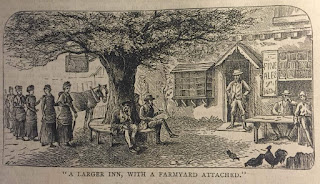

It was rather a dismaying discovery to find the "two inns" to be really nothing more than small public-houses, and quite impracticable, but hearing of a larger inn with a farm attached a mile away, we started on again, hopefully. The pathfinder and I feeling responsible in this matter, as we had been the ones to decide on leaving Haslemere, went quickly on, feeling a trifle anxious lest there should not be room at the "Old Ewe's Head." It proved to be indeed the beau ideal of an old-fashioned country inn, standing back from the road, with a little green in front, in the middle of the which was an immense patriarchal elm tree, whose branches, stretching out all round, nearly touched the trees on the other side of the road. Round the great gnarled trunk were seats ranged, on which doubtless, the lords of the creation resident in the neighbourhood would sit, when the day's work was done, smoking their evening pipe, and talking over the affairs of the nation.

The landlady, a buxom and highly good-natured dame, was really distressed to find re required more than one small room, which was all she could offer. This being the melancholy fact, my companion and I were,  for the moment, plunged into a state of abject despair. The only information the landlord could give was that we were nine miles from anywhere. "Ah, yes," he said, "it's a good nine mile afore you'll come anywhere worth mentioning; and a lonely road, too, a very lonely road, it is. Well do I remember when I was a lad going down that road of a morning with the other lads to see the gibbet, and sometimes there'd be as many as three bodies hanging there all at once; just opposite that pond as you'll see, 'bout two mile from here, where the trees meets over your 'ead now, that's where them gibbets used for to stand. Yes, a very lonesome road it is, and no mistake." He continued in this strain for some time; we had gone out to consult him whilst the tea we had thought it prudent to have ready against the others' arrival, was being prepared. Happily, the landlady broke in upon his enlivening information by coming to say the kettle was "just on the boil" and that tea would be ready in a minute.

"What's my old man been telling you about nine miles from nowhere, ladies? I heard him through the window; but never you heed him; he was always such a one to put the worst side upmost. I'll set you on the road as'll bring you to Midhurst under five miles, so you'll get there 'fore it's dark if you go as quick as you was when you come here. And as for them gibbets, he knows as well as I do that they've been all took down and done away with these forty years; so don't you heed him, ladies."

This was reviving, and we felt ready to fall upon her neck and weep for joy, but refrained, and greeted our companions with a sprightly air, refusing to tell them anything till after tea. And what a tea that was! Such new-laid eggs and fresh butter, such cream and new bread, and the giant water-cress, home-made jam, and native honey, combined with all the other good things, made up a repast not soon to be forgotten. And how the eatables vanished! We might not have eaten for a week, to see how quickly the table was cleared. At last we were satisfied, and with many directions from the kind hostess and predictions of evil from her saturnine spouse, we set off on the last stage of that long day's journey.

A lovely walk it was. Through the roadside trees were seen distant hills bathed in the ruddy sunset glow, and the sky, where visible through the green roof overhead, was flecked with amber and crimson and gold. The sunset was a glorious one, but it reminded us that darkness would soon follow, and we must hurry on. And hurry we certainly did , too much so, perhaps, as it soon became evident that we had missed the way among the many short cuts recommended.

After floundering wildly about for a little, we were soon hopelessly lost, so we stopped, to hold a council of war. The pathfinder and I volunteered to scour the country round till we met with either a house or a person to ask. Climbing to the top of a five-barred gate, from whence a very extensive view is obtained, I surveyed the prospect o'er till I discovered - oh joyful spectacle! - a house. The guide and I hastened to it, and our thanks will be for ever due to the lady of that house, who, with the greatest kindness, put us in the right road, by which a mistake would be impossible.

"Putting our best foot foremost," we went along at a good pace, singing "Marching thro' Georgia," and other martial airs, when sure there was no one "around," till at last our long walk was over, and we were peacefully ensconced in our hotel at Midhurst, having come twenty-three miles.

Next morning our rule of early rising was,  for the first time, broken, in fact I fear it was nearly nine o'clock before we gathered round the breakfast-table. We all felt rather stiff, and some of us even a little foot-sore, though our constant practice of bathing the feet in warm water, with a few drops of arnica therein, saved us from much suffering in that way.

After visiting the beautiful ruins of Cowdry, we crossed the park and gained the high road to Petworth. We were rather curious to see this little town, having heard a story of a regiment of soldiers which was ordered there. They marched what seemed to them to be more than the proper distance without apparently getting an nearer to the town; they then made inquiries and learned that they had already passed through the place, without being aware of the fact, and were marching back to London! I think the town must have considerably changed since this extraordinary thing took place.

The inhabitants appeared to think the spectacle of six girls dressed alike, with knapsacks in their hands (we always carried them thus in the towns), a curious and interesting one. We bought our viands, however, in spite of the eyes staring through the shop window at the transaction, and the noble president presented herself and us with a tin can, which the shopman filled with water for us.

Leaving Petworth, we went on only till out of the range of vision of its denizens, and then turning up a lane, we seated ourselves on the grass, and leaning against a gate, with our feet on our knapsacks, we lunched as comfortably as we could have done in our own dining-room. We were just congratulating ourselves on our privacy, too, when a gate at the end of the lane was opened, and a carriage and pair dashed past, its occupants gazing with astonishment at the merry party, and the various component parts of the luncheon that lay scattered around us.

It was always found that we walked better and with more enjoyment after lunch than before, and to-day was no exception. Passing along the pleasant lanes and across the open heaths, singing and telling tales to beguile the way, stiffness and blistered feet might have been things to us unknown, and we could hardly believe our day's walk was done, when we arrived at Pullborough.

As we left the village next morning, we heard a party of villagers speculating about us, and the president's gift evidently supplied them with a clue to our pursuits.


"They'll be painters, I reck'n," said one. "See the can that one is carrying? That's to hold the co'ours, that is."

Our road was said to be the Roman Stone Street. We could well believe it for, as our poet remarked, "it needs a great deal of the iron determination attributed to the Romans to tramp along this straight undeviating road." A bend or turn here or there would have been quite a relief; but no such weak-minded deviation from the severe straightness occurred.

At Billinghurst we were dismayed on visiting the only bread-shop to hear the owner say she had none left; but after a search in the back regions of her establishment she emerged with one very small loaf, all she had, and with that we had to be content. We lunched in a somewhat marshy spot, but the damp had happily no ill effects, being counteracted, perhaps, by our  usual drink of tea each.


The day was very warm, and the president's can proved a great comfort, for we refilled it on every opportunity so as to be able to quench our thirst as we went along. This night, the last of our tour, we spent in a comfortable hotel at Horsham.

Saturday morning broke gloomy and threatening, but as it did not actually rain we determined to start as usual, and it was not till we were beyond the region of railways that the storm began in earnest. It was trying to have to put up with very limited view of the pretty country which is obtainable from beneath an umbrella; but as it was the only wet day we had, we tried to persuade ourselves that it was quite a pleasant variety.

Our pathfinder had spent the previous evening in measuring on her maps and counting up the distances of each day. She now told us that, on our arrival at the starting-place, we should have walked altogether 96 miles, making an average of 16 miles a day, though, as will have been seen, we had generally been either above or below the average.

The treasurer, too, had been busy with her account-book, and it may be of interest to my readers to know exactly what our tour cost. The total expenditure  for the six of us during six days and five nights was £8 4s 6d, which gives £1 7s 5d as to the share of each, or 4s 6d each per day. This included everything, excepting only the president's noble gift of a tin can, value 3d. Our treasurer said that our plan of having "high tea" in the evening instead of dinner was an economical one. And, of course, taking our midday meal in the open air cost much less than having it at a hotel would have done, besides being much more agreeable. We should all have been very sorry to have missed the pleasure and fun of our daily picnics.

As we neared home the clouds broke, and the drops became few and far between.

"Look!" cried the artist, "there is quite a bright gleam of sunshine; we shall reach home under smiling skies after all."

"I believe we shall," said another of the party. "What a time of great enjoyment we have had! Do you know, I can't help thinking of this verse all the time -

Oh, God, oh Good beyond compare,
If thus Thine earthly works are fair,
How glorious will those mansions be
Where Thin elect shall dwell with Thee!"


For a moment or two we were all silent; then the president, looking up, cried - "See, there is our own home in sight. Now for a spurt, so as to come in gaily at last!" And so, with happy faces and thankful hearts, we marched up to the door, feeling, as we received the hearty welcome awaiting us, that we should be richer and better all our lives for the delightful hours spent in our walking tour.