I have preserved the slightly odd placement of the pictures amongst the text. And #TIL there's a flower that symbolises "You're not pretty, but at least you're not stupid too".
"Is there any moral shut within the bosom of the rose?" - Tennyson
You may look at flowers in two ways - botanically, which is very interesting, or sentimentally and poetically, which is more interesting still. They are almost all surrounded by a halo of human thought, and we find in them - or fancy we find in them, which is much the same thing - an approach to human expression. We speak of them as possessing pride, modesty, boldness, delicacy, as inspired by joy, sorrow, and ambition. We give them a voice and a language.
We do not, of course, always know what they say. You remember the man in the fairy tale who had the gift of understanding the speech of animals, but lost it through telling the secret to his wife. Now it is not unlikely that the exact language spoken by the flowers, if ever it was known, has been lost in some such fashion. We comprehend it very imperfectly, guessing at it as we might guess at the speech of our dogs and cats.
Some people can never understand its meaning, any more than they can make out what is told by any of the other wonders of nature. Such are not desirable acquaintances at all. Keep far away, says a wise man, from those who have no sympathy for flowers.
The great thing requisite is to be in love with what is beautiful, and to have an open and tender heart. To all happy natures of whom this is the description flowers say strange things, and birds and beasts make surprising revelations.
The object of this article is to speak of the language of flowers as it is at present understood. By the matter-of-fact this language has been held of small account, and has often been sadly misrepresented, but, girls, to speak seriously, it contains a genuine truth to which good sense will not refuse attention. The more the things of nature are mixed up with our own spiritual being the more interesting, the more enjoyable, the more beautiful the world will appear. Connect things with thoughts, then things are truly valuable.
If the study of the language of flowers did nothing more than send you to the garden and the fields, it would not be an unsatisfactory result. The value of the open air is not half understood, and how few, after all these years, have discovered that there is more genuine happiness to be obtained in the healthy round of rural life than amidst all the bustle of society.
There is a great deal of poetry still left in the country, though perhaps not quite so much - and the more's the pity - as in the olden times when "the elves danced full oft in many a green mead," and the cowslips were the pensioners of the fairy queen.
Flowers are in a special manner connected with the romance of life. They are mixed up with all our remembrances, and the older we grow the most quiet nooks they occupy in our hearts. It would be a curious calculation how many withered flowers there are in the world treasured as relics beyond price, and forming the links that connect us with a happy past. It is, therefore, of great interest to know the sentiments connected with different flowers, and the human attributes and human passions which they are held to denote and express.
There can be no doubt that the language of flowers came originally from the East, the home of so many marvels. It received a great deal of attention in Europe in the Middle Ages, and was of good service to lords and ladies, who in those times knew as little how to write as how to read. We have not the only example of utility in the case of the fair prisoner who, having no opportunity of speaking to her lover, informed him of her captivity by throwing from a lofty tower a rose bathed in her tears.
Those who have tried to reduce the language of flowers to a system have laid down several rules for its use. The first of these is that a flower presented in an upright position expressed a certain thought, but given with its head hanging downwards utters just the contrary sentiment. You may also, they say, vary the expression of flowers by altering their position. The marigold laced on the head, for example, signifies sorrow of mind; above the heart, pangs of love; resting on the breast, ennui. It makes a difference, too, if you present a flower with or without its leaves or without its thorns, if it happens to have any thorns. A rosebud, with all its thorns and leaves, means, "I fear, but I hope;" stripped of its thorns, "There is everything to hope for;" stripped of its leaves, "There is everything to fear."
But all this is too elaborate for most people, and we must always bear in mind that the poetry of nature may be ruined by indulgence in fantastic whims.
Let us speak first of the rose, the flower of love and beauty. No other has been more highly praised by poets in every country and in all past times. It has had the most high-sounding names given to it: Queen of Flowers, Daughter of the Sky, Glory of Spring, and Ornament of the Earth show the depth of enthusiasm it has excited. We therefore naturally expect it to take a leading place in speaking the language of flowers. And so it does.
Roses represent a different sentiment according to their colour. The white rose indicates "candour;" the musk rose "affectation;" the single rose "simplicity;" the damask rose "freshness;" the cabbage rose goes forth as "an ambassador of love;" and a white and red rose together form a symbol of unity.
A yellow rose means "decrease of love" or "jealousy," yellow, according to one of the articles of folk-lore, being a jealous colour. If you wish to indicate "charming grace and beauty," you must select a China rose. That must have been the flower sent by the poet with the famous verses -
"Go, lovely rose,
Tell her that wastes her time and me
That now she knows,
When I resemble her to thee,
How sweet and fair she seems to be."
In the East, the rose is above all others the flower of affection. There is a beautiful story which represents the bulbul - so the Armenians call the nightingale - as falling in love with the rose, and as only beginning to sing when inspired by the tender passion. This fable has been put into verse by Thackeray -
"Under the bought I sat and listened still,
I could not have my fill.
'How comes,' I said, 'such music to his bill?
Tell me for whom he sings so sweet a trill.
'Once I was dumb,' then did the bird disclose,
'But looked upon the Rose;
And in the garden where the loved one grows
I straightway did begin sweet music to compose.'"
The rose used to be employed as the symbol of silence, and from this arose a phrase one often hears, "under the rose." It seems that in ancient times it was a custom to place chaplets of roses above the heads of the guests, and on these occasions when people wished what they said to go no farther than those present they remarked that their observations were made "under the rose." Thus the phrase we use took its origin.
The lily is the emblem of majesty and purity. This flower is closely connected with the legendary history of the Virgin Mary, the lily which generally appears in pictures in connection with her being the great white lily of our gardens. As a token of purity it was frequently placed by artists in the Middle Ages in the hands of female saints.
The lily of the valley has always been held to be symbolical of purity and holiness. In some country places this humble but graceful plant is understood as pointing men's thoughts to a better world; it is called there the "ladder to heaven," a name evidently suggested by the arrangement of the flowers.
The snowdrop is another of those emblems of purity of which the world cannot have too many. This flower has become invested with a kind of sacredness; no doubt because it forms about the first sign that after the long sleep of winter Nature is rousing herself to begin the life and work of spring.
AS an emblem of modesty we have the daisy, the badge of Maid Margaret, that was so meek and mild, a very popular saint in the olden time. Another flower speaking the same language is the humble violet. The violet is also a lover's flower, and stands for constancy. As the old rhyme has it -
"The violet is for faithfulness
Which in me shall abide."
We have a contrast to these plants of modest looks and lowly thoughts in the tulip, which is held to be a symbol of grandeur and magnificence. During last century this flower created a sensation at which we may well imagine violets, daisies, and all quiet-minded flowers were much amazed. The love of tulips became a mania. IT was no rare thing to see a family ruined through the passion of the father for tulips.
The thistle in the language of flowers stands for "retaliation." To the Scotchman, however, as everyone knows, it speaks of nothing but the glories of his own native land, of which it is the emblem.
It became the emblem of Scotland, if legends be true, in the following way - When the Danes invaded Scotland, a long time ago, it was thought a shabby thing to attack an enemy except in broad daylight. On one occasion the invaders resolved to avail themselves of stratagem, and to come upon the Scots by night. To prevent their tramp from being heard they marched barefooted. They thus got unobserved within a short distance of the Scottish forces; but a Dane unluckily set his foot on a superb prickly thistle, and he gave such a howl of pain that the Scots heard him. They immediately ran to their arms and defeated the foe with great slaughter. After this the thistle was, out of pure gratitude, made the emblem of the Scottish kingdom.
Another Scottish flower is the harebell, the blue-bell of Scotland. In the language of flowers the harebell represents "submission." According to the poet -
"The harebell, for her stainless azure hue,
Claims to be worn of none but those are true."
All blue flowers, however, the bard should have noticed, have equal rights in this way, it being laid down in the old rhyme that blue is the colour of true love, as green is that of grief, and yellow that of love forsaken.
Now we come to "the sweet forget-me-nots that grow for happy lovers."
The language of this flower lies in its name, and its name it is said arose from the following incident - Two lovers were once loitering on the margin of a lake, when the maiden noticed some flowers growing on the surface of the water, near an island at some distance from the shore. She expressed a wish to obtain them, and her knight, in the true spirit of ancient chivalry, at once plunged into the water, and swimming to the spot plucked the wished-for plant. His strength, however, failed, and feeling that he could not regain the shore, although very near it, he threw the flowers on the bank; then, casting a last affectionate look upon his lady-love, he cried, "Forget me not," and was buried in the waters.
Rosemary stands for remembrance. At one time this plant was thought to strengthen the memory, and in consequence of this it became the symbol of remembrance amongst friends and lovers. A lover would say to his lass -
"Rosemary is for remembrance
Between us day and night;
Wishing that I might always have
You present in my sight."
Ophelia, in her madness, gives rosemary to her brother, "There's rosemary, that's for remembrance; pray, love, remember."
Silence is represented by lavender. There is a superstition in some parts of the Continent that lavender has the power of restoring speech to those who have lost it.
Eglantine means just the reverse of lavender, and stands for "you speak well."
Amongst our winter decorations holly has an important place, and it speaks a language of great interest. The Romans of old held holly to be a sign of peace and goodwill, and it has thus come to be the emblem of the principal festival of a religion which preaches peace and goodwill to all mankind. With the northern nations of Europe holly used to be a type of the life which preserved nature through the desolations of winter.
The laurel speaks of triumph or glory. In the middle ages this plant served to crown poets, artists, and men of learning, who had particularly distinguished themselves. From this practice we have derived our expression poet-laureate. During the time when Rome ruled the world the laurel was held to be the emblem of victory, and also that of clemency. Whenever a despatch was sent telling of a great success it was wrapped up in, and ornamented with laurel leaves. And in triumphal processions leaves of laurel were worn by the victorious generals, and the common soldiers bore sprigs of it in their hands.
Friendship, fidelity and marriage are represented by ivy. This pleasant duty has been performed by this plant for many a day. In Greece wreaths of ivy used to be presented to newly-married people as a suitable emblem of undying affection amid the ravages of time.
But we must not linger over the subject in this way or we shall never have done. Our purpose, girls, is to give just enough to show you that there is a language of flowers and that it is worth looking into for yourselves. We shall hurry on and just mention a few more of the commoner plants with the language popularly assigned to them.
Rushes are held to signify "submission" or "docility," and if any day you watch the wind sweeping over them you will see that the plant speaks quite in character. Heath signifies solitude. Pink verbena, on the contrary, has a leaning towards society, and is an emblem of "family union." Jasmine stands for "amiability," fern for "sincerity," and foxglove, which always wears a brazen-faced air, for "insincerity."
The acacia stands for "friendship" or "platonic affection." There is a deeper sentiment at work when one presents a sprig of mignonette, which signifies "your qualities surpass your charms" - mental qualities, be it understood, and personal charms. Apple-blossom is still more serious, for it means "preference;" but "preference' is cold compared with "generous and devoted affection," and that is indicated by a sprig of honeysuckle.
As the flame of affection burns still brighter, the heliotrope, the camellia, the pansy, and the mistletoe, find employment. The heliotrope says "I am ever faithful and devoted;" the camellia, "In me behold constancy itself;" the pansy, "I think of you, think of me;" and the mistletoe, "Whatever difficulties are in the way of winning you, I shall surmount them all." And may that be the fortune of all the honest-hearted hard-working lovers in the world.
Showing posts with label country life. Show all posts
Monday, 12 September 2016
Saturday, 18 June 2016
21 August 1880 - 'How I Managed My Picnic' by Dora Hope
It was a week to my birthday and I had not yet decided how to celebrate the great anniversary. My parents had always allowed us children the privilege of having some sort of treat on these occasions, but this year, being the first since my leaving school, I was very desirous of inviting some of my young friends to spend part of the day with me, and of entertaining them in a manner worthy the dignity of a grown-up young lady, no longer a school-girl.
Many ideas on the subject had suggested themselves to me, and been banished as unsuitable for one reason or another, and at present I was wavering between a tea-party in the garden and a picnic. As I sat pondering the matter my brother came into the room.
He is a year or two my senior, and possesses largely all those habits of teasing and jeering peculiar to brothers. He had been known, however, when in certain rare and happy moods, to do me some really "good turns"; so, hoping to find him by chance in one of these delightful humours, I ventured to ask his advice.
"Tom, dear," I said, "what - or what do you think of picnics? I want to have an excursion to some nice pretty place, and having tea gipsy fashion, you know - in fact, a picnic; what do you think of the girls and me having one next Thursday? Don't you think it would be nice?"
The creature fell back in his chair and laughed aloud. "Why, Gerty," he cried, "the idea is really too amusing. Have you so soon forgotten that ghastly entertainment given by the Somers's last year, and when dinner time came everybody had brought cold chickens, and there was nothing but teaspoons to carve them with? Oh, yes, have a picnic by all means; you'll have a jolly time of it no doubt, particularly when it begins to rain, as it is certain to do. Only don't expect me to come, that's all."
" 'Nobody asked you, sir, she said.' I'm not going to ask anybody at all, except some of the school girls."
Being rather of a contrary disposition, I determined now that it should be a picnic, if only to show Tom that they can be well managed.
That affair of the Somers's certainly was a failure. There were twenty guests, and each had been asked to bring a contribution to the feast. We had driven in breaks to the place decided upon, and had a very pleasant morning. But, as Dr. Johnson aptly remarks that the loveliest view possible is improved by a good hotel in the foreground, so the success of a picnic depends a good deal, though it sounds gluttonous to say so, on the arrangement of the luncheon. Of course, everyone must go prepared not to mind having salt put on one's tart instead of sugar, or to find sugar and salt forgotten altogether. One must smile and appear to enjoy it when the salad is emptied upon one's lap, and drink with a relish though the beverage is sprinkled with expiring flies and spiders. Trifling accidents of this sort are unavoidable, and indeed add to the excitement and novelty of the meal. But when, as at the Somers' picnic, there is really not enough to eat, and one's appetite is sharpened by a long morning in the fresh air, it is certainly dampening to the spirits.
Most of the guests had thought they were only expected to provide some small accessory to the meal, so had brought a basket of fruit, some salad, or such like slender provision. Several had indeed brought a cold fowl, and it was not until we were waiting to be served that, as Tom said, the dreadful discovery was made that knives and forks had been omitted altogether, though there was a plentiful supply of spoons. Mrs. Somers had intended each of her guests to bring sufficient for his or her own luncheon, and had herself provided only for her own family and the guests in her house. Happily she had over calculated their appetites, and was able to offer some little provision to the other hungry ones. So I believe in the end every one made a tolerably good lunch, though Tom declares that he and the other gentlemen had to satisfy the cravings of hunger with salad and ginger-beer corks.
But the most painful part of the luncheon was when someone discovered a leg of lamb which had been overlooked, and produced it triumphantly. But we might as well have been without it, so insurmountable was the difficulty of carving it with a teaspoon. Salt had also been omitted from the list, though this is a very trifling thing, and many people do not take any when there is plenty to be had; yet when they know there is none, they feel the greatest craving for it, and the meal seems very unpalatable without it.
With the remembrance of this unsatisfactory repast fresh in my mind, I resolved to be very careful that nothing was forgotten, and, above all, that there was plenty to eat. So I went straight away to have a consultation with my mother as to ways and means.
"Well, dear," she said, "the first thing to decide is, I think, where to go to; and I do not think you could do better than Vudley. You could ramble about the old castle before lunch, and afterwards go into the woods to get some wild flowers to bring home. And there is the waterfall only a short distance from the castle, so you will not be at a loss for amusements."
"But, mother, how shall we get there? It is too far to walk, and we cannot all get into the pony carriage," said I.
"I was just thinking of that, dear; but I think five of you might drive, and the rest will have to go by train to Vudley station, which is not more than half a mile from the castle and woods."
This settled, I flew off and issued my invitations, nine in number, asking my friends to be at our house by half-past nine on Thursday morning, unless it were wet or showery, in which case the picnic would be postponed to the first fine day.
Many were the consultations mother and I had as to what we should take for luncheon. I had very much set my heart on the popular idea of boiling a kettle and making tea; but as mother pointed out it would involve so many more implements and so much more trouble that I willingly gave it up, and was not at all sorry afterwards that I had done so.
Several times, when we thought our bill of fare very complete, one of us would be seized with a new and superior idea, quite upsetting the former arrangement. First we settled to take a joint of cold lamb, a bottle of mint sauce, a jar of dressed salad, rolls, butter (in a preserve pot with ice), two fruit pies, and a jar of Devonshire cream. This we thought complete, when an amendment was suggested by Tom, who could not refrain from taking a lively interest when eatables were in question, though he poured scorn and derision on the idea of my having a picnic at all.
Haunted by the conviction that we should forget to take knives and forks, he suggested a couple of cold fowls, ready cut up, in place of the joint; and, as this would save me the trouble and responsibility of carving, to which I was but little accustomed, it was agreed upon unanimously, and mother went off to give cook her orders.
In a minute I heard her voice calling to me from the kitchen:
"Gerty, dear," she said, when I went in, "cook has just been saying how would you like a dozen little meat pies, instead of the chickens? I think you would find them very convenient, and you will not then have to consider who must put up with the drumsticks in helping the fowls."
"Yes, mother, it will be a great improvement. As I could not eat four or six drumsticks myself, I should have to inflict them on several of my guests, which would not be polite, would it? I think the pies a splendid idea."
Finally our luncheon hamper contained the following: - One meat pie each, and two or three over in case of anyone's appetite being inordinately large; a dozen and a half rolls, a jar of salad ready dressed, a cucumber, a jar of butter packed with ice and wrapped in a flannel, a jelly in the mould to be turned out when required, one raspberry and one gooseberry tart, and a jar of Devonshire cream. The sugar and salt were put in bottles and well labelled, and by way of beverage we had a dozen bottles of assorted drinks, such as lemonade and gingerbeer, of course in a hamper by themselves, which also contained two corkscrews. I may mention that the meat pies were not taken out of their tins till we were ready to eat them, which insured their carrying well.
In the hamper we took a tablecloth, and a knife and fork and spoon for each person, with one or two of each extra for serving; two plates each, and a few tumblers, and one dish for the salad and cucumber. This was everything we could think of, and it proved to be everything that was necessary, which was a great relief to me.
The important day arrived at last, and was, as we had hardly dared to hope, bright and warm, and my friends assembled in due time. The driving party had to start shortly before those who went by train, so carefully stowing our hampers underneath the seats of the pony carriage, with a bundle of rags and cloaks, we despatched them, to meet again at Vudley station, whence we proceeded all together, "ride and tie," to the spot we had fixed upon to spend our day.
We explored the ruined castle and its grounds, and at one o'clock assembled for what was, I am afraid, really the event of the day. I and one other girl had gone to the spot shortly before that time to lay the cloth and spread the feat under the welcome shade of a large old oak; and very pretty it looked when all was read. We had originally intended to lunch in one of the old roofless halls of the castle; but its ivy-clad walls, though picturesque when looked at with a poetic eye, appeared to us too thickly populated with spiders and earwigs to make close proximity to them pleasant for any length of time, so we preferred to remain under the shadow of the trees outside the edifice.
We spread shawls, upon which to sit, all round the tablecloth, and at each person's place, by their knife, fork and roll, was laid a little bunch of flowers, which we flattered ourselves, to quote Mr. Spriggins, "imparted an air of botanical elegance to the scene." Having collected our party together, which we did by means of repeated performances on a loud and ear-piercing whistle, borrowed for the occasion to take the place of a dinner bell, we seated ourselves as gracefully as might be, and prepared to fall upon the banquet.
But before sitting down I suggested that we should sing our usual school grace, so with loyal hearts and true, we sang, "Praise God from whom all blessings flow." And I do believe that with the music of our fresh young voices our hearts blended harmoniously. God ever keep them so!
Our meat pies were highly appreciated, as indeed were all the viands. I found that we had just hit the right quantities required, and there was neither too much nor too little of anything, though I had thought mother had provided too bountifully. But, then, I had forgotten that a whole morning out of doors is highly conducive to hunger.
When we had finished, and whilst still reclining round what had once been a sumptuous repast, but was now only a wreck, one of my friends rose to her feet, and in most appropriate and flowery language, proposed the health of "their noble and honoured hostess," by which she meant me. I responded, and, though very short, and somewhat faulty in construction, I fear, my maiden speech was received with rounds of applause. After a little more eloquence from others of the guests, we packed up the plates and dishes in their hampers again, and then, digging a hole with a stick, we interred all pieces of paper, bottles and other remnants of the feast that were to be left behind.
Some of those present rather made fun of this proceeding, but I insisted upon it, as I have often thought it such a shame to leave paper and all sorts of unsightly odds and ends about, to disfigure the place where a picnic has been.
We spent the rest of the afternoon in rambling about the woods, which were radiant with flowers and ferns, and musical with birds' songs. After a visit to the waterfall, we found the dusk was beginning to creep on, and that we must turn towards home, very much to our regret, for the day had passed away too quickly for all of us.
I must mention that, when dragging our hampers from under the carriage seats before lunch, I discovered a smaller one which I had not seen before. It was found to contain a good supply of splendid strawberries, and had been put in by Tom as his contribution to our much-abused picnic.
That boy really has some good points, after all.
Labels:
1880,
country life,
dora hope,
food,
friendship,
girls,
picnics,
recreation
Monday, 30 May 2016
24 July 1880 - 'A Girls' Walking Tour' by Dora Hope - Part Two
Wednesday morning - much refreshed, we rose with the lark (unless, indeed, that estimable bird rises before 7.30), and having had our usual substantial breakfast we went on our way without staying to inspect the lions of Farnham, or even to inquire if there were any.
"I'm sure we may congratulate ourselves on having good tempers," said the poet, as we stepped briskly along in the bright morning air, "because my father prophesied that we should all have quarrelled with each other before the first day was over, and should probably part and return to our respective homes on the second."
"But why should we quarrel any more than anyone else?" asked one.
"Well, I could not quite grasp his reason, but he said people always do on walking tours; it's a way they have, I suppose. They get so tired of each other's society after a day or two."
"Naturally, they do, when the pedestrians are of the male sex," said our artist, who is something of a man-hater, "and very likely we should have been no exception to the rule had there been any gentlemen with us, so I think we have clearly proved that our arrangement is the best." Of course we all agreed, and rather than let the prediction come true I forbore for the future to express my opinions with regard to the cooking-stove, since the others all seemed peculiarly impressed with the conviction that it was the secretary's duty to carry the obnoxious machine.
Exhilarated by the fresh air and bright sun, we walked at a fine pace towards the wild barren country round the Hind-head, intending to stay the night at Haslemere.
Tilford was soon reached, and here we paused to buy provisions and also to inspect a splendid old oak tree on the green.
"It is called the King's Oak," said the pathfinder, "and is one of the boundary marks of the Waverley Abbey lands. Years ago orders were given for it to be cut down; but the country people assembled from far and near to protect the tree, which they regarded with great respect and even affection. They nailed plates of tin round the trunk so that the axes could not take effect." Seeing what she took to be incredulous looks, she added - "There are the pieces of tin before your eyes, so it must be true."
Whether the pathfinder's pretty story were true or not, we could not but be glad that the hoary old tree had stood so long, and such as were able made some hasty sketches of it, whilst the others went on an expedition to the one shop of the village, and secured a heterogeneous collection of viands for dinner.
As we left Tilford with its pretty bridge and river behind us, the aspect of the country grew wilder, and cultivation began to give place to heather-clad hill and wide breezy moor. The road was very dusty and glaring white. The sun, mounting high in the heavens, blazed down upon us, making us pine for the sight of a tree or anything that would cast more shade than a small umbrella; but we pushed on bravely till the strange mounds called the "Devil's Jumps" were clearly visible.
At this point a very unexpected "ten minutes' interval" took place. It is superfluous to relate that we owed this halt to our president, who, spying a small lake lying placid among the heather a short distance from the road, insinuated how delightful a closer investigation of it would be. The pathfinder warned us of the distance still to be traversed, and expatiated on the beauties which would soon be unfolded to our wondering view; we looked at the hot white road, then at the clear cool water. Alas! The temptation was too strong, and, headed by the president, we set off at a run, away from the path of duty, feeling rather like Christian and Hopeful when straying into Bye-path meadow. We did not, however, like them, come to repent having strayed, for of all the delightful remembrances of our tour, none is looked back to with more pleasure than the rest beside that lonely lake.
We lay down on the springy heather, most luxurious of couches, revelling in the floods of sunshine, whilst a gentle breeze fanned our hot faces as we gazed up into the cloudless blue overhead. We drank from the transparent water, where a tiny waterfall rushed over the stones in mimic wrath. We watched the caddis-flies and other "strange creepy creature" cutting capers in the water, all unconscious of the curious eyes marking their every movement, whilst a lark, hidden from view in the clouds, trilled forth its glad song "thanking the Lord for a life so sweet." The babble of the fairy cascade, the sound of insects humming drowsily, and the bird's song just broke the stillness that otherwise would have been oppressive. All too swiftly the moments flew by, we each knew we must soon be moving onwards, and yet dreaded hearing the pathfinder give the signal. Suddenly, looking at her watch, she started to her feet and exclaimed -
"Oh, it's actually twelve o'clock! How could I let you waste so much time by this silly little pool! You must shoulder knapsacks instantly. Come, wake up, president. Now, secretary, I long to hear the cheerful jangle of the stove again."
With much regret we obeyed her behests. Leaving our lovely resting-place, we were soon marching along the fine country road, and shortly began the actual ascent of the Hind-head.
Two hours' walking brought us to a belt of firs on the road side, in the cool depths of which we lunched, getting water for tea from a well hard by, said to be 200 feet deep. No misadventures occurred, except the usual one of setting fire to the grass by the stove-lamp. As this happened almost every day, we became very expert at extinguishing conflagrations of this sort, and ceased to notice them much, though at first they proved rather exciting.
We were very expeditious over our repast, having already spent too much time on the road; indeed, we were all anxious to start again quickly, for the scenery through which we were passing became more and more grand, and we longed to be at the top of the hill to see the view which we knew was in store.
"How far is it to the Devil's Punch Bowl?" asked the pathfinder, of a rustic sitting astride a low stone wall.
"Dunno, never yeard tell on't," was the stolid answer.
"What ignorance!" murmured she, and hastened on to ask a woman approaching. This individual seemed to have the very vaguest ideas of distances, but hazarded in reply, "It moight be about three moile." The next pedestrian declared it to be a "good foive moile," whilst still another said even rather than that.
Our guide concluded not to ask any more questions, so we trudged on. The strange parallel valleys causing the road to make a wide detour, possibly accounted for the difference of opinion about the distance. At last we reached the celebrated Punch Bowl. No doubt every one who knows Surrey will be familiar with this spot - one of the finest in that beautiful county. Standing there, half way up the Hind Head, one sees range upon range of bleak rounded hills. Conspicuous among them are the three conical peaks mentioned before as marking the jumps taken by the individual said to own the Punch Bowl. Behind, the ascent is more abrupt and steeper than that of the road by which we have come. At our very feet is the great hollow scooped out in the bosom of the earth, so sudden and unexpected as readily to account for the superstition which gave its name.
On its brim is a tombstone, erected to the memory of an unknown sailor foully murdered on this spot, and whose tragic end is set forth in a curious inscription. Coiled about the base of the stone lay a viper recently killed, perhaps by some passer-by. This gave the finishing touch to the weird, unnatural character of the scene. Gazing, in a silence unbroken by voice of any living thing, it was with almost a sigh of relief that we heard the sound of sheep-bells tinkling faintly far below us. We then saw for the first time, dwarfed by distance, but still recognisable, a substantial and most unghostly farmhouse nestling amongst the trees in the very Punch Bowl itself.
With that, all our eerie feelings vanished, and then someone remembered that this place is mentioned by Nicholas Nickleby, he having stopped to rest here when on his way to Portsmouth with poor Smike.
Turning away from the melancholy scene, we were soon at the top of the hill, whence a wonderfully extensive view is obtained. From thence a picturesque lane, whose high hedges sent forth long trails of honeysuckle, clematis, and rose, led to Haslemere, our goal. We had, for some reason or other, all been filled with intense admiration for Haslemere, never having seen it. Perhaps we rather associated it with the poems of the Laureate who lives there. However, our expectations were high, and, as is nearly always the case when one expects much, we were disappointed.
The pathfinder and myself had gone to reconnoitre, and we read in each other's faces the tale of blighted hopes.
"Oh, pathfinder, we cannot stay here, it's so very tame after what we have come through," I exclaimed.
"It is; painfully so," said my companion; "and see, the sun is not thinking of setting yet, it won't be dark for hours. Do let us go on again."
"But where to? And what will the others say?"
"Oh, if we settle all before they arrive and then just say we are going on to such and such a place, they will take it quite calmly."
Consulting the map, we found the next village to be Fernhurst, which sounded charming to us, and some women standing near told us there was sure to be accommodation there, as there were two inns, which could not both be full. Thus encouraged, we went to meet the others, who, hearing it was only two miles to Fernhurst, were quite satisfied with the arrangements.
It was rather a dismaying discovery to find the "two inns" to be really nothing more than small public-houses, and quite impracticable, but hearing of a larger inn with a farm attached a mile away, we started on again, hopefully. The pathfinder and I feeling responsible in this matter, as we had been the ones to decide on leaving Haslemere, went quickly on, feeling a trifle anxious lest there should not be room at the "Old Ewe's Head." It proved to be indeed the beau ideal of an old-fashioned country inn, standing back from the road, with a little green in front, in the middle of the which was an immense patriarchal elm tree, whose branches, stretching out all round, nearly touched the trees on the other side of the road. Round the great gnarled trunk were seats ranged, on which doubtless, the lords of the creation resident in the neighbourhood would sit, when the day's work was done, smoking their evening pipe, and talking over the affairs of the nation.
The landlady, a buxom and highly good-natured dame, was really distressed to find re required more than one small room, which was all she could offer. This being the melancholy fact, my companion and I were, for the moment, plunged into a state of abject despair. The only information the landlord could give was that we were nine miles from anywhere. "Ah, yes," he said, "it's a good nine mile afore you'll come anywhere worth mentioning; and a lonely road, too, a very lonely road, it is. Well do I remember when I was a lad going down that road of a morning with the other lads to see the gibbet, and sometimes there'd be as many as three bodies hanging there all at once; just opposite that pond as you'll see, 'bout two mile from here, where the trees meets over your 'ead now, that's where them gibbets used for to stand. Yes, a very lonesome road it is, and no mistake." He continued in this strain for some time; we had gone out to consult him whilst the tea we had thought it prudent to have ready against the others' arrival, was being prepared. Happily, the landlady broke in upon his enlivening information by coming to say the kettle was "just on the boil" and that tea would be ready in a minute.
"What's my old man been telling you about nine miles from nowhere, ladies? I heard him through the window; but never you heed him; he was always such a one to put the worst side upmost. I'll set you on the road as'll bring you to Midhurst under five miles, so you'll get there 'fore it's dark if you go as quick as you was when you come here. And as for them gibbets, he knows as well as I do that they've been all took down and done away with these forty years; so don't you heed him, ladies."
This was reviving, and we felt ready to fall upon her neck and weep for joy, but refrained, and greeted our companions with a sprightly air, refusing to tell them anything till after tea. And what a tea that was! Such new-laid eggs and fresh butter, such cream and new bread, and the giant water-cress, home-made jam, and native honey, combined with all the other good things, made up a repast not soon to be forgotten. And how the eatables vanished! We might not have eaten for a week, to see how quickly the table was cleared. At last we were satisfied, and with many directions from the kind hostess and predictions of evil from her saturnine spouse, we set off on the last stage of that long day's journey.
A lovely walk it was. Through the roadside trees were seen distant hills bathed in the ruddy sunset glow, and the sky, where visible through the green roof overhead, was flecked with amber and crimson and gold. The sunset was a glorious one, but it reminded us that darkness would soon follow, and we must hurry on. And hurry we certainly did , too much so, perhaps, as it soon became evident that we had missed the way among the many short cuts recommended.
After floundering wildly about for a little, we were soon hopelessly lost, so we stopped, to hold a council of war. The pathfinder and I volunteered to scour the country round till we met with either a house or a person to ask. Climbing to the top of a five-barred gate, from whence a very extensive view is obtained, I surveyed the prospect o'er till I discovered - oh joyful spectacle! - a house. The guide and I hastened to it, and our thanks will be for ever due to the lady of that house, who, with the greatest kindness, put us in the right road, by which a mistake would be impossible.
"Putting our best foot foremost," we went along at a good pace, singing "Marching thro' Georgia," and other martial airs, when sure there was no one "around," till at last our long walk was over, and we were peacefully ensconced in our hotel at Midhurst, having come twenty-three miles.
Next morning our rule of early rising was, for the first time, broken, in fact I fear it was nearly nine o'clock before we gathered round the breakfast-table. We all felt rather stiff, and some of us even a little foot-sore, though our constant practice of bathing the feet in warm water, with a few drops of arnica therein, saved us from much suffering in that way.
After visiting the beautiful ruins of Cowdry, we crossed the park and gained the high road to Petworth. We were rather curious to see this little town, having heard a story of a regiment of soldiers which was ordered there. They marched what seemed to them to be more than the proper distance without apparently getting an nearer to the town; they then made inquiries and learned that they had already passed through the place, without being aware of the fact, and were marching back to London! I think the town must have considerably changed since this extraordinary thing took place.
The inhabitants appeared to think the spectacle of six girls dressed alike, with knapsacks in their hands (we always carried them thus in the towns), a curious and interesting one. We bought our viands, however, in spite of the eyes staring through the shop window at the transaction, and the noble president presented herself and us with a tin can, which the shopman filled with water for us.
Leaving Petworth, we went on only till out of the range of vision of its denizens, and then turning up a lane, we seated ourselves on the grass, and leaning against a gate, with our feet on our knapsacks, we lunched as comfortably as we could have done in our own dining-room. We were just congratulating ourselves on our privacy, too, when a gate at the end of the lane was opened, and a carriage and pair dashed past, its occupants gazing with astonishment at the merry party, and the various component parts of the luncheon that lay scattered around us.
It was always found that we walked better and with more enjoyment after lunch than before, and to-day was no exception. Passing along the pleasant lanes and across the open heaths, singing and telling tales to beguile the way, stiffness and blistered feet might have been things to us unknown, and we could hardly believe our day's walk was done, when we arrived at Pullborough.
As we left the village next morning, we heard a party of villagers speculating about us, and the president's gift evidently supplied them with a clue to our pursuits.
"They'll be painters, I reck'n," said one. "See the can that one is carrying? That's to hold the co'ours, that is."
Our road was said to be the Roman Stone Street. We could well believe it for, as our poet remarked, "it needs a great deal of the iron determination attributed to the Romans to tramp along this straight undeviating road." A bend or turn here or there would have been quite a relief; but no such weak-minded deviation from the severe straightness occurred.
At Billinghurst we were dismayed on visiting the only bread-shop to hear the owner say she had none left; but after a search in the back regions of her establishment she emerged with one very small loaf, all she had, and with that we had to be content. We lunched in a somewhat marshy spot, but the damp had happily no ill effects, being counteracted, perhaps, by our usual drink of tea each.
The day was very warm, and the president's can proved a great comfort, for we refilled it on every opportunity so as to be able to quench our thirst as we went along. This night, the last of our tour, we spent in a comfortable hotel at Horsham.
Saturday morning broke gloomy and threatening, but as it did not actually rain we determined to start as usual, and it was not till we were beyond the region of railways that the storm began in earnest. It was trying to have to put up with very limited view of the pretty country which is obtainable from beneath an umbrella; but as it was the only wet day we had, we tried to persuade ourselves that it was quite a pleasant variety.
Our pathfinder had spent the previous evening in measuring on her maps and counting up the distances of each day. She now told us that, on our arrival at the starting-place, we should have walked altogether 96 miles, making an average of 16 miles a day, though, as will have been seen, we had generally been either above or below the average.
The treasurer, too, had been busy with her account-book, and it may be of interest to my readers to know exactly what our tour cost. The total expenditure for the six of us during six days and five nights was £8 4s 6d, which gives £1 7s 5d as to the share of each, or 4s 6d each per day. This included everything, excepting only the president's noble gift of a tin can, value 3d. Our treasurer said that our plan of having "high tea" in the evening instead of dinner was an economical one. And, of course, taking our midday meal in the open air cost much less than having it at a hotel would have done, besides being much more agreeable. We should all have been very sorry to have missed the pleasure and fun of our daily picnics.
As we neared home the clouds broke, and the drops became few and far between.
"Look!" cried the artist, "there is quite a bright gleam of sunshine; we shall reach home under smiling skies after all."
"I believe we shall," said another of the party. "What a time of great enjoyment we have had! Do you know, I can't help thinking of this verse all the time -
Oh, God, oh Good beyond compare,
If thus Thine earthly works are fair,
How glorious will those mansions be
Where Thin elect shall dwell with Thee!"
For a moment or two we were all silent; then the president, looking up, cried - "See, there is our own home in sight. Now for a spurt, so as to come in gaily at last!" And so, with happy faces and thankful hearts, we marched up to the door, feeling, as we received the hearty welcome awaiting us, that we should be richer and better all our lives for the delightful hours spent in our walking tour.
Tuesday, 17 May 2016
10 July 1880 - 'Bread and Bread-making' by Ruth Lamb - Chapter Two
Having glanced at the origin and early history of the loaf, and seen what it was and still is when in the shape of unleavened bread, we will trace the next step in its progress - the introduction of leaven. It does not seem difficult to imagine how it came into use. It is only needful to leave a portion of the unleavened dough in a warm place for some days, and you will see that it begins to ferment, as though it contained barm of some kind; but the taste is rather sour and not pleasant.
"A little leaven leaveneth the whole lump." These few words tell the story of leavened breadmaking. A small portion of this sour dough is mixed with the large quantity of flour, salt, and water requisite for the batch of bread, and in time the whole lump is leavened. But it retained, though in a less degree, the sour taste of the little piece put into the lump, and the bread requires a longer time to work than when made with yeast.
In remote country districts on the Continent this mode of leavening bread is still in common use, and English travellers find it anything but agreeable. I well remember that, when in Switzerland a dozen years ago, our party crossed the Gemmi Pass two days sooner than we intended because my husband could not endure the taste of this leavened bread, and there was nothing else to be had at Kendersteg just then. In many other hotels in the mountainous districts we found leavened bread, but with this one exception there were always plenty of the delightful little milk rolls, twists, and "cobs," as we call them in Lancashire, in addition to the sour-tasted loaves.
Brewer's yeast is merely the froth which rises on the surface of beer during the process of fermentation. It is skimmed off when thick enough, as cream is taken from the milk.
When I was a girl, we, whether lived in country towns and villages, were wholly dependent on this kind of yeast, or on a home-made article for lightening our bread. On certain days in each week a stream of small customers might be seen, mug or pitcher in hand, wending their way towards the various breweries, at which as small as quantity as a halfpennyworth of yeast could be purchased. Many an injunction did these young messengers receive not to loiter by the way lest all the yeast should be gone - a calamity of no small consequence. The yeast money was always the special perquisite of the brewer's wife.
On the weekly market-day, one of the first errands of the country carrier was to the brewery. He conveyed a whole string of tin cans, with close-fitting lids; earthenware jugs, with bungs, and of many sizes; and in these he took home yeast for the village shops, farmers' wives, and cottagers for many a mile round. Probably the motion of the cart would make the barm obstreperous on the homeward way. In spite of the wet rag put on to make the bung or lid fit more tightly, one would fly out with an explosion, the other be lifted off, and some passenger begin to grumble that the froth was trickling on to her bonnet from one of the shelves below the tilt which held the lesser parcels.
Country people are always neighbourly, and yeast was an article much borrowed and lent, not a thing to be rashly or wastefully treated. A little quantity left over was hoarded to make a bit of cake with, or given to a poor neighbour. Baking day only came once a week in cottage homes, new bread being deemed extravagant, and old bread reckoned to go further.
The difficulty of procuring brewer's yeast as often as was requisite, set invention to work to contrive modes of preservation of substitutes for it.
One way of preserving it was by whisking it well, and spreading a thin layer on a large wooden trencher or board. When this was dry another was added, and so on, until the paste was a couple of inches thick, when it was cut up and placed in air-tight canisters until required. Then it was dissolved in warm water and used like fresh yeast.
Potato yeast is made with mealy potatoes; boiled, pounded and passed through a sieve. To 1lb of this pulp add two tablespoonfuls of treacle and boiling water to make it the thickness of brewer's yeast. When just warm stir in two tablespoonfuls of yeast, and keep it in a warm place to ferment for twenty-four hours, when it will be fit for use. It will keep in a cold place for several weeks.
But almost all the substitutes for brewer's barm require just a little of the genuine article to set them going. I will give one recipe for yeast with which the brewer has nothing to do. It is from a very comprehensive treatise on the "Art of Breadmaking," published three quarters of a century ago. Ingredients, 1/2lb flour, 1/2lb coarse sugar, 3/4 peck of malt, bruised. Boil together in 1/2 gallon of water for fifteen minutes. When cooled to 80 degrees, add 1 pint of any water impregnated with fixed air, such as the artificial seltzer (Schweppe's). This will cause fermentation, and when it ceases the clear liquor can be poured off, and the yeast, fit for use, will be found at the bottom.
Many other recipes might be given for artificial yeasts, but fortunately we are much less likely to require them than we were when I made my first loaf. The introduction of German yeast, which is chiefly obtained from the great Continental distilleries, especially those of Holland and Hamburg, has proved a great boon. This is a cleanly article, which comes to us in the form of a light paste with a fresh and pleasant smell, and without the bitter taste of brewer's yeast. This is drained on cloths and pressed dry before being packed for exportation.
I can well remember the dubious looks we cast on the first lump of German yeast offered as a substitute for the ordinary barm by the baker from whom our flour was purchased, and at a time when brewer's yeast could not be easily obtained. We tried it from necessity; we liked it, and ever after preferred it to anything else. Within a very few years after the introduction of the article, one year's imports up to March 31, 1866, amounted to 5,735 tons! What the quantity has now reached I am unable to tell, but it must be something enormous.
Now having told you about the origin of bread and the various kinds of yeast, we will set about making a batch of household bread such as may be seen all the year round at our table. WE must have 12lbs of fine flour, 3oz German yeast, a good handful of salt, and a jug of warm water. But we need not tuck up our sleeves yet, as we are only going to "set the sponge."
A yellow earthenware pancheon, or, as Lancashire folk call it, a "mug," is the nicest thing to make bread in, and preferable to the large wooden bowl occasionally used.
In winter time the pancheon may be placed near the fire before the flour is put in, as the warmth helps the bread to rise in very cold weather. Dust it carefully with a dry cloth, put in nearly all the flour, into which sprinkle and stir the salt. Dissolve the yeast thoroughly in a pint of warm - *not hot - water, and having made a hole in the middle of the flour, pour it in through a strainer, and stir in with it some of the flour to a paste. Leave it near the fender for half an hour to rise, but do not forget to throw a clean cloth over the top of the pancheon, so that no dust may get in.
So far there has been no need to tuck up your sleeves. But at the half-hour's end mind that hands and nails are thoroughly clean, your cooking apron on, your sleeves secured so that they will not slip down, your large jug of warm water ready, and the small quantity of flour remaining out of the dozen pounds ready to hand in a bowl at the left side of your pancheon, which should stand on a stool. A table is generally too high.
I must mention another matter. Whatever may be your fashion of wearing your hair, have it smoothly and snugly tucked up when engaged in breadmaking or cookery of any kind There is nothing more disgusting or objectionable than to find a hair amongst our eatables; yet nothing more likely to occur if we go about our cooking with our locks hanging loosely about our necks and faces. I have seen a floury hand lifted from amongst the dough to push back a straggling wisp of hair or tuck up a fallen sleeve, and have always registered a mental resolution not to eat home-made bread at that establishment.
Every article used in breadmaking should be of the most spotless cleanliness. Paste-board, rolling-pin, baking-dishes, or tins should be put away clean after use, and carefully rubbed and dusted when taken out again.
Perhaps all these minute details may sound unnecessary, but I am not giving recipes to grown-up people, or merely a history of the origin of bread and a list of its varieties. I want to teach you, dear girls, to make bread as my dear mother taught me when I was a little one many years ago.
Begin to work the dough with the right hand, adding the warm water gradually with your left from the jug which is beside you. Draw the dough from the sides to the middle, using both hands when the ingredients are fairly mixed with the right. It must neither be hard nor soft, but of a sufficient consistency for you to lift it, when very thoroughly worked, in one lump and turn it over. You sprinkle a little flour round to enable you to do this, and if your dough is just what it should be there will be none sticking to the pancheon; it will be clean from everything but a little flour when you lift the dough to turn it.
Now place the pancheon outside the fender, covered as before with a fine white cloth, having sprinkled the flour on the top of the dough to keep it from sticking. It should be ready in less than two hours if the yeast is good. Get your own well-heated, then rub the shelves with a clean, wet dish-cloth; warm and grease your baking-tins or dishes with a little suet, butter, lard, or fresh dripping, held by a little writing paper in the fingers. This is to prevent the bread from sticking to the sides. Then, with clean hands, work a piece of dough on the floured pasteboard; shape it to suit your tin, which should be filled even with the edges. Let it stand on the hearth for a few minutes to rise, and before putting your loaves in the oven, either prick them with a steel fork, or make one or two cuts across the top of each with a sharp knife.
We never use tins for baking in, except for tea cakes. Our baking dishes are of coarse brown earthenware, and stand on four little knobs. With these we rarely have a burnt loaf, however hot the oven may be. A slack oven spoils bread, and the admission of cold air by opening the door should be avoided until the dough has had time to set. To ascertain when the loaf is baked enough, turn it out of the baking-dish and press the side firmly with the point of the finger. If the crust springs back you may judge that it is right; but if the pressure leaves a hollow, the loaf must be returned to the oven. When the dough is first put in, it should be placed on the oven bottom; and when well set and about half baked removed to the top to "soak" as it is technically termed. When sufficiently baked the loaves should be taken out of the dishes or tins, and placed on their sides; when quite cold we put ours in a large pancheon, and cover them with a clean cloth. This preserves the moistness of the bread and conduces to cleanliness also.
Many persons only use 2oz of German yeast to 12lbs of flour, but we prefer the larger quantity, and every one praises our home-made bread as being simply perfect. Our cook prides herself more upon it than upon the most dainty dish she prepares for the dinner-table. One day when she was far from well I suggested that she should suspend her bakings for a little time, and let us buy our bread in order to lighten her work. But this she promptly declined, adding, "It would be of no use, ma'am, for if everybody else in the house could put up with bought bread, *I couldn't."
I should add a word or two with regard to the quality of your ingredients. Buy thoroughly good flour; keep it in a dry place, as damp flour is bad. Never use doubtful yeast. It is poor economy to spoil a batch of bread in order to *use up yeast, or milk which is not perfectly sweet.
The Austrian flour, made from wheat frown on the banks of the Danube, is particularly fine. It goes into a very small compass, and absorbs an immense quantity of water. Some while ago when staying at a delightful farmhouse in summer we had a little difficulty about bread. At length a small shopkeeper, who sold everything, undertook to bake for us; and exquisite bread she made. But she bargained that she should be allowed to use what she called "ostrich flour," though it would be a trifle dearer. She meant Austrian.
Aerated bread is made by a patented process. It is mixed in a sort of iron box, with water charged with fixed air, or carbonic acid gas, which lightens the dough without the aid of yeast. The whole operation is performed by machinery, and the hand does not touch the dough. The bread is very light and digestible, and is said to effect a saving of ten per cent in flour, besides economising time and labour. But I do not find it so satisfying as ordinary bread, and have heard children complain that they soon feel hungry again after eating it.
There is also a self-raising flour, which is a good deal used for making cakes and pastry. It is prepared by Messrs McDougall, of Manchester, and the scones, tea-cakes, etc., made from it are very light and agreeable to eat, but none of these articles, to my mind, make ordinary home bread less enjoyable in comparison.
Delicious brown bread may be made in the same way as the white by using "ground down," or the whole of the powdered grain of wheat without removing any portion.
A mixture of rye with fine wheaten flour makes exquisitely sweet bread, and may be made with equal parts, or with only a third or a fourth portion rye. Rye flour is sticky to the touch, and the dough must be made very stiff. It is much nicer when baked in *thick cakes on the oven shelf than in loaves.
French bread has a pint of new milk, two eggs, and a 1/4lb of butter well mixed in with three quarts of water, or as much as will make 18lbs of flour of the proper consistency. Yeast and salt added in the same proportions as for home-made bread. This liquor is stirred into the flour until all is well mixed. When ready for baking it is made into loaves or bricks, which are turned over when half done, and the crust well browned. When quite cold, the loaves are rasped, or else chipped with a knife. Bran bread is made by adding a basinful of bran to 6lbs of flour, and working in the ordinary way Barley-bread, from the flour of barley carefully freed from the husks and made like rye-bread.
Potato bread is made by mixing mealy potatoes boiled and pounded in the proportion of 3lbs to 9lbs of flour. Make in the ordinary way and bake in a very hot oven. The bread is very light, but less nutritious than the pure wheaten. Were I to enumerate all the kinds of bread I should occupy far too much space. Maize, rice, beans, peas, acorns, chestnuts, turnips, and a variety of roots and barks of trees, have been used in seasons of scarcity and by various nations; so that read, or a substitute for it, however coarse, might not be wholly wanting to the very poorest.
Labels:
1880,
baking,
bread,
bread and bread-making,
country life,
food,
kitchen,
recipes,
ruth lamb
Tuesday, 3 May 2016
12 June 1880 - 'A Girls' Walking Tour' by Dora Hope - Part One of Two
I think the idea of our rather novel walking tour, first originated in the long winter of '78-'79, when a large party of our country relatives and friends had, as usual, met to spend Christmas and the New Year together. One evening, before the gas was lighted, we girls had congregated round the fire, as we always were very fond of doing, to have a cosy chat, between the lights, before dressing for dinner. WE were, on this particular evening, mourning over the various pleasures that girls are debarred from, just because they are girls, and not men, who can do anything they choose without anybody being shocked or scandalised. We spoke of the delights of cricket, some sighed for football or paper-chasing, others acknowledged a hankering after rowing or canoeing, which latter girls certainly cannot indulge in without being considered "fast," unless it be in private waters. We all united in denouncing the arbitrary laws of Society, which forbid us these and other delights including walking-tours, unless accompanied by gentlemen, or, at any rate, a chaperone; when one of our party, who had been silent for some moments, electrified us by saying; 'Well, for my part, I do not see why we should not go for a walking tour. I have just been considering the matter and, as we six are all good walkers and delight in the country, I believe we could make a glorious tour together, without a single gentleman or chaperones to interfere with us."
This startling speech was received with rapture by us all, and we instantly set about making plans; and that we would have such a tour when the summer came was decided without loss of time.
But the first thing to be done was to obtain our respective parents' consent. Some of them certainly demurred slightly at first; it was such an heard-of thing, they said, for six girls, the eldest of us only twenty-four, to go "skylarking" about the country and getting into all sorts of mischief and difficulties, with no one to look after us. We assured them we had not the slightest intentions of getting into any difficulties, and if we did, as it unfortunately is quite impossible to get out of the reach of railways in England, we should simply come straight home by train. Besides this, one of the party said she had, from her earliest youth, been taught to regard the skylark as a model of early rising and general good behaviour, and it was very hard to be stopped directly we tried to imitate that most exemplary bird.
At last a consent was wrung from these obstructionists, and we felt that the only obstacle to our holiday was removed.
I need not trouble my readers with all the ideas that suggested themselves and were talked over with the greatest zest before the time, place and duration of our walk were finally decided upon. It will be easily imagined that our brothers and male cousins at first begged to accompany us, but, finding that all entreaties met with a stern refusal they took quite a different tone, and jeered and ridiculed us unmercifully; some of them threatened to join us on our way, but this design was frustrated by our agreeing to keep our route a profound secret from all save a few trusty friends, from whom we were obliged to ask advice as to suitable hotels and distances. It was at last decided that, weather permitting, we would start on a certain Monday, early in June, from the house of a friend near Relgate, returning to the same place the following Saturday.
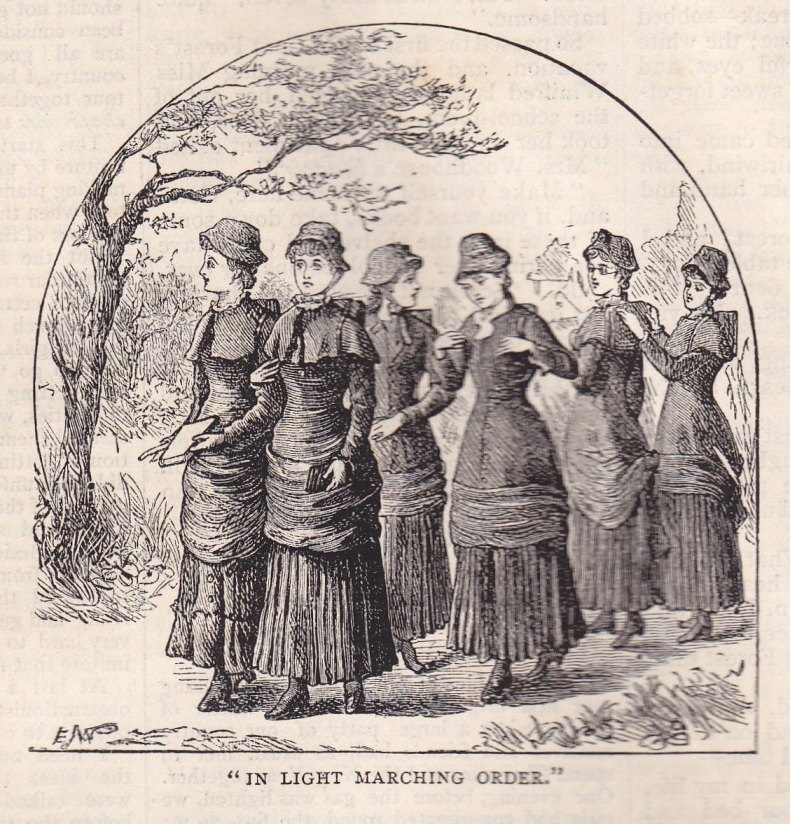
As we found our equipments all that could be desired, it may be interesting to mention what we took with us, and what we wore. We all had dresses of thin olive green serge, made quite short, and waterproofed to save carrying cloaks, quiet-looking hats of the same, and gloves to match, which, however, were generally discarded, except on occasions of ceremony; light, but strong, boots, and of course, woollen stockings. One of the party, who, fortunately for the rest of us, looked much older than her years, was set up with a cap and spectacles, and would have looked quite an imposing chaperone had one been needed; but, as it happened, in every hotel we had the coffee-room to ourselves. As to luggage, we each took what we wanted in a knapsack, which we carried orthodoxly on our backs; but, on this subject, let me breathe a word of caution to any inexperienced walking-touristess. Do not take anything more than is absolutely necessary in a knapsack, its weight seems to increase amazingly as the day wears on; though, if not too heavy, one soon gets accustomed to carrying it; in fact, some of our party went so far as to say that they preferred carrying one to walking without. Also take care that your shoulder straps are broad enough. Mine happened to be rather thin and narrow, and my poor shoulders suffered much in consequence, so much so, that I was obliged to get some new straps put on at the first village boasting a saddler's shop. One of our friends had presented us with a charming little portable cooking stove, the weight of which was said to be so extremely small, that the one to whose lot it fell would hardly know she was carrying it, but alas! I chanced to be that one, and never for a moment forgot the fact that I had to carry; and last, but not least, we had a small pocket filter, which we found most useful.
The long-talked of Monday came, and I rose with the lark, so as to be at our appointed meeting-place in good time to start at nine o'clock. As I said before, we were to start "weather permitting"; but, for the first half of the day, so far from permitting, the skies were decidedly forbidding, and we were obliged to wait a few hours in hopes of a change in the weather, so that when we did start, at half-past-one, the rain having ceased and the sun shining, we were constrained to take train as far as Dorking, to make up for lost time. Arrived there, and fairly outside the town, we shouldered knapsacks and set off, in light marching order, the vanguard consisting of the President and Pathfinder, the main body represented by the Poet and Artist, whilst the Treasurer and Secretary brought up the rear.
These titles, perhaps need a little explanation. I ought to have mentioned before that in making our plans we had deputed the eldest of our party to be Treasurer during the tour. She was to pay all the bills, and to keep a strict account of every penny spent. Very severe she was, never allowing any reckless expenditure on luxuries or souvenirs, and woe betide the rash individual who should even propose such a thing. Another of our number, officially known as pathfinder, acted as guide, carried the ordnance maps of the country, and informed us every evening how far we had walked during the day. Her tender feelings were sometimes lacerated when, at any perplexing juncture, some of the company insisted on taking the advice of local rustics in preference to trusting her and her maps I held the honourable post of Secretary. My duties were to despatch daily post cards to our friends reporting progress, to see that everyone duly wrote their diaries, and to keep a specially detailed one myself. So my work was really arduous; and why the secretary should have to carry the cooking stove I never could discover. Lest the others should feel injured at not holding any official position, we dubbed one Special Artist, and another Special Poet, apparently because this member never wrote a lien of anything but prose in her life. The remaining one installed herself as President, whose duties were of a vague and uncertain nature. After devoting our best consideration to the question, the rest of us concluded that the presidential avocations consisted solely in suggesting a rest every few miles.
Our first night was to be spent at Gomshall; the road thence from Dorking, though interesting in association and certainly pretty, does not call for special remark. One pleasing incident of the afternoon was our invaluable President's opportune discovery of a mill-pond, whereon lay a boat sheltered from the morning's rain by an overhanging tree, just at the time when we were all fain to confess that a few moment's rest would not be disagreeable. We were just comfortably settled in the boat, however, when a man, whom we took to be the owner thereof, was espied striding towards us, so, by way of having "first fire," two of our number started to meet him, and politely requested him to permit our resting in his boat He graciously assented, and we finished our siesta in peace.
We had agreed that on entering ay town or large village we would divide into two or three parties, and go in separately at intervals of a minute or two, so as not to attract the attention that all of us together might do, and also that two should always go forward and secure rooms at the hotels for the night. But we need not have troubled ourselves about being conspicuous in Gomshall; for, although it being a tolerably large place, there was not a soul to be seen save one stolid villagers, who vouchsafed us not even a glance. After securing rooms, ordering tea, and depositing knapsacks, our irrepressible pathfinder insisted that we must go for a stroll, "to make up the mileage," whatever that may mean; so, with a few gentle remonstrances we started again. Picking our way up a remarkably muddy lane for some distance, we climbed a high mound on gaining the summit of which the president, who affects archaeological tastes, gaspingly requested a halt, ostensibly because the mound was artificial, in her opinion a Roman remain. We were nothing loth, and enjoyed the lovely view of fertile valley dotted with farm-houses and pretty cottages, which was spread out before us, whilst our chief diligently poked about amongst the gorse bushes, seeking, I suppose, for further proof of the Roman origin of the mound. After our tea came the writing of diaries, which process was so frequently disturbed by the portentous yawns of certain of the party, that it was thought well to bring our literary pursuits to an abrupt conclusion and to retire at an early hour.
Early next morning, just as the sun was rising, my companion and I were aroused from our downy slumbers by a vigorous hammering at our door, for we had given stringent orders to be called betimes, and the deaf chambermaid was determined to do her duty. When she was at last convinced that we were really awake, she repeated her laudable battery at all the other doors with so much success that in a short time we were ready to start.
"Really a very moderate bill," said our treasurer, complacently, as we set out; "and, if not luxurious, everything was, at any rate, clean and comfortable."
"Quite true as it happens," said the artist; "but I believe our respected treasurer would think the accommodation in a workhouse princely, provided the bill were small."
"I was under the impression," remarked our poet, with a fine air of innocence, "that board and lodging were provided gratuitously at those establishments."
"So I believe; and it's a splendid idea," cried the treasurer; "and, since you have suggested it, we will by all means go to the casual ward to-night at Farnham; it will be a great saving of money, and quite a new experience too." On the whole, however, as we disliked gruel, and did not know how to pick oakum, we decided not to act on our treasurer's suggestion.
This conversation brought us to the village of Shere, where there is an interesting old church, kept locked up, however, according to the foolish custom in England. The stairs to the gallery are outside the church, and there is a curious Norman doorway. Obtaining the key, which is itself a curiosity, being nearly as long as my arm, we entered and admired the fine modern window, old brasses, and other interesting objects.
We were all familiar with the Silent Pool, which lay about a mile away, and had often looked in wonder at its limpid depths of moonlight clearness, and had gathered the wild sweetbriar and forget-me-nots from its banks, so on this occasion we did not diverge from our path to visit the favourite spot, but proceeded at once by a field-path into a park, called, according to the map, "Albury," where our artist was in constant raptures at the lovely effects of sunlight on the trees, and the picturesque glimpses of hills beyond. She was also anxious for us to stop to admire some Channel Island cattle, but I was of opinion that in this case discretion was the better part of valour, and so did not pause until I was safe on the further side of the fence.
Shortly afterwards we were directed by our pathfinder to leave the high road and clamber up a steep grassy hill, as the top of which we should find "St Martyr's," or, as it is now called, "Martha's," Chapel. "Here," she said, when she had recovered her breath after the climb, "here the Canterbury Pilgrims, in whose steps we have been treading all day, used to stay for rest and prayer." "Oh, pathfinder," cried the president reproachfully, "you surely do not expect us to believe that they would come so far out of their way, and up this dreadful hill, to say their prayers and to rest, forsooth, when they could have done it just as well by the roadside." The pathfinder immediately prepared to prove by an overwhelming mass of authorities that the pilgrims much preferred hilltops for their resting-places; but her attention was diverted by the poet to the lovely view of verdant, smiling country, while the president proceeded to examine the chapel, and pronounced it "quite modern, and not very interesting." Notwithstanding this adverse verdict, the artist and I attempted to sketch the building and its few simple grave-mounds, but before we had succeeded to our satisfaction we were obliged to move on towards Guildford.
When we reached the outskirts of this "fine, neat, old town" (vide guidebook), we separated for a time, the president and treasurer going to buy the materials for the out-of-door lunch, which was part of our scheme, the pathfinder and poet vanishing without any explanation, and the artist and I endeavouring to visit the Castle, which we had been told we ought to see. We found, however, that the keep was the only part remaining, and that was occupied by a party of school-boys, who informed us that visitors are no longer allowed to go over the place. We therefore rejoined the rest of our party in the lower part of the town, where we were just in time to witness the wrath of the treasurer, who had taken that spendthrift couple, the post and the pathfinder, in the very act of buying unnecessary oranges.
The president now appeared, laden with the various constituent parts of our lunch, and, after distributing the parcels as fairly as possible, we began to ascend the steep road which leads up to the Hog's Back.
A carter who was going the same way kindly offered to add our knapsacks to his load; but, as we did not fancy the look of it, we politely declined, and pretended that we quite enjoyed carrying our burdens.
The view from the Hog's Back is very beautiful and varied, with hills and dales, heathy ground, broad sheets of water and corn-field, mingled with park and pasture, but, unfortunately for pedestrians, the hedges on each side of the road are very high, so that it is only through a gap or a gateway that it can be seen. This made the walk rather monotonous, so, as we were all accustomed to singing in parts, and there was no one to be scandalised at such conduct, we cheered it with song" for a considerable distance. Then, and always, we found it a wonderful help when we were tired or the road was dull to unite our voices in any well-known ditty, the more spirited the better.
Before very long, however, we came to a most inviting bank, and all agreed that it would be foolish to pass by so good a chance of lunching in comfort.
We, of course, took off our knapsacks, and then set up the cooking stove, while one of us begged some water from a cottage near, the mistress of which, scorning our diminutive teapot, insisted on lending us a large pitcherful.
The poet, who certainly ought to have been writing an ode on the occasion, displayed a previously unsuspected genius for poaching eggs, and turning them daintily on to the slices of bread held to receive them. They were a great success, and though the tea had prismatic colours on its surface, from some peculiarity in the pot, which made most of the party decline to drink it, on the ground that it was poisonous, preferring to quench their thirst from the pitcher instead, on the whole we felt the first course of our first al fresco meal to be quite satisfactory. Bread and marmalade made a sumptuous second course, and we should also have had a slice of cake each, but for the reprehensible conduct of the president.
We were sitting by the road-side, and we were intent on our cooking, so that none of us noticed, til they were quite close, that several cattle were being driven past. Suddenly the president screamed, and, leaping up, seized an umbrella with which to protect herself from her pet aversions, which she had just perceived. Her quick movement caused one of the cows to stop and look at her with mild and gentle wonder, which so added to her terror that when the drover made the animal proceed she thanked him effusively, and actually presented him with the remains of our cake, "as a reward," she said, "for saving all our lives." Our feelings were too deep for words, so she escaped the reproof she so richly deserved.
With little delay we returned the pitcher to its owner, and continued our march along the Hog's Back, pausing at every gap to gaze at the lovely view, and after several miles taking a short rest on a road-side hillock. We were soon astonished by an exclamation from the treasurer. "Poet," she cried, and that ingenuous damsel started as though accused of some fresh crime. "I beg your pardon. I retract all my protests against your purchase of the oranges. The dust of this abominably long road has nearly choked me, and the juice of your generous present will save me from suffocation."
"It is the distinguishable mark of a great mind to confess when it has been in error," said the poet gravely, "so, treasurer, I forgive you."
In her turn she produced an orange from her knapsack, and we were all following her example, in an attitude, I fear, rather of comfort than of elegance, when three young ladies most fashionably arrayed in lawn-tennis costume passed by, and, as we fancied, eyed us with lofty scorn. I hope they enjoyed their tennis as much as we did our oranges, but I hardly think it possible. The rest of the way to Farnham we walked without a halt, and at the ancient hostelry there we had time for a pleasant stroll in its pretty garden before retiring to our rooms, where we were speedily lapped in balmy slumbers, living over again in our dreams the lovely views and delightful events of the day.
(To be concluded.)
Saturday, 30 April 2016
5 June 1880 - 'Sunday School Treats'
Who that has had anything to do with the management of Sunday schools cannot recall some protracted teachers' meeting convened at the beginning of summer to discuss the plans for the children's summer treat? First there is generally a warm discussion as to whether they shall have a treat in the summer at all, or whether an entertainment in the winter would not be better; but when everyone else is thinking of their approaching holidays, it seems hard that the poor little children, particularly those in the back slums of our large towns, should not have one day's enjoyment of the fresh pure country air.
We think a change of air once a year to the country or seaside almost a necessity to the children of the higher classes, but hundreds of poor little creatures, cooped up all the year round in close rooms and narrow alleys, would never have a change of air, nor see the fields and lanes of the country at all, but for the annual excursions which have now become so general in all Sunday and ragged schools.
For children living in the country, who have plenty of fresh air all the year round, and a far larger share of healthy play than falls to the lot of the little ones in towns, there is much to be said in favour of winter treats instead of summer excursions. Being held in the schoolroom, there is not the fear that a storm of rain will damp the children's spirits and spoil their best clothing, and the anxious and responsible teachers are not kept in a constant panic by rumours that a boy has fallen into the river, or a girl is lost in the wood; and last, but by no means least, it is considerably less expensive. But, on the other hand, a very strong argument for the excursions in the summer is that they afford a great, often the only, opportunity for a teacher to become on a friendly footing with the scholars. The lower classes of scholars are too apt to look upon their teachers, either secular or religious, as their natural enemies, only one grade less obnoxious than the policeman, and these holidays give us an opportunity of showing them, by entering heartily into their happiness, that we are their friends as well as their teachers; and, indeed, that religion, of which we are in their eyes the representatives, makes us better able to sympathise with others in everything, their enjoyments as well as their troubles.
In most schools the discussion ends in favour of the summer holiday, and if this conclusion is come to, the next question to be decided is "Where shall we go to?" the details and minor arrangements being usually left to a select committee.
It has been said that if Rome had been built by a committee it never would have become the mistress of the world, and happy the school which has one competent person who will undertake all the arrangements and so dispense with the endless discussion of a committee meeting.
But to return to the question of a desirable spot for the excursion. This is generally a very knotty point, and a unanimous verdict in favour of any one place is as difficult to arrive at as though it were left to the decision of twelve stubborn jurymen. One timorous person puts his veto upon a lace, perfect in other respects, because it is too near the river, and children seem to make a point of getting drowned if within a mile of water. Another has a ghastly tale of tell of youthful scholars, decoyed away by gipsies, when it is proposed to pitch their camp for the occasion in a wood.
In choosing a suitable place the distance should always be considered, as the cost of conveyance is a serious matter to a poor school. Except in large towns, it is seldom necessary to travel far; the convenience of the place is the chief thing to be considered in the selection, for beauty and scenery are not so much the attraction to the children as the novelty of a picnic out of doors and of having a whole day with nothing to do but play. Nothing can be better than a large field, particularly if it contains a few trees, to which swings can be attached; for though in a limited space like a field it is necessary to provide more amusements, the extra trouble is more than compensated for by the comfort of knowing that all the children are safely under your eye and not getting into any of the mischief which children are so expert in finding out. Failing a regular field, we might put up with a common, or wood, or any private park which is open for parties.
One important consideration which must not be overlooked is the chance of obtaining shelter in case of rain. No one who has not suffered it can fully sympathise with the despair a teacher feels who has no means of sheltering the children, on seeing them huddled together during a heavy storm, like a flock of sheep, and looking very minute more wet through and miserable. One experience of this kind is generally quite enough to prevent its recurrence. It is most important that the superintendent, or some other competent person, should visit the place first to ascertain that there is a barn or room that can be used if required. If there is no such accommodation to be had, the best plan is to hire one or more large tents, the comfort of which will be found quite worth the outlay, and as the owner will always send men to put up and remove them, they are no trouble.
In the country, when a field can be had for the purpose close at hand, the greatest difficulty of these summer treats, that of conveying the children to their destination, is avoided, an advantage which country teachers cannot too highly appreciate. Comparatively few schools, however, are so fortunate; but there are contractors to be found in nearly all towns who will provide covered vans at a moderate cost, and most of the railway companies make special arrangements to convey schools at less than half price, so that the travelling expenses need not be so large as is generally imagined. The trouble and anxiety is a much more serious consideration, though if the teachers will all come forward t do their part even that is a very trifling matter.
It is generally arranged to meet at the schoolroom, when the children are divided into small parties, each party being assigned to the care of a teacher, who undertakes to see that they neither get into a wrong train nor are left behind altogether. This arrangement saves the superintendent a great deal of anxiety, and, indeed, if going by train, is almost a sine qua non.
And now, having reached our destination, how are we to amuse our young guests? As usual, the boys are most troublesome to cater for; but we generally succeed in making them very happy by providing some cricket-sets, a large ball for football (the goals have to be improvised on the spot), some bats for rounders, and any other games after which boy-nature is supposed to hanker. The number of each provided depends, of course, upon the size of the school.
In addition, we generally organise some jumping and running-matches, and other athletic sports. The prizes need not be at all valuable. We give simply a rosette of ribbon, which makes the winner proud and happy for the rest of the day, and is a most trifling expense to the school.
For the girls we take balls and a quantity of rope, to be cut up into swings and skipping ropes, both single and long ones; but they are much more easily entertained than the boys, and are usually quite content with different games which do not require any materials providing. Here comes in a splendid opportunity for a teacher who is fond of any kind of natural history to persuade those who are tired of games to notice the different flowers and birds and insects around them, explaining a little about each. It will be found that some of the girls will think little walks with their teacher a delightful change after a surfeit of games.
By the time the children have played for a couple of hours they will probably begin to get hungry. In most schools who go for the whole day no dinner is provided, but the children are expected to take their own; generally, however, their provisions are eaten, if not before their arrival, at least very shortly after it; so that when the proper dinner hour arrives they are very hungry and have nothing left to eat. In anticipation of this, it is customary to give each child in the middle of the day, either a large biscuit and cheese, or a thick slice of bread and butter, on the strength of which they can go till tea-time, which is generally about four o'clock. This meal, being the only one, is an important feature of the day; and the arrangements for it, unless it is contracted for, generally fall into the hands of one of the lady teachers.
When practicable, it is very much less trouble to put the whole thing into the hands of a contractor, who will provide a good tea, with crockery, tables and seats, for about sixpence a head; some of the large contractors do it for less. In consideration of the great saving of trouble and the little extra expense, this plan is much to be recommended.
For the assistance of those who are out of reach of these advantages, and compelled to manage the commissariat themselves, I will give a list of the average quantities supplied for 50 children.
Tea, 1lb; milk, five pints; sugar 4lb, bread, four quarterns; cake, 20lb, butter, 2lb.
If the children have not left home till after their dinner rather less than these quantities of bread and cake will be sufficient; but when they have been playing all day, with only such dinner as they take with them, their appetites become sharpened to a marvellous extent, and this supply will not be found at all too large.
The best time for treats has not been mentioned, but no rule can be given for it; as it must depend upon the convenience of the teachers, their presence in good numbers being of the first importance. Generally speaking, July is the favourite month, because as far as we can judge at all in our variable climate we expect more settled weather then than earlier in the year; there is also the advantage that the hay harvest being over, there is less difficulty in obtaining the use of a field.
Subscribe to:
Posts (Atom)