Showing posts with label essay. Show all posts

Wednesday, 8 March 2017

9 July 1881 - 'The Duties of Servants' by Sophia F.A. Caulfield, Part Two

While the world lasts there will be the rich and the poor, the rulers and the ruled, the employer and the employed; each class enjoying its own rights, privileges, and responsibilities. Those employing your labour, be assured, are fellow-workers, even if not for hire, and have to bear the cares and anxieties which belong to their position, many of which are far heavier than your own, and with which you have little or no acquaintance. Do not wish to exchange your lot for theirs. You can elevate your position and gain the respect of your employers as well as your fellows by your propriety of conduct, manners and dress. Common, cheap finery is as little becoming as it is unsuitable, and those who wear it are not those who obtain first-class situations and become elevated to confidential positions amongst their employers. The common-looking, vulgar style of wearing what a low class of servant-girls in lodging-houses call a "flag" at the back of the head stamps them at once as belonging to the lowest grade of untrained and cheap servants. A real cap is pretty and becoming, and is suitable to those whose work must make their hair dusty, and the exposure to draughts disarrange it. That most respectable and high-class race of servants who used to live from twenty to fifty years, or for life, in the same family – dying in the home of their adoption, beloved and respected; or else were pensioned on the death of their employers, to enjoy independence in a home of their own – these were not people who wore a strap of crochet work on the back of a dusty head. They had no desire to look "shabby genteel" either. They wore good, plain dresses and pretty white caps. And so in the gentry, the maid servants are dressed as in olden times, following in the steps of those who rose to positions of competence and future independence. The lady's-maid alone is exempt from wearing a cap, simply because she is always about her mistress, and her work does not exposure her to any chance of looking dusty and disarranged. But as she advances in life she also adopts a cap, as the hair becomes grey and possibly thin.

It is said that "there is honour amongst thieves." If not influenced by better and more sacred motives, at least you might be ashamed to degrade yourself to a lower standard than theirs. Yet, rightly or wrongly, young servant girls are accused of being very dishonourable, in being much given to what is called "tittle-tattle," as well as charged with trying hopelessly to look like what they are not. It should be regarded as a point of honour amongst you never to repeat outside the house, nor even in the servants' hall nor kitchen, what you were trusted to hear at your master's table or in your mistress's apartments. Never stop to listen to their conversation (which you might misunderstand if you did), but give your whole attention to your own business. With reference to the respect due to them, to the duty of "not answering again," of abstaining from purloining, and "showing all fidelity," I refer you to the words of Divine inspiration, which have given no "Uncertain sound" in their directions both to masters and servants. Having known of several instances within the circle of my own family and connections of those who have lived from five-and-twenty to upwards of fifty years in the same family, deservedly beloved and respected, I know how to appreciate the faithful and high-principled amongst them, and am ready to believe in the extensive existence of such, in the class to which you, my readers, belong. Strive early to emulate such bright examples, and ever remember that amongst the most humble in birth and circumstances there is such a thing as "Nature's nobility" – the highest sentiments of honour and feelings of propriety, combined with the greatest humility and modesty of demeanour, and of that good sense which makes a man or woman know and live according to their natural position in life; and are placed in that position of trust and trial only as a temporary training for a state of far higher existence.

"Be thou faithful in a few things, and I will make thee ruler over many things."

To the mistresses of families I would now make two or three suggestions. The inefficiency of domestic servants, the rare examples of grateful and loving service rendered, the silly vanity which induces ignorant young girls to ape a position they can never attain and thus even throw a doubt on their moral character – all these points form subjects of perpetual fault-finding, sour your temper and prejudice you against the whole class.

Doubtless you cannot "make bricks without straw," and you have much cause for dissatisfaction. A servant professes to know all the duties and method of performing, for which she expects all the wages you may be induced to give, with all the comforts of a home, and you discover that she possesses but a very superficial idea of any of them. She wastes your provisions perhaps by bad cookery or forgetfulness of them; articles destroyed by neglect of repair, and every description of disaster and annoyance. We all suffer in a greater or less degree, paying honest wages for dishonest services. Alas! "That which is crooked cannot be made straight, and that which is wanting cannot be numbered."

But if we feel so keenly our own wrongs we should apply ourselves all the more zealously to redress them; and if we judge the shortcomings and misdoings of our maid-servants, let us take care that our own conduct be absolutely above reproach.

If, as a general rule, the young domestic servants of the present day are inferior as regards both their efficiency and manners, as well as devoted fidelity to their predecessors, the fault is not always and entirely to be laid to their charge. Those whether employ them very frequently show themselves utterly ignorant of their own duties towards them, and the great responsibility which lies on their own shoulders. Apart from all higher motives, the old saying, "Noblesse oblige" seems little to influence their deportment towards them. There is a petty and most vulgar meanness in the ostentatious way in which ladies of no real position in society themselves will order about their attendants as if they were only automatons, and not persons under their benevolent care and wise judicious training. The more or less uneducated need as careful and considerate training as children.

Every household should remember that by a Divine decree it is the mistress who is to "guide the house," and the duties which this sacred charge involves are to be gravely accepted and prayerfully carried out. It is not to be supposed that she has only to give her servants certain orders, and to scold or dismiss them if they be not fulfilled. In a very extended sense, she has the souls and bodies, health, training, and the present and eternal well-being of those under her authority placed in her charge; or, to say the least, within her influence – an influence for good or evil for which she will assuredly have one day to render an account.

The service which she buys with gold may be rendered for love. How often has this been realised when reverses have changed the order of the household, and the faithful servant has selected to share the scant necessaries of life with the beloved and revered heads of the family; not grudging the least extra service that seems to outweigh the gold in the balance set against it, but, thenceforth, as the tried and tested and deservedly trusted friend, clinging with affection and respect to her unfortunate master and mistress?

But money alone will not purchase fidelity like this. "If a man would give all the substance of his house for love, it would utterly be contemned." Of course there are the naturally high-principled, as well as the God-fearing, amongst little-educated people, as well as amongst those who have had the benefit of the best intellectual culture. Faithful service, even in little matters – out of sight, perhaps, and unappreciated – will sometimes be found here, even when mistress – who pays her servant, and gives her a home – is not to be classed among "the good and gentle." But "as a man sows so shall he reap" is a rule of very general application. If kindness and consideration, supplementing honest payment of service, do not always meet a just reward at the hands of our servants, so we have no right to expect a cordial, hearty, cheerful service for a cold return in money only.

To claim unquestioning obedience – a respectful address and answers – a suitable style of dress – a strict conformity to the hours and rules of the house – and of the performance of the work, in conformity with your own directions – are all requirements perfectly within the limits of your rightful authority. But be careful to give each servant, before her entrance into your family, the complete list of the rules by which she is to be guided; so that if she should demur at any of them, she may do so at once. In the same way, make her acquainted with the amount of rest and recreation you can allow her; and after her ready agreement to your proposals, then let her find that – strict as you may be on certain points – you are no niggard in kindly consideration for her, and that her pleasures are given with an ungrudging hand. Above all things, remember that if you lose your temper in speaking to her, you lower yourself in her estimation. Speak firmly, and gravely, if need be; but do not forget yourself for a moment, or lower your dignity by saying anything in haste that you would not like to hear repeated in the servants' hall as a specimen of an ill-governed temper. Such outbreaks, however justly you may have been offended, may make your servants fear, but never respect you.

In reference to the recreations to which I alluded, a few suggestions should be given. Going out after dark is by no means include amongst them, unless it to be to take turn with other servants in going to church or chapel. Let no Sundays pass without sending each servant to a place of worship once in the day. They need out-of-door air, as well as their mistress. Send them for their weekly outing while the sun shines, or at least that the daylight lasts, to see their families and friends, or do their shopping. Do not grudge a cup of tea "once in a way," to the relative or friend who may come to see them when the chief work of the day is over.

Supply them always with some nice book – such as a volume of magazines (for instance, our own paper, the Sunday at Home, or the Leisure Hour), for, apart from the kindliness of the act, it is your duty to educate their minds; and in so doing you are also training them to be more efficient servants.

Some little time should always be allowed – if not every day, at least once in the week – for their own needlework, the necessary mending and making of their clothing and caps. It is equally for your own satisfaction that they should be accorded some time for this, as otherwise their appearance will be unsuitable to your house; and sitting up late at night – as many are obliged to do – is most undesirable on every account.

Remember that while all familiarity should be avoided, there is a quiet dignified politeness of manner and mode of address that invariably calls forth a politeness of response. Do not allow your self-respect and self-assertion to border upon an ostentatious demeanour. You will never elevate your position in their eyes by so doing. The lady-like politeness of your own manner will invariably be reflected to some extent in that of the servant whom you address.

Tuesday, 10 January 2017

21 May 1881 - 'The Duties of Servants' by Sophia F.A. Caulfield


The question of the respective duties of all classes of domestic servants to their employers, and no less so those of the latter to their paid dependents, is one which often supplies a subject of painful disagreement between the two parties concerned. Unhappily for each, they are too much disposed to regard each other as opponents, actuated by conflicting interests. On the contrary, the well-being and peace of the household forms an important object of interest to each. They have it equally in their own power, respectively, to promote, or mar their mutual comfort and happiness, and to confer more substantial benefit on each other in their own especial departments of duty than money could either purchase or reward. All antagonistic feeling should be extinguished on both sides, and this can be effected without in the least degree interfering with the order of society and of those distinctions of position which exist by the ordinance of God. It is to be recognised throughout all nature, from the humble "hyssop on the wall, to the cedar of Libanus;" "one star differing from another star in glory;" one faithful servant being "ruler over ten cities," and another "over five" only. "The head cannot boast itself," we are told, "against the hand' or the foot; nor can they be envious of the head. For all the members there is a fit and seemly place, and an honourable work to do; and of every arrangement of divine appointment we may be perfectly sure that all is well and wisely ordained.

In giving a general summary of the duties devolving on those employed in every department of female domestic service, I propose to offer a few suggestions both to them, and to those appointed to be heads of households.

The HOUSEKEEPER has the entire direction of all the female servants, with the exception of the lady's maid and the head nurse; receiving the orders of her mistress and acting as her deputy. Excepting where a house steward is kept, it devolves on her to keep the weekly accounts, to enter on her ledger the expenditure of each day; to pay all bills and file receipts; superintend the weighing of meat, to correct the tickets sent with it, and to examine every article sent to the house  for the table or otherwise. Should there be a man cook he will relieve her of many of her duties, including that of marketing, one with which she would otherwise be charged. In the case of a female cook being kept, the housekeeper should be prepared to supplement her work as may be found necessary, and to make, as well as to superintend the making of all dishes of a delicate or *recherché kind, and likewise the arrangement of the bill of fare for every meal. The taking in of the fruits in their due season for preserving, and all the direction and assistance requisite  for the making of pickles, jams, and confectionery; the preparation of syrups and the bottling of them, and other juices and liquors are also amongst her duties; as also salting of meat, changing of the brine, the curing and smoking of hams, the storing of salted butter and of eggs, the preserving of potted meats, preparation of stock for soup, and in fact, everything connected with the kitchen, larder, store-room, still-room, and dairy; as well as the superintendence of the poultry, and all live stock designed  for the table, outside the house, all this comes under her jurisdiction. But her duties must be regulated with each particular family, by the establishment kept, and the character of the house, whether a country seat where most of the necessaries of her several departments of trust are home supplied, or a town mansion where the domestic arrangements are of a different character.

The linen closet and laundry demand her close attention, and she has to give out from the former what is either for use or repair to the under-servants, and to see that the requisite mending be accomplished. The body linen she separates from the rest, and commits to the hands of the lady's maid or head nurse, as the case may be. In the evening she directs the breaking of lump-sugar, washing and stoning of raisins, blanching of almonds, and general preparation of all that will be required for use on the following day.

The inventory, which she should receive on entering her situation, should be carefully compared with everything committed to her charge at stated intervals of six or twelve months, including all the household furniture and kitchen requisites, and a report of wear and tear or deficiencies supplied to her mistress, and entered on the list, if not made good. Her own accounts should likewise be submitted for inspection at least once a month. But all such rules must depend on the wishes of the mistress herself. The wages of a housekeeper vary from £20 to £50 per annum. The "finding" or providing with beer, tea, and sugar, over and above the ordinary food of an indispensible character, is subject to no "hard and fast" rule. It varies, according to private arrangement, as regards every class of domestic servant.

The COOK, where no housekeeper is kept, has a considerable amount of work on her hands besides the cooking of meals, such as the marketing, continual supervision of the  larder, the salting of the meat, the making of the preserves, and the baking of cakes and perhaps of bread. She must make the study of cookery her continual business, by reading as well as by practice. She must know when meat of all kinds, and different sorts of game, poultry, and fish are in season. She must study the gardener's calendars to ascertain when certain vegetables and fruits come in, and when to make pickles and jams. The cooking of the dinners and what may be requires for all the other meals, of course devolve on her, and the scullery-maid is under her direction, to whom she should make it a point of conscience to teach, to the best of her ability, the art of cookery. In small households she is required to give some assistance in household work, such as to take the front hall, dining room, hall door, and the steps and pavement in front of a town house under her care; not to speak of the kitchen and all the basement. But where a kitchen-maid is kept, the basement floor, area, pavement and pot and pan, and all floor cleaning, and the bringing in of coal and water, naturally devolve on her, instead of on the cook. But private arrangements may be made by mutual agreement, either increasing or decreasing the legitimate work which a mistress has a right to demand of her cook. Her wages vary from £16 to about £30 per annum.

It will be remembered by the reader that a cook's duties – while she cannot refuse to fulfil those which I have named – may, as I have stated, be multiplied by private arrangement; and must be so, as a matter of course and right, when she undertakes a situation where no housekeeper, nor kitchen-maid is kept. Thus she will have to study the list of that functionary's duties, to be thoroughly acquainted with her own. On this account I have introduced her out of place in the order of precedence amongst servants, in which she ranks after both the lady's maid and the head nurse.

The LADY'S MAID holds a position next to the housekeeper. Her duties commence before her mistress rises; and if tea be taken in bed, it is her duty to bring in the small tray containing it, and the toast or bread and butter she also should prepare. She then places all the underlinen, slippers, and dressing-gown ready for use, takes out the dress and cap to be worn, and remains to assist, or retires for a time, according to her mistress's wishes, until she be summoned  for the hair-dressing, and to complete her mistress's toilet. Every such maid should be proficient in the art of dressing hair, and should learn every new style as it comes in. She should also know how to make cleansing washes, and rosemary and other decoctions requisite  for the hair, so as to provide them at home; also such necessaries of the toilet as camphor-cake and lip-salve, pomatum, &c. After her lady has left the bed-room, it is her business to fold the night and dressing-gowns, and place all in order before the entrance of the housemaids throwing open the bed and the window, taking out such articles as may need repair or alteration, those requiring fresh lace and frills, and the linen that should be aired. Gloves and boots should likewise be inspected, that buttons may be supplied and small rips sewn up as required. The jewel-case and all private drawers should be locked before leaving the room.

Not only reparations and alterations of dresses come within the limits of her duties, but she should know how to cut out, fit, and make them. She should understand the art of blending colours, so as to become a light or a dark complexion; and her mistress, whether tall or short, stout or slight, fair, sallow, or a brunette, should be to her an object of study; as it is her duty to make her appear at all times to the best advantage. In many houses where a lady's maid is kept, there is no private laundry maid, and thus it is one of her duties to understand the cleaning of lace, "getting up" of fine things, clear starching and gauffering. Also how to preserve furs from moth.

A lady's maid should likewise understand millinery, how to make a bonnet, cap or hat, and should study all the new fashions in their style as they appear in the best shops. She will have to keep an account of all t she expends in reference to her needlework, as she may be entrusted with a certain sum to meet current expenses. It is her duty to count all the body linen on its return from the laundry, to divide all requiring buttons and strings or other repairs from the rest, and to place each set in a separate spot, drawer, or work-basket, after all have been well aired. An inventory should be kept and notice given to her lady when the wardrobe needs to be replenished with new articles. Having inquired at what hour she proposes to go out, it is her duty to be again in attendance at the appointed time, having to place all that is needful, whether for driving, riding, or walking, in readiness for her; and on her return her lady should find the suitable change of dress prepared for her, and the maid awaiting her arrival to attend upon her. A knowledge of folding and packing closely, so as to save space, without injury to clothing, is another of her essential duties, and one in which must deficiency is generally observable amongst them. At a suitable time before dinner the maid should again adjourn to the bed or dressing-room, and lay out all she may require for her evening costume, and be prepared to dress her. On her leaving the room she extinguishes the candles or lets down the gas, and places a screen on the fire. At bed-time all required for night should be put out in readiness, and she should be in attendance until dismissed. In case of going out to dinner, or any kind of evening entertainments, her mistress has a right to expect her to sit up till her return, and see that she has all that she may require, such as tea or sandwiches, hot water, &c. Should the mistress be an invalid or an elderly person, the maid would be required to act more or less as a nurse, and would have to read aloud, which she should study to do agreeably, and to write letters at dictation, on which account her writing and spelling should be thoroughly good. But under these circumstances many of the duties required of her by a younger mistress, and one in good health and going into society would not be required of her, so that her work would not be excessive. In small families some of the duties of a housekeeper are united with those of the lady's maid. Her wages vary, according to her efficiency in all her duties, from £18 to £30 per annum.

An UPPER NURSE should have a thorough acquaintance with all the ailments to which infants and children are commonly liable. She should therefore have some reliable book on the subject of nursing the sick, and children in particular, always by her, and keep her memory perpetually refreshed on all points, so as to recognise the first symptoms of every complaint, and to be prepared for all emergencies. She should also study all questions relative to attendance upon her mistress, so as to nurse her, and supplement the services of the regular nurse temporarily hired. Her place is in the nursery, for meals as well as for a sitting and work-room, should it happen that there were no day-nursery; and only when her charges are asleep  for the night can she leave them in the care of the under nurse, or housemaid, to take her supper in the housekeeper's room, or with the other servants if there e none. The only female servants who have a right to avail themselves at all times, for meals and otherwise, of the housekeeper's room are the upper nurse and the lady's maid. The washing and dressing of a young infant must be exclusively done by the upper nurse, and that of the older children by the under nurse, always by the supervision of the former. She must take them out, wheel their carriage, and carry them in turn with her assistants. She has the dress and under-linen to make and mend, and she has the assistance of the under nurse, who acts at all times under her directions, helps her to make the bed, and does the rough work of cleaning the room and grate, making the fire, and bringing up the water and all the meals. Should the nurse be single-handed, she must be prepared to keep the nursery in all due order herself, and obtain assistance from the under housemaid, or the single-handed housemaid, as she could not be expected to leave her charge to fetch water, coals, nor the daily meals. She also lights her own fire when single-handed, unless assisted by the housemaid, and makes the beds. A head nurse receives from £18 to £25 or £30 per annum. Ordinary single-handed nurses in small households receive less. But the qualifications, experience, and age of the latter must always regulate the amount of wages expected, even should a valuable servant prefer a situation in a small family of limited means, and to undertake the whole charge of the nursery and its young occupants, to a situation of a higher character.

The UPPERHOUSE MAID. – The duties that devolve on this class of domestic servants are comparatively light, but they are only well performed by a careful, industrious woman – methodical, gentle in touch, and one who "has her eyes about her," knowing how to direct and superintend, and is not above assisting in any duties which are performed by the under-housemaid. Whether she be aided in her work, or be single-handed, that work must be the same in every house, great or small. The cleaning and arrangement of the breakfast room, boudoir, and then the drawing-room, should be accomplished before the family leave their bed-rooms; just as the cleaning of the hall, hall door, steps before it, and dining-room are all done by the cook or kitchen maid before their appearance downstairs. While the family are at breakfast the bed-rooms have to be set in order, the windows opened, the beds shaken and turned, the slops emptied, and all crockery washed and scalded, carafes, jugs, and tins refilled; a T-shaped sweeping brush wrapped in a wet cloth passed under the bed and all round the room where there may be no carpet; and a damp and dry duster employed in successively removing the dust from the whole room, especially all the ledges in the wood-work. The table, looking-glass, and cheval-glass, or that in the wardrobe door, should be well polished. The rugs should be taken out and shaken daily, the grate and irons cleaned; the cinders must be sifted from the ashes, and the latter removed before the dusting of the room, and the bed also, having been previously shaken and turned, may be re-made without making any fresh dust, the last thing in the finishing of the work. The making of the bed is no unimportant matter, as there is much variety of taste, and one person does not like the bed to be made as another may like it to be arranged. Thus the housemaid should observe what alterations have been made in the amount and ordering of the clothes, and also inquire whether any change would be agreeable. Housemaids are little aware how often the beds are completely re-made by their occupants, as visitors never like to give directions to the servants of their hosts, even in reference to the room especially allotted to their own use, and many are the comments made o dullness, and want of observation of those who attend to the bed-making.

The cleaning of the paint and of the windows, the washing of china ornaments, and the polishing of the furniture (if need be) should be the work appointed for a certain day in every week, a room or more being completely cleaned every week. The wiping down of the uncovered portions of the stairs and landings, and upper corridors and passages with a damp cloth should be the housemaid's daily work, but when two are kept it devolves on the under maid. The taking out of each rod, one at a time, to wipe underneath the carpet, should be done weekly, on a certain day, and each rod rubbed with a leather before being returned to its place. It is a most inconvenient and unsightly habit, adopted by half-trained maids, to always be taking up the whole of the stair carpet at once. Furniture polish should also be applied to the top of the balusters at intervals, and careful rubbing performed afterwards.

It is the housemaid's business to collect and count the linen to be washed, under the housekeeper's or lady's maid's supervision, weekly; to mend and hem the house-linen, and also to count all on its return home. She has to take down, shake, and put up the curtains and hangings; attend also to all the rugs and cushions in the house, and destroy all moths and flies which may be found behind the shutters in the spring or early summer. Of course, much devolves on the housemaid which properly is the work of the lady's maid, if there be none in the establishment, and in various ways in the nursery, and even sometimes in waiting at table, if only one man-servant be kept. It is also very usual for the office of housemaid to be combined with that of parlour maid, and this demands great quickness, method, and extra knowledge – such as that of cleaning plate, knives, lamps (including the entire management of the latter), the laying of the table, and the art of waiting well – observantly, in reference to the requirements of each individual at the table, quickly and noiselessly. As a housemaid's duties may be so much regulated by the circumstances of the establishment kept, she may have, as I said, to include some of those which naturally belong to the lady's maid, nurse, and footman, and must not be ready to say "this or that is not my work." She will also have to answer the hall door at certain times, if not always. Her wages range from £15 to £25 per annum.

The UNDER HOUSEMAID, UNDER NURSE and KITCHEN MAID are directed by the servants holding a higher position in the same department of service as themselves; and, with the exception of remarking that the kitchen maid is expected to dress the nursery and kitchen dinner, it is not necessary to enter into any detailed account of the work of each respectively.  The wages of all these maids vary from £9 to £14.

A GENERAL SERVANT should be a very well-informed person, particularly active, methodical and intelligent; yet she is usually more ignorant and more incompetent than any other class or servants. Well-trained and experienced persons naturally object to the almost never-ceasing work which their situation entails; but quickness and a judicious timing of all the work to be done will, with the kindly aid of her mistress, enable her so to get through her duties – if the dinner be an early one – and enable her to have a quiet hour or two for her own needlework or reading before bedtime. She will have to be an early riser, and she must manage her work so as to be dressed in the afternoon, to attend the hall door when visitors may be expected; but the enumeration of all her duties is superfluous in this place, as she needs only to study the directions given to the cook, housemaid, and parlour-maid to be fully acquainted with all her own work. Her wages vary, according to her efficiency as a cook especially, from £8 to £18.

Upon the duties of the Laundry and Under Laundry Maids, the still-room and the Dairy Maids it is scarcely necessary that I should write, and I hope in my next paper to add a few friendly words to those of my readers who have selected domestic service as their vocation.

Monday, 24 October 2016

19 March 1881 - 'Mourning Attire' by S.F.A. Caulfield

The outward symbol of affliction has been dignified with the name of the reality which it so feebly portrays. In the reality, and in its external shadow, I find a rather extensive subject for our consideration.

It has been a necessity of our pour human nature to give vent to feelings of distress in some manner from the earliest period of the world's history, ever since the day that sin "brought death into the world, and all our woe." And in the history of nations - as in those of each individual being, from the cradle to the bier - various in character have been the expressions of mortal anguish when "it must have way."

It is my intention to take a three-fold view of the subject: historical, sentimental (in the best sense of the term) and practical, and further, to consider the case of those who find satisfaction in wearing black garments; those who find none in so doing; and those who, desiring to wear mourning, have not the means to purchase it.

The Israelites use dot fast and weep and rend their garments, clothe themselves with sackcloth, hair-cloth, or coarse black or brown cloth. They sat in ashes, threw them on their heads, tore and cut off their hair and their beards, smote on their breasts and tore them, made loud wailing, and went barefoot and bareheaded. All the time of their mourning they sat at home or went to mourn at the grave, and ate whatever they allowed themselves on the ground, their faces being covered. They further gave vent to their misery by leaving their beds unmade, abstaining from the use of a bath, and all the duties of the toilet. It was, of course, impossible to protract a mourning of this description, and the ordinary limit was restricted to a week, but extended to a month on special occasions. Contemporary nations used to "cut themselves with knives and lancets," and gave vent to loud, and what we should regard as extravagant grief; and, as we are informed in a Holy Writ, they "made themselves bald  for the dead" (Jer. XVI, 6, 7).  The mourning by Joseph and the Egyptians for Jacob was of seven days - "a great and very sore lamentation;" and in the Book of Daniel, tenth chapter, three weeks are named as a period for mourning. From what the prophet Zechariah tells us, it would seem that men and women used to part company on such occasions, and give vent to their sorrow. They "put on mourning apparel," and abstained from their "anointing with oil." (See 2 Sam, XIV, 2.) It was also a custom to hire public wailing women to mourn after a complimentary manner, just as we hire "mutes" to wear black, and long black or white bands from their hats, and scarves. See Jer. IX, 17, 18 where "mourning and cunning women" are mentioned; as likewise in the prophecies of Amos V, 16, where persons "skilful in lamentation" are named.

I spoke just now of "the cuttings" made in evidence of grief  for the dead by the ancient Israelites as not being peculiar to them. The custom of self-bleeding obtained amongst the Greeks, and also the Turks, and the cicatrices left  for the remainder of life served as mementoes of the departed. As to the Lacedaeomonians, they used to tear the flesh from each other's foreheads with pins and needles in honour of deceased monarchs. The making bald also was by no means peculiar to the Israelites and their contemporaries,  for the Greeks and Romans cut off their hair, as an offering of what they greatly esteemed, to a deceased relative; and sometimes it was laid upon the grave. The whole Greek army would do the same in honour of a much esteemed general. It was also their habit to retire into solitude, and to throw ashes on their heads, under which circumstances it was well that they did cut off their hair; and as natural also that they wore a veil whenever they appeared in public. Their dress was of black. The early Peruvians had an unpleasant prejudice in favour of pulling out the eyebrows and eyelashes as an offering to the dead; and in savage tribes of modern times the sacrifice of the hair, more or less, much prevails, as amongst the Carib and Dakota tribes of North America. The former sacrifice their long and precious scalplock, which is plaited down their backs, as the utmost expression of their respect and utter distraction; and the latter also cutting short, like their slaves and captives, that in which they glory. I have read of some uncivilised tribes who make their expression of grief a still more unpleasant affair, that of cutting off a joint of a finger. Indeed, the devotion of the Greeks to the memory of their commanders is thrown into the shade by some of these aboriginal tribes, whose magnates gave orders that a hundred fingers should be cut off to do honour to the memory of a chieftain just deceased.

The colours adopted in various parts of the world to express respect  for the dead have been various. We derived our idea from the Romans, who wore a black toga for mourning, and sometimes left it off altogether  for the same purpose. So far as the men were generally concerned, the colour did not change either under the Empire or the Republic, but under the former the women wore white, under the latter dark blue - a colour adopted by some of the men.

The Egyptians, in all probability, gave the custom of hiring "wailing women" to sing and lament, and beat tambourines, divested of the tinkling metal plates, to the Israelites. Two or more were engaged to mourn for an hour at a time. Strange to say, the colour adopted by them for their mourning is yellow.

In Turkey they adopt blue or violet, in China and Japan white, and in Ethiopia brown. In Bokhara they wear purple, as we are informed by Thomas Moore, in "Lalla Rookh."

"Not glittering o'er
With gems and wreaths, such as the others wore,
But in that deep-blue, melancholy dress,
Bokhara's maidens wear in mindfulness
Of friends or kindred - dead, or far away."

But throughout Europe, the United States of America, and our own colonies and dependencies, black is universal for deep mourning; and grey, or black with a little admixture of white, for slight mourning.

I have now reached the second division of my subject - the sentiment, which supplies the origin of all external exhibition of grief, whether of a positive or negative character.

I have related many extraordinary customs very uncongenial to our feelings, but it must not be supposed that hypocrisy was necessarily exhibited; for, custom having prescribed certain observances, to devote time, care, self-mortification, and money to their accomplishment was surely an indication of genuine respect of affection. And, however barbarous the ceremony, it might have indicated as much genuine feeling as the shedding of quiet tears unseen at home. Few of us "creatures of habit," as we are bound by the prejudices of our friends, care to be remarkable, any more than less civilised nations, by acting after a contrary fashion to them.

But, without scandalising them, a considerable amount of personal freedom is conceded to all. And, moreover, "necessity has no law;" and the pecuniary circumstances of one person might permit of much indulgence in the outward expression of distress, while those of another allow of little or none. It is scarcely possible to find two leaves alike on the same tree; and so even among members of the same family features and characters vary too. Therefore as others differ from us in disposition, we must check all unkindly criticism, misjudging of motives and personal vain-glory. There may be no difference whatever in the depth of feeling between the individual who is shrouded in crape, and one who wears but the most trifling expression of mourning; experience continually proves the fact that each alike may -

"...have that within which passeth show."

A strong prejudice against the wearing of black is consistent with great strength of feeling, yet those who entertain it are too often misjudged. In their behalf I would observe that there are no black flowers in Nature, although there are sombre hues. Still there is nothing really black in the beautiful garment with which our world is clothed. Even the firmament above it, though inky-dark at night, is wondrously glorified and gladdened with its stars. I have known a great lover of the beauties of Nature who mourned  for the loss of one beloved for years so acutely that she could scarcely endure to speak of that bereavement, even to the day of her death. And yet she had such an objection to being wrapped in black attire that she omitted to wear it on some occasions when custom required its adoption. A sincere feeling of sorrow was veiled under an ordinary garb, for she wished to look up from the narrow bed, where her dear ones were laid, to their happy place of rest beyond the charnel house, and to shake off as much as possible all depressing influences that her mind might be the more absorbed in thoughts of the beatific vision of the hereafter. In reference to these mourners after a fashion of their own, I may quote the words of one who had studied human nature more closely than most of his fellows -

"'Tis not my inky cloak, good mother,
Nor customary suits of solemn black
That can denote me truly...
These but the trappings and the suits of woe."

At the same time our sympathies may be as tenderly and truly enlisted in behalf of that still larger company feeling a necessity for a vent for grief. Like the outburst of tears and convulsive sobs, that medium  for the relief of the nerves provided for all living, so the adoption of a sable garb supplies something of consolation to mankind in general. And then if some appear to outstep the limits of ordinary custom, in the amount of their crape and the duration of its wear, we must not be censorious, and charge them with affectation nor even with folly. Leave them alone and undisturbed for a season. Let it suffice for you to know that the hand of God is upon them, how heavily, for their state of mind, of health, of nerves, of faith, He only and they themselves can realise. Doctors will sometimes prescribe crying, even aloud, under a certain amount of mental and physical strain. The nerves demand an "opening of the floodgates." The bereaved ones must be left to turn their sad faces to the wall, and to unburden their hearts for awhile unrestrained. "The heart knoweth its own bitterness," God only knows it as well. "In all their affliction He is afflicted," of whom it is recorded, when, in a scene of mourning -

"Jesus wept!"

It is a gracious act of Christian charity to supply those of your poor friends or relatives, lacking the means to purchase them, with a black dress, bonnet, or out-door covering which their position in life would demand on such an occasion. For amongst these indigent persons there are those who would derive much consolation from showing outward marks of respect for their loved and lost; and none are so keenly sensitive, as a general rule, as poor gentlefolks, who struggle to keep up a certain appearance suitable to their birth, both because they wish to associate with their own connections, and because they would rather bravely struggle on under unseen privations, than prove a burden to their relatives, however, unintentionally. "Withhold not thy hand" in such cases as these. Light up the poor wan faces with a gleam somewhat akin to a smile, by helping them to vent their sufferings in some little external exhibition, in harmony with the "shadow of death" brooding within. In Nature the heavier the shower, the sooner the break in the cloud, the clearer the light, and the warmer the sunshine that follows - a meet emblem for that calm that succeeds a stormy grief, in trustful anticipation of the blessed "clear shining after the rain," and that "reaping in joy" of "those that sow in tears" - "sorrowing after a godly sort." Show no impatience. Let them give free vent to their trouble in their own way, having this consummation in view.

I have now arrived at the third and last portion of my subject - the practical part of so-called "mourning." To many a few hints may prove of service.

As to the length of its duration  for the several relationships in life, there can be no fixed and unalterable law. A widow, however, could not, with ordinary propriety, leave off her "weed" under a twelvemonth; nor should deep mourning be left off for a parent under that time. A year is not too long to wear it for a brother or sister; but under any circumstances no change should be made from the first deep crape until six months have elapsed. From three to six months for an uncle or aunt would be within ordinary rules, unless under special circumstances, of early residence under the same roof, or close relations of much affection or obligation. There is a paltry affectation of mourning which is very objectionable for women for a two-fold reason, because, while acknowledging the wearer's feeling of obligation to wear it, the least possible expense and trouble are conceded to that feeling. Better make no sign at all, than one so poor and mean. I allude to the wearing of a band of cloth or crape round one arm, the wearer being otherwise dressed in colours. The second objection to this "freak of fancy" is that it is an aping of a masculine style. In many respects men are allowed more license than women, and often wear a coloured overcoat, if not entire suit, together with crape on the hat alone. Women are hedged about by stricter rules; they are expected to show a greater semblance of grief in family troubles, and to shed tears more freely. Thus, to show any hardness or indifference to the usages of society, is to throw off a certain amount of feminine propriety and tenderness, at once unnatural and repulsive. Wear a black bonnet or hat, and black gloves, in lieu of that strap round one arm; and your ulster, though not a black one, may be worn by as true a mourner, and as true a "lady," as any in the land.

All mourning should be plain, without ornamental trimmings. A widow's dress may be nearly or altogether covered with crape. Paramatta and crape-cloth are suitable for widows, and these, with cashmere, grenadine, camel's hair cloth, and barathea may be worn in mourning for other connections; white for slighter mourning, whether of widows or others. Plain black lustreless silk may be worn trimmed with crape. Plain grey stuff trimmed with black are suitable for slight mourning; also crepe lisse collars, serge, nuns' cloth, and mohair. For inexpensive mourning cashmerette and alpaca can be worn. Even in deep and expensive styles a slight introduction of white may be permitted; and, for economy's sake, widows may cover their white cuffs with single crape, to keep them clean. Satin, lace, and fringe must be excluded from the black dress worn as deep mourning, either for a husband or very near relative.

The only material exclusively appropriated to mourning is crape, and this is a most expensive item. Only the best in quality is worth purchase, as the inferior kinds wear badly. The former may be renovated. To persons to whom a certain amount of economy is an object, I advise that crape should be reserved for a best dress, and for out-of-door wear; and that a perfectly plain dull black material should be adopted for home wear, and for an ordinary walking costume. French people do not wear crape, except for bonnet and veil. They consider that a plain black crape-cloth which may be sent to a laundress  for the common washing, a black woollen shawl, and black woollen gloves - not kid - are full mourning. I also recommend all those who are not wealthy, and who feel themselves under weightier personal obligations than those of "encouraging trade," to have one black dress always on the list of their wardrobe, which will be ready on any emergency, and save some outlay when, perhaps, their purses may ill afford to make it. Such a dress might be worn with equal propriety out of mourning, as it has of late years been so much disassociated with it, if only worn with some coloured article.

And while on the subject of crape I should not omit to tell you that, since it has been known that arsenic is employed in the dyeing of this material, people are less disposed to wear it constantly, and some even send it to go through the process of renovation when quite new, as by this means all that is injurious is abstracted: and it is, moreover, rendered impervious to damp. A crape bonnet no longer new may be restored to its original condition, without being taken off the frame, nor even removed from a silk lining. But were the latter of any other material, the removal would be necessary. If a warmer material than cashmere be desired, merino may be a good substitute. Sealskin fur, black lynx, or sable jackets and cloaks, muffs, and collars may be worn in the very deepest black with perfect consistency, but not as mere trimmings; and chinchilla is a good selection for a slighter degree of mourning, but where not very deep, any fur may be worn the price of which may render it suitable  for the means of the wearer.

This last observation reminds me to add a few words for those of my readers whose slender resources preclude their indulgence in what would be to them so great a solace in their affliction. Genuine grief will make itself quite apparent without intentional effort, or any external exhibition in the colour of the dress, at least, to all those whose intimacy, or near relationship would make that sorrow a matter of any interest. Thus no disrespect to the dead will be charged by them to the amount of your coloured dress. And if to add a few black ribbons to your bonnet - in lieu of some faded trimming of a different hue - and one dark outer covering, be all the attempt within your power to make, to conceal your ordinary dress when out of doors, do not fret over your inability to do more. That poor black ribbon tells as much on behalf of your loving remembrance, as the costly and elegant costume a wealthy neighbour may purchase, who consoles herself by the greatest outlay her ample means may afford. Think of it as the utmost that the wise providence of God permits you to do. He who regarded the widow's mite as more than all that of the rich, of their abundance, had cast into the treasury, because it was "all that she had." Could your lost ones revisit your dwelling, they would but say approvingly, "She hath done what she could." Besides, as a matter of principle, it is wrong to purchase mourning when the money is due for rent, taxes, or other responsibilities, or when required for outlay on clothing essential for warmth, or for suitable food for yourself, or your family.

I have now no more to say on the question which we have under consideration, unless it be to remind you of the somewhat remarkable example left us by David, when he lost his child. While he yet lingered in life, the King fasted and wept and prayed; but when God took him, he "washed his face and anointed his head," and, laying aside all external expression of grief, he resumed his public duties. Few could act thus; yet the example is worthy of consideration, as well as that recorded in the sixtieth chapter of the prophecies of Isaiah, twentieth verse, referring to that blessed hereafter, when -

"The days of thy mourning shall be ended."

Saturday, 15 October 2016

5 March 1881 - 'Female Names' No.3 - 'Edith'


Yes, there have been two previous 'Female Names' papers, but this is the name of my favourite Crawley sister, so we are skipping right to it, especially omitting name number one, as this is my blog. (Okay, I will transcribe the others too if anybody wants me to, just email me or leave a comment.) 

How very little most of us think of our Christian names! Yet, if we would only see it, every name is a little poem in itself, and every name contains a moral lesson which we all of us should be the better for attending to. Our name may, it is true, have been given to us somewhat at haphazard; we may have been called after one of our godparents or relatives, or possibly after some illustrious personage. Or again a name may have been chosen because it is pretty or romantic. But however we may have come by our Christian name, we cannot change it, much as we may wish to, so let us make the best of it, and try to learn what we can about its meaning and its associations.

It is a good sign that at the present day we are returning to our fine old English names once more; we have done with the Letitias, Euphemias, Clarissas, Arabellas, and Sophonisbas of the last century, and even such names as Julia and Amelia are becoming less common every year. We consider this a very decided improvement, for why should we go to Latin or Greek for names when our own English tongue supplies us with such a variety of beautiful appellations? Our surnames are  for the most part pure English, and  for the future let our Christian names be English likewise.

Surely such a name as that of Edith is not inferior in sound to any grandiloquent classical appellation, and it has the advantage of being pure Anglo-Saxon, and of possessing a most beautiful meaning. The earliest form of the name may sound somewhat harsh to modern ears, but to those who first used it the meaning it conveyed was so apparent as to atone for any defect in the sound. Eadgyth, as the name was first written, meant "a noble gift," and was a name very frequently given to the princesses of the West Saxon Royal house. Indeed, our early kings were very fond of the first syllable of this name, and it occurs in a great many of the Royal cognomens. Thus we have three kings before the Conquest called Ead-ward, two Ead-munds, one Ead-wig, and one Ead-gar, and besides these there are found such names as Ead-ric, Ead-bald, and Ead-bert among the various members of the Royal house. This prefix ead, then, was a widely used one, and very beautiful it is, signifying "noble," "pleasant," "happy," "prosperous." And so when a fair daughter was born to one of our Anglo-Saxon kings, he often called her Ead-gyth, "the noble gift from God," just as the Greeks gave their children the name of Dorothea. Of these early Ead-gyths, or Ediths, the most famous were the daughter of Edward the Elder, who became the wife of the mighty Emperor Otto the Great; and the daughter of King Edgar whose holy life and good deeds earned for her the title of Saint Edith. The wife of the Confessor was Edith, daughter of Earl Godwine, whose virtues were praised by English and Normans alike. The latter, who hated Godwine, because he had once driven all the Normans out of England, made a verse which said that as a rose springs from a thorn, so had Edith sprung from Godwine. Of another Edith, whose beauty gave her the name of Swan's-neck, it is told that she, and she alone, recognised the body of her lover Harold as he lay dead on the fatal field of Hastings.

When the Normans got hold of England, of course all English names were dropped, and instead of Edwards and Harolds we find Roberts and Williams, and so strange did the English names seem that when Edith of Scotland, who was the niece of Edgar Etheling, was brought into England to be married to King Henry, her name was changed to Matilda, or Maud, which was as favourite an appellation with the Normans as Edith had been with the Anglo-Saxons. So that we must not forget that the real name of "Good Queen Maud" was Edith. Many are the stories told by the old chroniclers of her piety and her charity, how she washed the feet of the poor, and tended the lepers, relieved the wretched and studied to increase her holiness. Everyone who saw her was the better  for the sight, and when she died the whole nation mourned as if each man had lost his mother.

Of Edith, King Edgar's daughter, a story is told which shows her to have possessed a degree of common sense in religious matters very uncommon in those days. She possessed a natural love for fair attire, for which he was one day rebuked by a monk, who thought by his untidiness and slovenliness to manifest his great devotion and unworldliness. But Edith quickly answered that she thought a mind might be as pure and devout under seemly raiments as beneath tattered rags.

From the time of Good Queen Maud we hardly meet with any Ediths till we come to the present century when the grand old name began to be revived, and we find Charles Lamb, after enumerating some fashionable names of the day, declare, "These all than Saxon Edith please me less." Since his time Edith has gradually been getting into favour, and it bids fair to be, as it really deserves to be, one of the most popular of our female names. All those girls who bear the name should never forget its meaning, and should try to be in reality happy, blessed gifts to their parents, while from "Saint" Edith and from Good Queen Maud they may learn lessons which are not altogether unneeded in our day.

Tuesday, 3 May 2016

12 June 1880 - 'A Girls' Walking Tour' by Dora Hope - Part One of Two


In which six young ladies take themselves on a walk through the countryside, sans chaperone or male protectors, in defiance of the patriarchy. 

I think the idea of our rather novel walking tour, first originated in the long winter of '78-'79, when a large party of our country relatives and friends had, as usual, met to spend Christmas and the New Year together. One evening, before the gas was lighted, we girls had congregated round the fire, as we always were very fond of doing, to have a cosy chat, between the lights, before dressing for dinner. WE were, on this particular evening, mourning over the various pleasures that girls are debarred from, just because they are girls, and not men, who can do anything they choose without anybody being shocked or scandalised. We spoke of the delights of cricket, some sighed for football or paper-chasing, others acknowledged a hankering after rowing or canoeing, which latter girls certainly cannot indulge in without being considered "fast," unless it be in private waters. We all united in denouncing the arbitrary laws of Society, which forbid us these and other delights including walking-tours, unless accompanied by gentlemen, or, at any rate, a chaperone; when one of our party, who had been silent for some moments, electrified us by saying; 'Well, for my part, I do not see why we should not go for a walking tour. I have just been considering the matter and, as we six are all good walkers and delight in the country, I believe we could make a glorious tour together, without a single gentleman or chaperones to interfere with us."

This startling speech was received with rapture by us all, and we instantly set about making plans; and that we would have such a tour when the summer came was decided without loss of time.

But the first thing to be done was to obtain our respective parents' consent. Some of them certainly demurred slightly at first; it was such an heard-of thing, they said, for six girls, the eldest of us only twenty-four, to go "skylarking" about the country and getting into all sorts of mischief and difficulties, with no one to look after us. We assured them we had not the slightest intentions of getting into any difficulties, and if we did, as it unfortunately is quite impossible to get out of the reach of railways in England, we should simply come straight home by train. Besides this, one of the party said she had, from her earliest youth, been taught to regard the skylark as a model of early rising and general good behaviour, and it was very hard to be stopped directly we tried to imitate that most exemplary bird.

At last a consent was wrung from these obstructionists, and we felt that the only obstacle to our holiday was removed.

I need not trouble my readers with all the ideas that suggested themselves and were talked over with the greatest zest before the time, place and duration of our walk were finally decided upon. It will be easily imagined that our brothers and male cousins at first begged to accompany us, but, finding that all entreaties met with a stern refusal they took quite a different tone, and jeered and ridiculed us unmercifully; some of them threatened to join us on our way, but this design was frustrated by our agreeing to keep our route a profound secret from all save a few trusty friends, from whom we were obliged to ask advice as to suitable hotels and distances. It was at last decided that, weather permitting, we would start on a certain Monday, early in June, from the house of a friend near Relgate, returning to the same place the following Saturday.


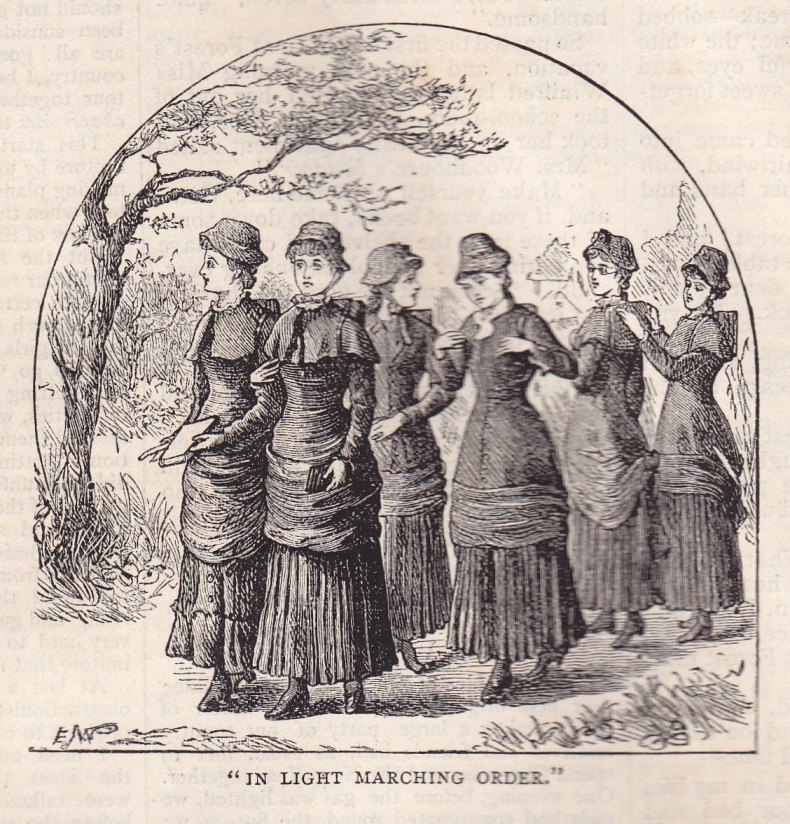
As we found our equipments all that could be desired, it may be interesting to mention what we took with us, and what we wore. We all had dresses of thin olive green serge, made quite short, and waterproofed to save carrying cloaks, quiet-looking hats of the same, and gloves to match, which, however, were generally discarded, except on occasions of ceremony; light, but strong, boots, and of course, woollen stockings. One of the party, who, fortunately  for the rest of us, looked much older than her years, was set up with a cap and spectacles, and would have looked quite an imposing chaperone had one been needed; but, as it happened, in every hotel we had the coffee-room to ourselves. As to luggage, we each took what we wanted in a knapsack, which we carried orthodoxly on our backs; but, on this subject, let me breathe a word of caution to any inexperienced walking-touristess. Do not take anything more than is absolutely necessary in a knapsack, its weight seems to increase amazingly as the day wears on; though, if not too heavy, one soon gets accustomed to carrying it; in fact, some of our party went so far as to say that they preferred carrying one to walking without. Also take care that your shoulder straps are broad enough. Mine happened to be rather thin and narrow, and my poor shoulders suffered much in consequence, so much so, that I was obliged to get some new straps put on at the first village boasting a saddler's shop. One of our friends had presented us with a charming little portable cooking stove, the weight of which was said to be so extremely small, that the one to whose lot it fell would hardly know she was carrying it, but alas! I chanced to be that one, and never for a moment forgot the fact that I had to carry; and last, but not least, we had a small pocket filter, which we found most useful.

The long-talked of Monday came, and I rose with the lark, so as to be at our appointed meeting-place in good time to start at nine o'clock. As I said before, we were to start "weather permitting"; but,  for the first half of the day, so far from permitting, the skies were decidedly forbidding, and we were obliged to wait a few hours in hopes of a change in the weather, so that when we did start, at half-past-one, the rain having ceased and the sun shining, we were constrained to take train as far as Dorking, to make up for lost time. Arrived there, and fairly outside the town, we shouldered knapsacks and set off, in light marching order, the vanguard consisting of the President and Pathfinder, the main body represented by the Poet and Artist, whilst the Treasurer and Secretary brought up the rear.

These titles, perhaps need a little explanation. I ought to have mentioned before that in making our plans we had deputed the eldest of our party to be Treasurer during the tour. She was to pay all the bills, and to keep a strict account of every penny spent. Very severe she was, never allowing any reckless expenditure on luxuries or souvenirs, and woe betide the rash individual who should even propose such a thing. Another of our number, officially known as pathfinder, acted as guide, carried the ordnance maps of the country, and informed us every evening how far we had walked during the day. Her tender feelings were sometimes lacerated when, at any perplexing juncture, some of the company insisted on taking the advice of local rustics in preference to trusting her and her maps I held the honourable post of Secretary. My duties were to despatch daily post cards to our friends reporting progress, to see that everyone duly wrote their diaries, and to keep a specially detailed one myself. So my work was really arduous; and why the secretary should have to carry the cooking stove I never could discover. Lest the others should feel injured at not holding any official position, we dubbed one Special Artist, and another Special Poet, apparently because this member never wrote a lien of anything but prose in her life. The remaining one installed herself as President, whose duties were of a vague and uncertain nature. After devoting our best consideration to the question, the rest of us concluded that the presidential avocations consisted solely in suggesting a rest every few miles.
 

Our first night was to be spent at Gomshall; the road thence from Dorking, though interesting in association and certainly pretty, does not call for special remark. One pleasing incident of the afternoon was our invaluable President's opportune discovery of a mill-pond, whereon lay a boat sheltered from the morning's rain by an overhanging tree, just at the time when we were all fain to confess that a few moment's rest would not be disagreeable. We were just comfortably settled in the boat, however, when a man, whom we took to be the owner thereof, was espied striding towards us, so, by way of having "first fire," two of our number started to meet him, and politely requested him to permit our resting in his boat He graciously assented, and we finished our siesta in peace.

We had agreed that on entering ay town or large village we would divide into two or three parties, and go in separately at intervals of a minute or two, so as not to attract the attention that all of us together might do, and also that two should always go forward and secure rooms at the hotels  for the night. But we need not have troubled ourselves about being conspicuous in Gomshall; for, although it being a tolerably large place, there was not a soul to be seen save one stolid villagers, who vouchsafed us not even a glance. After securing rooms, ordering tea, and depositing knapsacks, our irrepressible pathfinder insisted that we must go for a stroll, "to make up the mileage," whatever that may mean; so, with a few gentle remonstrances we started again. Picking our way up a remarkably muddy lane for some distance, we climbed a high mound on gaining the summit of which the president, who affects archaeological tastes, gaspingly requested a halt, ostensibly because the mound was artificial, in her opinion a Roman remain. We were nothing loth, and enjoyed the lovely view of fertile valley dotted with farm-houses and pretty cottages, which was spread out before us, whilst our chief diligently poked about amongst the gorse bushes, seeking, I suppose, for further proof of the Roman origin of the mound. After our tea came the writing of diaries, which process was so frequently disturbed by the portentous yawns of certain of the party, that it was thought well to bring our literary pursuits to an abrupt conclusion and to retire at an early hour.

Early next morning, just as the sun was rising, my companion and I were aroused from our downy slumbers by a vigorous hammering at our door, for we had given stringent orders to be called betimes, and the deaf chambermaid was determined to do her duty. When she was at last convinced that we were really awake, she repeated her laudable battery at all the other doors with so much success that in a short time we were ready to start.

"Really a very moderate bill," said our treasurer, complacently, as we set out; "and, if not luxurious, everything was, at any rate, clean and comfortable."

"Quite true as it happens," said the artist; "but I believe our respected treasurer would think the accommodation in a workhouse princely, provided the bill were small."

"I was under the impression," remarked our poet, with a fine air of innocence, "that board and lodging were provided gratuitously at those establishments."

"So I believe; and it's a splendid idea," cried the treasurer; "and, since you have suggested it, we will by all means go to the casual ward to-night at Farnham; it will be a great saving of money, and quite a new experience too." On the whole, however, as we disliked gruel, and did not know how to pick oakum, we decided not to act on our treasurer's suggestion.


This conversation brought us to the village of Shere, where there is an interesting old church, kept locked up, however, according to the foolish custom in England. The stairs to the gallery are outside the church, and there is a curious Norman doorway. Obtaining the key, which is itself a curiosity, being nearly as long as my arm, we entered and admired the fine modern window, old brasses, and other interesting objects.

We were all familiar with the Silent Pool, which lay about a mile away, and had often looked in wonder at its limpid depths of moonlight clearness, and had gathered the wild sweetbriar and forget-me-nots from its banks, so on this occasion we did not diverge from our path to visit the favourite spot, but proceeded at once by a field-path into a park, called, according to the map, "Albury," where our artist was in constant raptures at the lovely effects of sunlight on the trees, and the picturesque glimpses of hills beyond. She was also anxious for us to stop to admire some Channel Island cattle, but I was of opinion that in this case discretion was the better part of valour, and so did not pause until I was safe on the further side of the fence.

Shortly afterwards we were directed by our pathfinder to leave the high road and clamber up a steep grassy hill, as the top of which we should find "St Martyr's," or, as it is now called, "Martha's," Chapel. "Here," she said, when she had recovered her breath after the climb, "here the Canterbury Pilgrims, in whose steps we have been treading all day, used to stay for rest and prayer." "Oh, pathfinder," cried the president reproachfully, "you surely do not expect us to believe that they would come so far out of their way, and up this dreadful hill, to say their prayers and to rest, forsooth, when they could have done it just as well by the roadside." The pathfinder immediately prepared to prove by an overwhelming mass of authorities that the pilgrims much preferred hilltops for their resting-places; but her attention was diverted by the poet to the lovely view of verdant, smiling country, while the president proceeded to examine the chapel, and pronounced it "quite modern, and not very interesting." Notwithstanding this adverse verdict, the artist and I attempted to sketch the building and its few simple grave-mounds, but before we had succeeded to our satisfaction we were obliged to move on towards Guildford.

When we reached the outskirts of this "fine, neat, old town" (vide guidebook), we separated for a time, the president and treasurer going to buy the materials  for the out-of-door lunch, which was part of our scheme, the pathfinder and poet vanishing without any explanation, and the artist and I endeavouring to visit the Castle, which we had been told we ought to see. We found, however, that the keep was the only part remaining, and that was occupied by a party of school-boys, who informed us that visitors are no longer allowed to go over the place. We therefore rejoined the rest of our party in the lower part of the town, where we were just in time to witness the wrath of the treasurer, who had taken that spendthrift couple, the post and the pathfinder, in the very act of buying unnecessary oranges.

The president now appeared, laden with the various constituent parts of our lunch, and, after distributing the parcels as fairly as possible, we began to ascend the steep road which leads up to the Hog's Back.

A carter who was going the same way kindly offered to add our knapsacks to his load; but, as we did not fancy the look of it, we politely declined, and pretended that we quite enjoyed carrying our burdens.

The view from the Hog's Back is very beautiful and varied, with hills and dales, heathy ground, broad sheets of water and corn-field, mingled with park and pasture, but, unfortunately for pedestrians, the hedges on each side of the road are very high, so that it is only through a gap or a gateway that it can be seen. This made the walk rather monotonous, so, as we were all accustomed to singing in parts, and there was no one to be scandalised at such conduct, we cheered it with song" for a considerable distance. Then, and always, we found it a wonderful help when we were tired or the road was dull to unite our voices in any well-known ditty, the more spirited the better.

Before very long, however, we came to a most inviting bank, and all agreed that it would be foolish to pass by so good a chance of lunching in comfort.


We, of course, took off our knapsacks, and then set up the cooking stove, while one of us begged some water from a cottage near, the mistress of which, scorning our diminutive teapot, insisted on lending us a large pitcherful.

The poet, who certainly ought to have been writing an ode on the occasion, displayed a previously unsuspected genius for poaching eggs, and turning them daintily on to the slices of bread held to receive them. They were a great success, and though the tea had prismatic colours on its surface, from some peculiarity in the pot, which made most of the party decline to drink it, on the ground that it was poisonous, preferring to quench their thirst from the pitcher instead, on the whole we felt the first course of our first al fresco meal to be quite satisfactory. Bread and marmalade made a sumptuous second course, and we should also have had a slice of cake each, but  for the reprehensible conduct of the president.


We were sitting by the road-side, and we were intent on our cooking, so that none of us noticed, til they were quite close, that several cattle were being driven past. Suddenly the president screamed, and, leaping up, seized an umbrella with which to protect herself from her pet aversions, which she had just perceived. Her quick movement caused one of the cows to stop and look at her with mild and gentle wonder, which so added to her terror that when the drover made the animal proceed she thanked him effusively, and actually presented him with the remains of our cake, "as a reward," she said, "for saving all our lives." Our feelings were too deep for words, so she escaped the reproof she so richly deserved.

With little delay we returned the pitcher to its owner, and continued our march along the Hog's Back, pausing at every gap to gaze at the lovely view, and after several miles taking a short rest on a road-side hillock. We were soon astonished by an exclamation from the treasurer. "Poet," she cried, and that ingenuous damsel started as though accused of some fresh crime. "I beg your pardon. I retract all my protests against your purchase of the oranges. The dust of this abominably long road has nearly choked me, and the juice of your generous present will save me from suffocation."

"It is the distinguishable mark of a great mind to confess when it has been in error," said the poet gravely, "so, treasurer, I forgive you."

In her turn she produced an orange from her knapsack, and we were all following her example, in an attitude, I fear, rather of comfort than of elegance, when three young ladies most fashionably arrayed in lawn-tennis costume passed by, and, as we fancied, eyed us with lofty scorn. I hope they enjoyed their tennis as much as we did our oranges, but I hardly think it possible. The rest of the way to Farnham we walked without a halt, and at the ancient hostelry there we had time for a pleasant stroll in its pretty garden before retiring to our rooms, where we were speedily lapped in balmy slumbers, living over again in our dreams the lovely views and delightful events of the day.

(To be concluded.)