:/
OXTAIL SOUP
Ingredients – One oxtail, one large carrot, two onions stuck with cloves, one turnip, four sticks of celery, four mushrooms, half a parsnip, a bunch of herbs, two blades of mace, twelve black peppercorns, three ounces of butter, one dessertspoonful of red currant jelly, two quarts and a half of water, a wine-glass of sherry, three ounces of fine flour, salt.
Method – Wash the oxtail and chop it; put it in a saucepan and cover with cold water; bring to the boil and throw the water away. Fry the oxtail gently in the butter until it is a good brown; prepare the vegetables and slice them and put them in a saucepan with the oxtail, water, herbs, mace, salt and peppercorns; put on the lid and simmer gently for five hours. Strain the stock and skim off the fat; pick out the meat and put it aside to keep hot; pick out the vegetables and pound them finely, add the stock by degrees, return to the stove and reheat; melt the rest of the butter in a small frying pan and stir in the flour, fry it a good dark brown over the fire, stir in a little of the hot soup and add this thickening to the soup; add the sherry and red currant jelly and the pieces of oxtail, and serve.
KIDNEY SOUP
Ingredients – One pound of kidney, half each of carrot, turnip, onion and parsnip, two sticks of celery, one tomato, one bay leaf, one sprig of parsley, one dessertspoonful of Harvey’s sauce, a little browning, one quart of water or stock, one ounce of butter, pepper and salt.
Method – Wash the kidney and cut away any fat; cut it in dice and fry gently in the butter; prepare the vegetables, cut them in pieces and put them in a saucepan with the kidney, bay leaf, parsley, water or stock and salt. Put on the lid and let all simmer gently for four hours; strain off the soup, pick out the pieces of kidney and put them aside to keep hot. Return the stock to the saucepan, add the Harvey’s sauce and the browning; put back the pieces of kidney, reheat and serve.
MULLIGATAWNY
Ingredients – One large onion, one apple, one tablespoonful of good curry powder, one ounce of flour, half an ounce of grated cocoanut, a few drops of lemon juice, one dessertspoonful of red currant jelly, one dessertspoonful of chutney, salt, one quart of chicken or veal stock, three ounces of butter, one ounce and a half of cornflour, some well boiled rice.
Method – Skin the onion, slice it and pound it in a mortar; chop and pound the apple. Mix the curry powder smoothly with half a teacupful of cold water, melt the butter in a stewpan, stir in the curry powder and water and the pounded onion; cook and stir until the water cooks away and the onion browns in the butter; add the apple, cocoanut, chutney, salt and the stock (warm); put on the lid and simmer for half an hour; rub through a sieve, mix the flour with a little cold stock, re-heat the soup and when it boils stir in the flour; add the lemon juice and red currant jelly; hand well-cooked rice with this soup.

Showing posts with label 1898. Show all posts
Showing posts with label 1898. Show all posts
Wednesday, 6 November 2013

Saturday, 19 October 2013
26 November 1898 - 'Frocks for Tomorrow' by the Lady Dressmaker
Good news, the Amateur Swimming Association are close to deciding on the design of the regulation swimsuit! Also this month, dress is fitted and clinging to create a tall slender ligne, tre-corne hats should only be worn by the young and beautiful, puffy sleeves are gone, and flame-red orange is a popular colour in French millinery currently, though the French hats unfortunately don't suit the current trends in English hairdressing.
The first thing on my list with which I must deal is the recent meeting of the Amateur Swimming Association, at which the vexed question of a regulation dress for the women members was discussed; and there is a good chance that it will be wisely and properly decided so that there will be a regular uniform dress in future, and all misunderstanding will be avoided. The material to which the lady delegates appear to have given in their adhesion is stockingette; which they consider superior in every way to serge, flannel, silk or merino. A model costume made of it, shown by the Birmingham Ladies Club, was so much approved of by the large assembly of ladies present, that it was adopted as a guide, the fullest liberty as to trimmings being given, while only three colours were allowed, viz., navy blue, red and black. The Birmingham costume had flat facings of Turkey-red twill, but of course it is open to any club to select their own colours. It buttoned on the shoulders, and by means of gussets under the arms a short sleeve was formed. The great recommendation, however, was its cheapness, as it was announced that it could be produced in quantities of not less than one dozen at a fraction, over two shillings each, in the various sizes required by the wearers, Of course where there are so many working women’s clubs, this question of cost is a grave consideration. The costume finally recommended was much on this Birmingham model. With the additional advice that “it should reach, at least, to within three inches from the knee” should be cut square at the neck, and button on the shoulder, where it must be not less than thee inches in width, and where it must be shaped to the arm beneath, so as to form a short sleeve.
Now that swimming as a pastime has become so popular amongst women and girls, and when it is taught in so many schools, it is only wise to decide on a suitable dress, which can be modified to meet all views, and trimmed to please all wearers, and be attainable to limited purses, and above all, should be seemly to wear in a mixed assemblage of all ages.
Although we have worn the Eton jacket with more or less decoration for many years, it seems still to hold its own, and is very becoming indeed to many people. The same may be said of the Bolero fronts; both of these are braided and buttoned this autumn, and the braiding is generally in panels, while the buttons most used are of the fancy order. Basqued bodices with and without belts, three-quarter-length coats, quite tight to the figure, and a coat of the Directoire style, short at the waist in front, with a rounded basque and long coat-tails; all of these are in fashion, and, so far as I see, though all have basques, they may be long or short, according to individual fancy. The great desire of all women this winter is to present an appearance of height and thinness, and all draperies must be sweeping, and the outlines flowing, to meet with our approval. Flounces and frills are used with much discretion, so that they may not contradict the clinging effect. Skirts are, if possible, tighter than ever, and only show fullness at the feet, while as regards our sleeves, the last vestige of puffiness has deserted them, and not even a tiny pleat is permitted at the shoulder, and the whole appearance is that of the old coat-sleeve, which was originally introduced by the Princess of Wales.
Of course, with this clinging effect, we may naturally go on to say that the Princess dress that was worn by a few people last season will be adopted by many this winter; and the newest ones, if in cloth, have very generally strapped seams; the French Princess gowns having very generally a plastron, which is buttoned up on each side with handsome buttons.
In hats, we find the tre-corne much used in Paris; but this is a style only suitable to the very young, or very pretty, so that the wider brimmed felts are more generally popular. Many of the felt hats are made in two colours, the underpart being of a different colour to the upper, and very little trimming is used for them. Low-crowned hats of almost a sailor shape have been predicted, and the boat shape is one of the favourite winter models. Quills and wings have taken the place of the long and graceful ostrich feathers, the former being more suitable for winter weather; a large bow and ends, and jewelled buckles, form part of the trimming, and the hat-pins are sumptuously jewelled, and as every lady tries to select those that are most decorative to her hat or bonnet, they have become quite a feature in the head-dress of the day.
I spoke in my last chat on cloths, and dress in general, of the change that has taken place in the dressing of the hair, and that it is worn much lower; in fact in a coil that lies on the nape of the neck, the rest of the hair is waved in large waves, which lie regularly over the top of the head, and across it from ear to ear, while the front locks are curled over the forehead. The chief difficulty presented by this new departure is in finding a hat or bonnet to go with it; for all the French bonnets are made to go with the high rolled coiffure universally worn on the Continent, but never very becoming to Englishwomen who have good heads of hair and find a difficulty in producing the tiny knot of hair, which is the essential part of the high hair-dressing. The low knot is shown in our picture of the two figures representing the new winter gowns, and called “A Princess Dress of brown cloth”. These two gowns show exactly the prevailing styles of the winter.

I daresay you will have already seen though perhaps not quite relished the change that dresses are now worn with bodices of the same material, and the sketch in question displays this alteration in style. The seated figure wears a Princess dress of brown cloth, with revers of cream-coloured satin, one of which overlaps the other so far as to close the gown on the side of the front, and the band of cream satin is continued across the front and terminates in a scroll. The satin has a scroll pattern braided on it with brown silk braid, and the cuffs are decorated in the same manner. To those who contemplate having a Princess gown, I would say, be careful to choose a good tailor or dressmaker, and a firm material of which to make your dress, in order to avoid dissatisfaction with your gown.
The second gown is of green face-cloth. The bodice and sleeves are tucked with small horizontal tucks all over them. The skirt is one of the new ones, and is in three tiers, cut away from the front, and each is edged with a small band of chinchilla fur.

The second sketch shows a sac jacket of smooth blue serge, with a skirt to match. The jacket is beautifully braided and embroidered in black, both in front and on the shoulders. The hat is of blue felt, trimmed with blue velvet and feathers. The second figure wears a long basqued coat with a fur collar, and wide revers in front which taper down to the waist, and end in two tails. The cuffs are turned back in the new shape, and the collar is high and closes in front. The skirt worn is plain, and is cut in the umbrella style. The hat is a small velvet one, with fur trimmings and white or cream lace. The mixture of lace and fur indeed with all our winter trimmings this year is very remarkable, and contributes to the very light effect of all the millinery worn.
The pretty sketch next in order represents a gown made of one of the new fancy materials trimmed with chinchilla; cape of chinchilla trimmed with green silk and cream lace, and muff to match. The hat is a very charming model, which is called by some milliners a Trelawnley. It droops in front and is made of black velvet, found the crown a very handsome ostrich plume is laid, and under the brim of the hat is a cache peigne of pink roses. The new capes of this season are, many of them, pointed in front and back; and are often caught in at the waist behind. Violet cloth has been very much used for capes, and this is a colour that goes so well with fur of all kinds that it is likely to be popular. Where jackets are concerned, whether long or short in the basques, the latter must fit very snugly round the hips, without fullness, or they will not give the effect of the newest style. Many of the basques are added with a seam just below the waist, and are marvels of careful fitting.
There is a rather strong tendency to use a great quantity of orange in the French millinery; the hue of the moment being of the reddest and most vivid flame colour. The other colours in vogue for the same purpose are green, some shades of red, golden brown, wallflower and much blue in all shades. For capes and coats putty-colour and fawn are much used, and there is a large amount of white used for trimming.
I must not finish my chat without mentioning the ribbon trimmings which have so largely replaced lace, tulle and chiffon ruches, especially upon bodices and blouses. Skirts as well as bodices are ornamented with gathered ribbons. The prettiest effect is given by using two ribbons together, a narrow and a wider one. These may be of two different colours, or of black and white, the latter being placed on the top. Plain bands of ribbon edged with black velvet, or with baby ribbons gathered, are also much used; in fact there seems no style of design which cannot be turned to account in this decoration.
The first thing on my list with which I must deal is the recent meeting of the Amateur Swimming Association, at which the vexed question of a regulation dress for the women members was discussed; and there is a good chance that it will be wisely and properly decided so that there will be a regular uniform dress in future, and all misunderstanding will be avoided. The material to which the lady delegates appear to have given in their adhesion is stockingette; which they consider superior in every way to serge, flannel, silk or merino. A model costume made of it, shown by the Birmingham Ladies Club, was so much approved of by the large assembly of ladies present, that it was adopted as a guide, the fullest liberty as to trimmings being given, while only three colours were allowed, viz., navy blue, red and black. The Birmingham costume had flat facings of Turkey-red twill, but of course it is open to any club to select their own colours. It buttoned on the shoulders, and by means of gussets under the arms a short sleeve was formed. The great recommendation, however, was its cheapness, as it was announced that it could be produced in quantities of not less than one dozen at a fraction, over two shillings each, in the various sizes required by the wearers, Of course where there are so many working women’s clubs, this question of cost is a grave consideration. The costume finally recommended was much on this Birmingham model. With the additional advice that “it should reach, at least, to within three inches from the knee” should be cut square at the neck, and button on the shoulder, where it must be not less than thee inches in width, and where it must be shaped to the arm beneath, so as to form a short sleeve.
Now that swimming as a pastime has become so popular amongst women and girls, and when it is taught in so many schools, it is only wise to decide on a suitable dress, which can be modified to meet all views, and trimmed to please all wearers, and be attainable to limited purses, and above all, should be seemly to wear in a mixed assemblage of all ages.
Although we have worn the Eton jacket with more or less decoration for many years, it seems still to hold its own, and is very becoming indeed to many people. The same may be said of the Bolero fronts; both of these are braided and buttoned this autumn, and the braiding is generally in panels, while the buttons most used are of the fancy order. Basqued bodices with and without belts, three-quarter-length coats, quite tight to the figure, and a coat of the Directoire style, short at the waist in front, with a rounded basque and long coat-tails; all of these are in fashion, and, so far as I see, though all have basques, they may be long or short, according to individual fancy. The great desire of all women this winter is to present an appearance of height and thinness, and all draperies must be sweeping, and the outlines flowing, to meet with our approval. Flounces and frills are used with much discretion, so that they may not contradict the clinging effect. Skirts are, if possible, tighter than ever, and only show fullness at the feet, while as regards our sleeves, the last vestige of puffiness has deserted them, and not even a tiny pleat is permitted at the shoulder, and the whole appearance is that of the old coat-sleeve, which was originally introduced by the Princess of Wales.
Of course, with this clinging effect, we may naturally go on to say that the Princess dress that was worn by a few people last season will be adopted by many this winter; and the newest ones, if in cloth, have very generally strapped seams; the French Princess gowns having very generally a plastron, which is buttoned up on each side with handsome buttons.
In hats, we find the tre-corne much used in Paris; but this is a style only suitable to the very young, or very pretty, so that the wider brimmed felts are more generally popular. Many of the felt hats are made in two colours, the underpart being of a different colour to the upper, and very little trimming is used for them. Low-crowned hats of almost a sailor shape have been predicted, and the boat shape is one of the favourite winter models. Quills and wings have taken the place of the long and graceful ostrich feathers, the former being more suitable for winter weather; a large bow and ends, and jewelled buckles, form part of the trimming, and the hat-pins are sumptuously jewelled, and as every lady tries to select those that are most decorative to her hat or bonnet, they have become quite a feature in the head-dress of the day.
I spoke in my last chat on cloths, and dress in general, of the change that has taken place in the dressing of the hair, and that it is worn much lower; in fact in a coil that lies on the nape of the neck, the rest of the hair is waved in large waves, which lie regularly over the top of the head, and across it from ear to ear, while the front locks are curled over the forehead. The chief difficulty presented by this new departure is in finding a hat or bonnet to go with it; for all the French bonnets are made to go with the high rolled coiffure universally worn on the Continent, but never very becoming to Englishwomen who have good heads of hair and find a difficulty in producing the tiny knot of hair, which is the essential part of the high hair-dressing. The low knot is shown in our picture of the two figures representing the new winter gowns, and called “A Princess Dress of brown cloth”. These two gowns show exactly the prevailing styles of the winter.

Princess Dress of Brown Cloth
I daresay you will have already seen though perhaps not quite relished the change that dresses are now worn with bodices of the same material, and the sketch in question displays this alteration in style. The seated figure wears a Princess dress of brown cloth, with revers of cream-coloured satin, one of which overlaps the other so far as to close the gown on the side of the front, and the band of cream satin is continued across the front and terminates in a scroll. The satin has a scroll pattern braided on it with brown silk braid, and the cuffs are decorated in the same manner. To those who contemplate having a Princess gown, I would say, be careful to choose a good tailor or dressmaker, and a firm material of which to make your dress, in order to avoid dissatisfaction with your gown.
The second gown is of green face-cloth. The bodice and sleeves are tucked with small horizontal tucks all over them. The skirt is one of the new ones, and is in three tiers, cut away from the front, and each is edged with a small band of chinchilla fur.

Long Basqued Coat and Embroidered Jacket
The second sketch shows a sac jacket of smooth blue serge, with a skirt to match. The jacket is beautifully braided and embroidered in black, both in front and on the shoulders. The hat is of blue felt, trimmed with blue velvet and feathers. The second figure wears a long basqued coat with a fur collar, and wide revers in front which taper down to the waist, and end in two tails. The cuffs are turned back in the new shape, and the collar is high and closes in front. The skirt worn is plain, and is cut in the umbrella style. The hat is a small velvet one, with fur trimmings and white or cream lace. The mixture of lace and fur indeed with all our winter trimmings this year is very remarkable, and contributes to the very light effect of all the millinery worn.

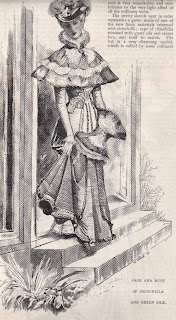
Cape and Muff of Chinchilla and Green Silk
The pretty sketch next in order represents a gown made of one of the new fancy materials trimmed with chinchilla; cape of chinchilla trimmed with green silk and cream lace, and muff to match. The hat is a very charming model, which is called by some milliners a Trelawnley. It droops in front and is made of black velvet, found the crown a very handsome ostrich plume is laid, and under the brim of the hat is a cache peigne of pink roses. The new capes of this season are, many of them, pointed in front and back; and are often caught in at the waist behind. Violet cloth has been very much used for capes, and this is a colour that goes so well with fur of all kinds that it is likely to be popular. Where jackets are concerned, whether long or short in the basques, the latter must fit very snugly round the hips, without fullness, or they will not give the effect of the newest style. Many of the basques are added with a seam just below the waist, and are marvels of careful fitting.
There is a rather strong tendency to use a great quantity of orange in the French millinery; the hue of the moment being of the reddest and most vivid flame colour. The other colours in vogue for the same purpose are green, some shades of red, golden brown, wallflower and much blue in all shades. For capes and coats putty-colour and fawn are much used, and there is a large amount of white used for trimming.
I must not finish my chat without mentioning the ribbon trimmings which have so largely replaced lace, tulle and chiffon ruches, especially upon bodices and blouses. Skirts as well as bodices are ornamented with gathered ribbons. The prettiest effect is given by using two ribbons together, a narrow and a wider one. These may be of two different colours, or of black and white, the latter being placed on the top. Plain bands of ribbon edged with black velvet, or with baby ribbons gathered, are also much used; in fact there seems no style of design which cannot be turned to account in this decoration.
Sunday, 21 October 2012
8 January 1898 - Hints on Home Nursing by M.D. Goldie
ICE is employed in various ways in illness as a remedy. The ice-bag is applied to the head in cases where there is severe pain, and to various parts of the body to reduce inflammation. If a proper bag is not at hand, a common bladder from the butcher may be used filled with ice broken up into small pieces, so as to lie on the part more comfortably; if a cork is placed in the centre it may be tied more securely. The ice-bag should be slung over the place so that the weight of the bag does not rest on the part, but just be in contact with it; a piece of folded flannel or lint should be placed under it so that the bag does not rest on the bare skin; it might cause gangrene without this precaution.
Ice is given to stop sickness, or in cases of haemorrhage from the lungs, a small piece is placed on the tongue frequently. Ice should be kept in large lumps if possible, and these ought to be wrapped in a flannel or blanket. When required to be kept by the bedside a piece of flannel is tied over a cup of basin, the ice resting in the centre, the water then runs, when melted, into a cup and prevents the ice from melting too quickly. A darning needle or bonnet pin is the best thing to break up the ice with, if a proper ice pick is not at hand.
IN CROUP place the child in a warm mustard bath. Give an emetic of one teaspoonful of vin ipecac in water, or if this is not at hand, an emetic of salt or mustard and water. After removing the child from the bath place in a warmed bed, and keep hot applications to the throat. If the spasm does not pass off put the child into a steam tent. See that the bowels are opened as soon as possible.
IN FAINTING FITS make the person lie down with the head lower than the rest of the body. Apply smelling salts to the nose, and throw cold water on the face. Allow plenty of fresh air, and see that the clothes are loosened.
A TOURNIQUET is made by a bandage or handkerchief tied over the pad, with a reef knot and a stick thrust in under the knot and twisted round until firm pressure is obtained. N.B. A tourniquet is only a temporary remedy, and must not be left on indefinitely.
IN CASES OF HAEMORRHAGE until you can get a doctor's assistance, (1) Make the person lie down and raise the bleeding part above the level of the body, and keep it at perfect rest. (2) Press the point of the thumb directly over the bleeding part until you can get help. (3) Wash the part with cold water. (4) Notice if the bleeding is from arteries or veins. The bleeding is from an artery when it is a bright red colour, and flows out in a rush; when from veins the blood is a darker purplish ed colour, and it flows out in an even stream. Place a pad on the bleeding point, and fix with a tourniquet if necessary.
Ice is given to stop sickness, or in cases of haemorrhage from the lungs, a small piece is placed on the tongue frequently. Ice should be kept in large lumps if possible, and these ought to be wrapped in a flannel or blanket. When required to be kept by the bedside a piece of flannel is tied over a cup of basin, the ice resting in the centre, the water then runs, when melted, into a cup and prevents the ice from melting too quickly. A darning needle or bonnet pin is the best thing to break up the ice with, if a proper ice pick is not at hand.
IN CROUP place the child in a warm mustard bath. Give an emetic of one teaspoonful of vin ipecac in water, or if this is not at hand, an emetic of salt or mustard and water. After removing the child from the bath place in a warmed bed, and keep hot applications to the throat. If the spasm does not pass off put the child into a steam tent. See that the bowels are opened as soon as possible.
IN FAINTING FITS make the person lie down with the head lower than the rest of the body. Apply smelling salts to the nose, and throw cold water on the face. Allow plenty of fresh air, and see that the clothes are loosened.
A TOURNIQUET is made by a bandage or handkerchief tied over the pad, with a reef knot and a stick thrust in under the knot and twisted round until firm pressure is obtained. N.B. A tourniquet is only a temporary remedy, and must not be left on indefinitely.
IN CASES OF HAEMORRHAGE until you can get a doctor's assistance, (1) Make the person lie down and raise the bleeding part above the level of the body, and keep it at perfect rest. (2) Press the point of the thumb directly over the bleeding part until you can get help. (3) Wash the part with cold water. (4) Notice if the bleeding is from arteries or veins. The bleeding is from an artery when it is a bright red colour, and flows out in a rush; when from veins the blood is a darker purplish ed colour, and it flows out in an even stream. Place a pad on the bleeding point, and fix with a tourniquet if necessary.
Tuesday, 16 October 2012
30 April 1898 - All About Water' by T.N.D. (The New Doctor?)
Water for domestic purposes is obtained from the following sources - rain, springs, wells, streams and rivers. In mountainous countries it is also obtained by melting snow.
Waters may be divided into hard and soft. If you have ever tried to wash with soap in sea-water you will have noticed that the soap will not lather, but as soon as it is dissolved it floats to the top as a greasy scum. It is a typically hard water. When washing in rainwater the soap lathers beautifully, therefore rain-water is a soft water. The degree of hardness of water is estimated by the amount of soap which is required to make a fine lather.
The hardness of water is of two kinds, temporary and permanent. Temporary hardness is removed by boiling and is due to the presence of bicarbonate of lime and magnesia. When water containing these ingredients is boiled, the soluble bicarbonates are changed into the insoluble carbonates, which deposit as the "fur" in kettles and boilers.
Waters may be divided into hard and soft. If you have ever tried to wash with soap in sea-water you will have noticed that the soap will not lather, but as soon as it is dissolved it floats to the top as a greasy scum. It is a typically hard water. When washing in rainwater the soap lathers beautifully, therefore rain-water is a soft water. The degree of hardness of water is estimated by the amount of soap which is required to make a fine lather.
The hardness of water is of two kinds, temporary and permanent. Temporary hardness is removed by boiling and is due to the presence of bicarbonate of lime and magnesia. When water containing these ingredients is boiled, the soluble bicarbonates are changed into the insoluble carbonates, which deposit as the "fur" in kettles and boilers.
Friday, 12 October 2012
21 May 1898 - Household Hints
DISCARDED tea cosies of a large size can be usefully employed to cover over hot water cans in bedrooms. The water can be kept hot for a long time if thus covered over.
CELLULOID balls and other toys, though very pretty to look at, should never be given to children, as they are highly inflammable and very dangerous.
NEVER slam an oven door if pastry or cakes are cooking in the oven - it will make them heavy.
DO not ever burn or throw away corks - they are valuable in many ways.
THE nicest way to eat an orange is to cut a slice off the top and scoop out all the juice with a tea-spoon; a spoonful of sugar can be put in the middle if the fruit is sour.
PINEAPPLE juice is said to be valuable in cases of diphtheria.
BOOTS and shoes should never be kept in a cupboard or box; they should be left where air can get freely to them, and whenever it is possible the insides should be aired.
SILK handkerchiefs are extremely nice to use, and a present of a few to an invalid would be very acceptable.
COCOA is always best made with milk, not water, and should be boiled, not merely made with boiling water.
NUTS and almonds are very nourishing food.
BEDROOM fires should be lit oftener than they are; it would save much illness and many colds, for it is when one goes to bed tired and weary after sitting in hot rooms that one is most apt to catch colds.
TOOTHBRUSHES should be occasionally placed in cold water with a little borax, sanitas or other disinfectant, and left to stand in it for a while.
CELLULOID balls and other toys, though very pretty to look at, should never be given to children, as they are highly inflammable and very dangerous.
NEVER slam an oven door if pastry or cakes are cooking in the oven - it will make them heavy.
DO not ever burn or throw away corks - they are valuable in many ways.
THE nicest way to eat an orange is to cut a slice off the top and scoop out all the juice with a tea-spoon; a spoonful of sugar can be put in the middle if the fruit is sour.
PINEAPPLE juice is said to be valuable in cases of diphtheria.
BOOTS and shoes should never be kept in a cupboard or box; they should be left where air can get freely to them, and whenever it is possible the insides should be aired.
SILK handkerchiefs are extremely nice to use, and a present of a few to an invalid would be very acceptable.
COCOA is always best made with milk, not water, and should be boiled, not merely made with boiling water.
NUTS and almonds are very nourishing food.
BEDROOM fires should be lit oftener than they are; it would save much illness and many colds, for it is when one goes to bed tired and weary after sitting in hot rooms that one is most apt to catch colds.
TOOTHBRUSHES should be occasionally placed in cold water with a little borax, sanitas or other disinfectant, and left to stand in it for a while.
Thursday, 11 October 2012
1 January 1898 - Answers to Correspondents - Medical Advice
KINDERGARTEN:- The "round lump" in your neck is undoubtedly a swollen gland, but it is necessary to discover the cause of it before considering what is the right treatment. Inflamed glands in the neck may be secondary to bad teeth, sore gums, sore places inside the mouth, inflamed or enlarged tonsils, sore throat of various kinds, sores on the face or head, and, lastly, to tuberculosis. It is only in this last case that it is commonly necessary to operate, and it is not always necessary even in this case. Bad teeth, sore gums and enlarged tonsils are the commonest causes of swollen glands. Have you any one of these? If so you should treat the primary condition and the gland will subside. If you have been told by a competent surgeons that the gland must be cut out by all means consent to have it done at once. It will leave a small and insignificant scar, whereas if left to nature the gland may break down and discharge its contents, in which case a ragged very unsightly scar will be left.
QUEEN RUVANI:- You seem to be very much more annoyed at such a trifling ailment as blushing than there is any call for. At your age it is natural for all girls to blush. A great many girls of fourteen blush whenever they are spoken to, but they outgrow it in a few years and you will do likewise. It is nothing to worry yourself about. Not only do we allow very young girls to write to us, but we encourage them to do so if we can help them in any way.
STAMMERING:- (an answer to 'ANXIOUS ONE", 'A SICKLE" and others) - It is impossible for anyone to say what is the primary cause of stammering. We cannot even say for certain whether it is an affection of the voice box, or the lips or of the brain. Sometimes we can point to some obvious unhealthy condition of the vocal organs as the cause of stammering, for the symptom goes when the local condition has been cured. but in the vast majority of cases, no morbid condition is anywhere to be discovered. IN such cases what is the cause of stammering? WE do not know for certain, but in all probability it is due to a condition of the mind. Habit has a lot to say in the production of this exceedingly tiresome defect. The habit of speaking rapidly without thought,and of clipping words is a very important cause of this condition. The cure of stammering is often a most difficult affair, but occasionally a very trifling matter. If there is any obvious defect anywhere in the vocal organs that must be seen to first and probably the stammering will cease. But how are we to proceed when no local cause can be discovered? Always speak slowly and carefully and never slur or clip your syllables. AS a rule you will find that you only stammer over one or two sounds. These differ in almost every case. The commonest letters to stammer over are P, D, R, I, M, N and K. Every person who stammers must find out what letters she has difficulty with. Then she must educate herself. Reading aloud to one's self is the best way to do this. But read carefully, distinctly and attentively, and work till you have mastered the letters that gave you trouble.
QUEEN RUVANI:- You seem to be very much more annoyed at such a trifling ailment as blushing than there is any call for. At your age it is natural for all girls to blush. A great many girls of fourteen blush whenever they are spoken to, but they outgrow it in a few years and you will do likewise. It is nothing to worry yourself about. Not only do we allow very young girls to write to us, but we encourage them to do so if we can help them in any way.
STAMMERING:- (an answer to 'ANXIOUS ONE", 'A SICKLE" and others) - It is impossible for anyone to say what is the primary cause of stammering. We cannot even say for certain whether it is an affection of the voice box, or the lips or of the brain. Sometimes we can point to some obvious unhealthy condition of the vocal organs as the cause of stammering, for the symptom goes when the local condition has been cured. but in the vast majority of cases, no morbid condition is anywhere to be discovered. IN such cases what is the cause of stammering? WE do not know for certain, but in all probability it is due to a condition of the mind. Habit has a lot to say in the production of this exceedingly tiresome defect. The habit of speaking rapidly without thought,and of clipping words is a very important cause of this condition. The cure of stammering is often a most difficult affair, but occasionally a very trifling matter. If there is any obvious defect anywhere in the vocal organs that must be seen to first and probably the stammering will cease. But how are we to proceed when no local cause can be discovered? Always speak slowly and carefully and never slur or clip your syllables. AS a rule you will find that you only stammer over one or two sounds. These differ in almost every case. The commonest letters to stammer over are P, D, R, I, M, N and K. Every person who stammers must find out what letters she has difficulty with. Then she must educate herself. Reading aloud to one's self is the best way to do this. But read carefully, distinctly and attentively, and work till you have mastered the letters that gave you trouble.
Friday, 5 October 2012
5 February 1898 - Useful Recipes
Cosmetics! And a recipe for toothpaste!
ORIENTAL FACE CREAM:- Six grains of powdered tragacanth, six drams of pure glycerine, nine ounces of triple rosewater. Mix well, and add two drams of simple tincture of benzoin. This makes a splendid white emulsion which leaves no greasy stain upon the skin.
HAIR RESTORER (IN POWDER):- Two drams of pure sugar of lead, three drams and a half of pure milk of sulphur, five grains of powdered cinnamon. Mix. To be added to twenty ounces of rosewater.
LAVENDER PERFUME FOR SMELLING SALTS:- Six drams of oil of lavender aug., five drops of oil of cloves aug., ten drops of oil of rose geranium, ten drops of attar of roses, one dram and a half of essence of ambergris, two drams of essence of bergamot, one dram and a half of essence of musk. Mix and shake well before dropping on the salts.
MACASSAR OIL.:- Ten ounces of oil of sweet almonds, three drams of oil of bergamot, two drams of oil of rose geranium, sufficient alkanet root to colour. Digest.
COCA TOOTH PASTE:- Four ounces of powdered precipitated chalk, three ounces of powdered orris root, one ounce of powdered white soap, half an ounce of powdered cuttlefish, two drams of powdered carmine, half an ounce of tincture of coca leaves, thirty drops of oil of ligu aloe, thirty drops of oil of peppermint, five drops of oil of castarilla, sufficient pure glycerine to make a paste.
BLOOM OF ROSES:- One dram of pure carmine, one dram and a half of strong solution of ammonia, three drams of pure glycerine, one dram and a half of white rose triple perfume. Sufficient triple rosewater to make up four ounces; rub up the carmine with the ammonia and glycerine, add an ounce of rosewater, and heat to drive of traces of ammonia. When cold add the white rose and make up four ounces with rosewater, and filter.
FRECKLE LOTION:- One dram of sulpho-carbolate of lime, two ounces of pure glycerine, one ounce of spirits of wine, one ounce and a half of orange flower water, three ounces and a half of triple rosewater. Mix well; to be applied morning and evening, and also after exposure.
LIME JUICE AND GLYCERINE:- Two drams of white curd-soap, two ounces of distilled water, eight ounces of fresh lime-water, eight ounces of oil of sweet almonds, one dram of oil of bergamot, half a dram of oil of lemongrass, half an ounce of essence of lemon. Well mix the oil and the lime-water in a large bottle, dissolve the soap in the distilled water by aid of heat, add the solution to the emulsion, shake well, and lastly add the essential oils.
MOUTH WASH:- Half an ounce of salts of tartar, four ounces of honey aug. opt., thirty drops of peppermint, thirty drops of oil of wintergeen, two ounces of spirits of wine, ten ounces of triple rosewater, sufficient liquid cochineal to colour. Mix well. To be used morning and evening.
WHITE HELIOTROPE:- (A) One dram of heliotrope, one ounce of extract of jasmine, one ounce of extract of white rose, two ounces of extract of ambergris, sixteen ounces of spirit of wine. (B) Thirty drops of oil of bergamot, three ounces of extract of neroly, three drops of essential oil of almonds. Mix. Allow (A and B) to stand separately for a week, then mix them and filter.
ORIENTAL FACE CREAM:- Six grains of powdered tragacanth, six drams of pure glycerine, nine ounces of triple rosewater. Mix well, and add two drams of simple tincture of benzoin. This makes a splendid white emulsion which leaves no greasy stain upon the skin.
HAIR RESTORER (IN POWDER):- Two drams of pure sugar of lead, three drams and a half of pure milk of sulphur, five grains of powdered cinnamon. Mix. To be added to twenty ounces of rosewater.
LAVENDER PERFUME FOR SMELLING SALTS:- Six drams of oil of lavender aug., five drops of oil of cloves aug., ten drops of oil of rose geranium, ten drops of attar of roses, one dram and a half of essence of ambergris, two drams of essence of bergamot, one dram and a half of essence of musk. Mix and shake well before dropping on the salts.
MACASSAR OIL.:- Ten ounces of oil of sweet almonds, three drams of oil of bergamot, two drams of oil of rose geranium, sufficient alkanet root to colour. Digest.
COCA TOOTH PASTE:- Four ounces of powdered precipitated chalk, three ounces of powdered orris root, one ounce of powdered white soap, half an ounce of powdered cuttlefish, two drams of powdered carmine, half an ounce of tincture of coca leaves, thirty drops of oil of ligu aloe, thirty drops of oil of peppermint, five drops of oil of castarilla, sufficient pure glycerine to make a paste.
BLOOM OF ROSES:- One dram of pure carmine, one dram and a half of strong solution of ammonia, three drams of pure glycerine, one dram and a half of white rose triple perfume. Sufficient triple rosewater to make up four ounces; rub up the carmine with the ammonia and glycerine, add an ounce of rosewater, and heat to drive of traces of ammonia. When cold add the white rose and make up four ounces with rosewater, and filter.
FRECKLE LOTION:- One dram of sulpho-carbolate of lime, two ounces of pure glycerine, one ounce of spirits of wine, one ounce and a half of orange flower water, three ounces and a half of triple rosewater. Mix well; to be applied morning and evening, and also after exposure.
LIME JUICE AND GLYCERINE:- Two drams of white curd-soap, two ounces of distilled water, eight ounces of fresh lime-water, eight ounces of oil of sweet almonds, one dram of oil of bergamot, half a dram of oil of lemongrass, half an ounce of essence of lemon. Well mix the oil and the lime-water in a large bottle, dissolve the soap in the distilled water by aid of heat, add the solution to the emulsion, shake well, and lastly add the essential oils.
MOUTH WASH:- Half an ounce of salts of tartar, four ounces of honey aug. opt., thirty drops of peppermint, thirty drops of oil of wintergeen, two ounces of spirits of wine, ten ounces of triple rosewater, sufficient liquid cochineal to colour. Mix well. To be used morning and evening.
WHITE HELIOTROPE:- (A) One dram of heliotrope, one ounce of extract of jasmine, one ounce of extract of white rose, two ounces of extract of ambergris, sixteen ounces of spirit of wine. (B) Thirty drops of oil of bergamot, three ounces of extract of neroly, three drops of essential oil of almonds. Mix. Allow (A and B) to stand separately for a week, then mix them and filter.
Wednesday, 3 October 2012
29 January 1898 - Answers to Correspondents - Medical
MARJORIE:- Decidedly you suffer from dyspepsia, and a very troublesome form of that complaint. that you found "quinine and iron" made you worse we readily believe. We have given advice to many girls suffering the same way as yourself; and also we have published two articles dealing with the subject of "indigestion" and food. The first article was called "Indigestion" and appeared in the December part of THE GIRL'S OWN PAPER. The second, entitled "Food in Health and Sickness" appeared in the beginning of last year. The two papers will tell you almost everything you require. You should eat very little farinaceous food, and above all things avoid tea, coffee, potatoes, cheese and pastry.An alkaline stomachich taken before meals would relieve excessive acidity.
MEASLES:- You say that when you return home from a walk "a red rash comes out all over your face". We would like to have been told whether this occurs only during the winter or windy weather, or at all times of the year. You are quite right to wear a veil. You have used all the common applications, but we will suggest one which apparently you have not tried - "Lanoline", a fine white cream. Be careful about the soap you use.
STELLA:- As blisters in the feet are caused by illfitting boots, the first thing to do to get rid of them is to look to your footgear. To make the blisters heal if they have burst, wash your feet every morning and evening in warm water, and then thickly cover the raw places with powdered boracic acid. When you have raw places upon your feet, to whatever cause they may be due, wear white stockings and change them immediately they are soiled in the slightest degree.
MEASLES:- You say that when you return home from a walk "a red rash comes out all over your face". We would like to have been told whether this occurs only during the winter or windy weather, or at all times of the year. You are quite right to wear a veil. You have used all the common applications, but we will suggest one which apparently you have not tried - "Lanoline", a fine white cream. Be careful about the soap you use.
STELLA:- As blisters in the feet are caused by illfitting boots, the first thing to do to get rid of them is to look to your footgear. To make the blisters heal if they have burst, wash your feet every morning and evening in warm water, and then thickly cover the raw places with powdered boracic acid. When you have raw places upon your feet, to whatever cause they may be due, wear white stockings and change them immediately they are soiled in the slightest degree.
Tuesday, 2 October 2012
30 April, 1898 - 'Frocks For Tomorrow' by The Lady Dressmaker
In which the Lady Dressmaker expresses her opinion that Englishwomen aren't likely to take to the new fashion of smoking and reminds us that decorating hats with dead bird parts is ugly and cruel. Includes pictures.
On all sides I hear that there is to be a great revival of those fashions of the "forties" in which flounces and pelerines and mantles all flourished together; and I have no doubt that those who go in for extremes will find plenty of them. It seems likely, however, that we shall all have a choice, and that plain skirts will flourish beside those covered with flounces.
The tightness of the upper part of the skirts is something wonderful to see, but round the feet they run to four or even five yards round. And, after all, they are not ungraceful, and the flounces even may be arranged to make us look slight and tall, for they are not as those of old, gathered on the skirt and so rendered bunchy and ugly; they are in general cut so that they are of the same width, and so can be put on with no fullness at all. The number of trimmed and tucked skirts is very great, and the trimmings follow no special rule, but run vertically, horizontally, or across, just at their own sweet will, or rather that of the dressmaker who put them on. One of the new styles of trimming is seen in the rouleaux, which are either gathered, or plain, over cord. Folds of material and tucks are generally worn, and braiding of all kinds. Some of the tucks are quite astonishing; they are so very tiny, and so beautifully done, especially where the new blouses are concerned. The folds of material vary in width from half an inch to three or four inches.
On all sides I hear that there is to be a great revival of those fashions of the "forties" in which flounces and pelerines and mantles all flourished together; and I have no doubt that those who go in for extremes will find plenty of them. It seems likely, however, that we shall all have a choice, and that plain skirts will flourish beside those covered with flounces.
The tightness of the upper part of the skirts is something wonderful to see, but round the feet they run to four or even five yards round. And, after all, they are not ungraceful, and the flounces even may be arranged to make us look slight and tall, for they are not as those of old, gathered on the skirt and so rendered bunchy and ugly; they are in general cut so that they are of the same width, and so can be put on with no fullness at all. The number of trimmed and tucked skirts is very great, and the trimmings follow no special rule, but run vertically, horizontally, or across, just at their own sweet will, or rather that of the dressmaker who put them on. One of the new styles of trimming is seen in the rouleaux, which are either gathered, or plain, over cord. Folds of material and tucks are generally worn, and braiding of all kinds. Some of the tucks are quite astonishing; they are so very tiny, and so beautifully done, especially where the new blouses are concerned. The folds of material vary in width from half an inch to three or four inches.
Subscribe to:
Posts (Atom)