Showing posts with label fashion. Show all posts

Monday, 20 February 2017

25 June 1881 - 'Seasonable Dress and How to Make It'


This month we learn that the Little Black Dress was as integral a part of a woman's wardrobe a century ago as it was today. 

Last month we mentioned the pretty old-fashioned ginghams had returned to fashion under the name of "Zephirs," and that they fully retained their former qualities of excellent wear and washing. Since then we have seen some charming dressed of pink, both plain, striped, and checked, which we must mention in the first instance. We always think how pleasant it is to be young, and to be able to wear a pink dress; they seem so becoming and suitable to the brightness of the fresh springtime of youth, that one feels glad when they are in fashion; and we like to clothe our human flowers with some of the lovely hues that our Maker uses for His "flowers of the field." Flowers and young girls should ever resemble innocence, purity and beauty.

These pretty dresses should be simply made. Both last month and this we have given suitable sketches for them – and the gatherings at the neck, sleeves, and front form a very pretty style. Nottingham lace is a good trimming for them, or Swiss embroidery; but they are quite as often made up with plaitings of the same, or bias bands turned up as a border, and sewn down on the outside with the sewing-machine. The bodices are made full, and gathered at the waist and neck, like the small figure in the June number.

The present seems to be an excellent time for purchasing black silks at moderate prices, and as a good black silk is unquestionably one of the best and most serviceable of dresses that any woman or girl can have, much care should be exercised in its selections. As far as we can see, about 5s per yard should purchase silk of good quality and wear, and there are several of the very best London drapers who both sell and recommend black silks at this price. We advise, when it is possible, that everyone who requires one should go to some well-known shop, and be guided by the advice there given in choosing. Very thick, ribbed, heavy silks should be avoided, and one of lighter texture be selected, as bright-looking on the surface as can be found. An old lady of our acquaintance used to choose black silk by holding it up to the light. If it looked of a greenish hue the silk was a good one, and she knew it would wear well. Another friend of ours takes up a fold of the silk between her finger and thumb, and, pressing it, makes a crease. If the crease should come out easily the silk is a good one; but if it remain, or should make a whitish mark, beware of purchasing it. We have ourselves found, however, that at a good draper's they will usually recommend a good article. Of course we make up our black and other silk dresses just now under great advantages, false or foundation skirts being used, generally made of alpaca, on which the silk may be suitable mounted as trimmings, kiltings, scarves and draperies; so we save the silk to the extent of four or five yards. Ten or twelve yards are nor generally sold for an ordinary short costume, so if we manage to make it at home, it will be seen that a black silk gown is within the reach of a very modest purse.

From an American source we glean a very clever and economical idea – i.e., that of having several plastrons or fronts to our "one black silk," which completely change its appearance, and give us walking, dinner, and evening dresses in one gown. The dress must, of course, be made en princesse in front, or the plastrons cannot be buttoned on. It forms the front of the bodice, and the apron or front breadth of the skirt, and is edged with button-holes if the buttons be on the dress, or hooks and eyes if preferred. One plastron may be of black velvet, edged with lace, or plain; high in the neck, and finished by a black lace frill. Another, for evening wear, might be of red, old gold, or violet satin, covered or trimmed with black or white lace, opening square or heart-shaped at the neck. A third might be of puffings or gathers, in damasse silk, brocade, or satin, to make it into a simple yet stylish walking-dress. A cuff or trimming  for the sleeves may also be arranged to match each plastron, such as a pair of long velvet cuffs to button on over the sleeves, with the black velvet one; or a pair of puffed sleeves to be sewn in with the coloured evening dress. The buttons may be of jet, and if they to be attached to the bodice and skirt they will do for every plastron.

Amongst the great boons to our clever readers, who are able to help themselves in trimming and altering dress, the fashionable Madras muslin must be named, a material which can be made useful in so many ways and over so many styles of dresses. The last time we saw an old black silk "done up," Madras muslin was the material used, and several of the pretty self-coloured sateens f last year have been remodelled this season with the aid of a few yards of this moderately-priced stuff. For an old half-worn coloured silk it is the very thing, and with a scarf tunic and draperies, gathered and puffed sleeves, and front, it becomes quite a new dress.

The fashion of coat bodices of different materials is a very useful and convenient one. They are made of velvet, velveteen, velvet broche, striped and chessboard velvet and satin. These last are all cheap now, as they are gone out of fashion, and the present stock is all reduced. Steel or silver buttons, or jet ones, are pretty, and no other trimming is requisite with them. We have recently seen some young ladies in the park in coat-bodices of red, or dull crimson cloth, with tiny gold buttons. These are worn with black silk, satin velveteen, or well-trimmed cashmere skirts. Also with cream-coloured and any fancy sateens which have red in the pattern. Perhaps this idea may be considered a happy one for a tennis club uniform, or a dress for the frequent lawn-tennis garden meetings, which constitute the chief amusement of the summer.


The Alsatian bows seem very great favourites with young girls, as well as older ones; and we have seen several very pretty turn-down hats decorated with one of these graceful bows on the top of the crown. They also form the great ornament of the favourite "Granny" and "Under the window" bonnets, which seem to be worn everywhere excepting in London.

Our illustration gives a lively party of girls enjoying themselves in a shrubbery. The dresses are all useful and pretty summer ones, which nearly any girl could arrange for herself. The figure standing by the table, with her hand upon it, wears a gingham, or zephyr costume, of pale blue, the trimmings being of Swiss embroidery. The bodice is gathered in front at the waist and on the shoulders; the sleeves are in rows of fine puffs all the way down; the over-skirt consists of two pointed shawl-shaped corners.

The second figure is made of cashmere and satin, the polonaise being of cashmere and the skirt of the same, trimmed with longitudinal plaitings of satin. The cape is of closely gathered satin, and is edged with a beaded fringe. The hat is a very small straw one with undulating wavy edges, and a spray of fern leaves, roses, and black velvet at the back.

The third figure wears a Mother Hubbard cloak of cashmere to match her dress, while the dress of number four is a brown beige, made up with a plaided or "shepherdess checked" beige of a darker colour. The hat is of white straw, trimmed with brown velvet, and brown ostrich tips shaded to yellow.

The young lady who holds a branch, and faces the reader, is the wearer of one of the pretty old-fashioned gowns which have been revived from the fashions of our grandmothers. Any light-washing material may be chosen for it. Each of the four flounces are headed by a puffing of the same, with a very small amount of fullness. The bodice is full, and has a band on the waist, while the pretty fichu is crossed over it, which fastens at the back. The small leather satchel which hangs at the side represents one of the newest and most fashionable shapes in which they are worn.  It is made of yellow leather, and has a leathern girdle, to hang round the waist.


In the second illustration, we find an old lady and a very little girl; both are intended as suggestions; for, in spite of ours being a girls' paper, there is no doubt but that our readers include many who are no longer girls, and a considerable number of mammas who are glad of a small bit of advice. The cloak of the elderly lady is of silk or cashmere, and that of the little girl a "Mother Hubbard" of grey beige, with trimming of blue. However foolish-looking we may think them as garments, there is no doubt that little girls do wear them, and look very well in them too, but they are only suited to the promenade and the park, and for very best Sunday habiliments.


The illustration given of a cloak is one suitable to any age, and which is worn by quite young girls. They sometimes match the dress material, or are of black cashmere and satin, or of satin only. A thin material like grenadine will probably be used as the summer advances, if it should prove pleasant and warm.

The shaded or ombre satins, and aerophane crapes are much used  for the tops of toque hats, and they are very pretty indeed, as well as becoming. The gathered edges of the hats are made of black velvet.

Friday, 6 January 2017

21 May 1881 - 'Seasonable Dress, and How to Make It'


Welcome back! 

The prevailing tendency of the summer materials is towards extreme softness and lack of "dress." Everything hangs in graceful folds, and more drapery is used than has been seen for some time past. Gathers, or as they are now called, "reevings," form the most popular way of making up all the thin materials, such as nun's cloth, grenadine, zephyrs, or ginghams, as they were once called. The little girl's dress in our monthly illustration shows the newest and prettiest way of making in this manner. It is gathered at the neck, waist, and sleeves, and the style is as suitable to sixteen and eighteen summers as to six. The "zephyr cloth," or old-fashioned gingham, is, as it always was, a delightfully pretty and becoming dress for all ages, and from its excellent washing and wearing qualities is extremely economical, and it costs from 1s 2d to 1s 4d per yard. It is made in pink, blue, and a soft grey. The favourite trimming for it now is one of the Nottingham or "Calais" laces, which are coarse in texture, but very strong, and wear well even for children, while they are moderate in price, and do not add to the trouble of washing.

The numbers of non-washing materials prove how useful they were found to be last year, and though the patterns are improved, the way of making up a figured sateen or print, with a plain petticoat and trimmings, is unchanged, the ground of the former being generally chosen as the colour  for the latter. This style is a great help to those who have old summer dresses to alter and enlarge to suit growing girls, because if the old dress be figured, a plain sateen, gingham, or cotton can usually be found  to go with it. A small bodice can be enlarged by putting in a gathered front and back, and a circular collar-like piece can also be added at the neck to increase the length. A puffing at the shoulder and elbow will give length to the sleeve, and the skirt may be lengthened by means of a kilted flounce at the edge. A little consideration and cleverness are needed to make these changes, but I hope that the readers of THE GIRL'S OWN PAPER have improved so much in the art of dressmaking during this last year that they will be able to accomplish any alterations required. Of the excellence of their needlework there can be no doubt, as it is sufficiently proved by the work sent in to the "plain needlework competition."

Dresses ornamented with crewel embroidery are as much used as ever, although the manner of its application has slightly changed. The embroider is applied to a pointed plastron down the front of the bodice, or to a circular yoke at the neck, into which the top of the bodice is gathered. An embroidered band is also used, and similar bands on the sleeves, with narrow puffs in the centre of every second band.

The long "Newmarket coat," as it is called, shown upon the second figure, supplies the most stylish shape for ulsters of light summer cloth, and also for those useful dust cloaks which are made either of thin tweed, pongee, or tussore silk, or alpaca of quiet colours. For travelling their use is nearly imperative, as they protect the dress from being utterly ruined by the dust and blacks of the railway and steamer; while for those who walk much, or have to make shopping expeditions at home, they are equally useful. The turndown hat that is worn by this figure shows a quiet ladylike shape for morning wear.

The third figure wears a handkerchief dress of summer alpaca, or a thin woollen nun's cloth. The method of making is clearly shown. As these handkerchiefs can be purchased separately at so much a piece in all good drapers' shops, they form an economical means of doing up old dresses, for which the style of the illustration might be adopted as a guide. The handkerchiefs require no trimming, and are simply hemmed round, either by machine or hand.

The fourth figure shows the present style of the jersey, which continues to be worn by young girls, but not by married nor older women. This jersey is of dark blue merino, very thin in texture, the overskirt being a plain shawl-shaped scarf, tied at the side; the under skirt is of plaid. The material is a very light tweed, the colours dark blue, green and threads of yellow and red. The plaids used are of the most quiet and modest description, and they are in keeping with the present quiet taste in colour. This figure wears a "Mother Hubbard," or more properly a "Grannie" bonnet. These will be made to match the summer dresses, and are gathered, or drawn in deep puffs in front, the crown being high and loose. The last new shape of this kind is called "Under the Window," and is copied from one of the bonnets in Kate Greenaway's book.

The summer costume worn by the young lady gardening may be made of sateen, cotton, batiste, or pique, and is trimmed round with Swiss embroidery. It is made with a full bodice and waistband. The skirt is decorated with two kilted flounces. A small coarse straw hat is worn with it, trimmed with India muslin and Valenciennes lace. Capes, resembling the top of the "Mother Hubbard cloak," are made for all washing dresses. The stockings and gloves are of plain colours, and will probably be worn to match the costume by those who can afford them. Dark blue stockings with coloured clocks are excellent for summer use, and if carefully washed in tepid, or even cold water, they do not lose their colour, but they must be wrung out till perfectly dry to avoid a "streaky" appearance, and look better if rinsed in salt and water.

Oxford shoes are worn, as usual, this summer, and are the most economical foot-gear for those who are obliged likewise to think of their pence. Care should always be taken to avoid extremely pointed toes, as no style could be more unbecoming, or injurious to the foot. The shoes should be selected of a long and rather narrow shape, instead of being very short and broad. Greater comfort will ensue if this rule be followed.

Galatea stripes have returned to fashion, the material being rather thinner than it was formerly. Plain blue is used  for the petticoats and trimmings; and the "sailor costume," a kind of loose blouse, is the favourite way of making. Very large round collars of lace or Swiss embroidery are much worn by all young people. Some very recent novelties are made of a plaid gingham, the edges being trimmed with Swiss embroidery – these would certainly keep the longest.

The most sensible, as well as the prettiest garments for every day out-of-door use for girls of all ages are the long, closely-fitting jackets made of black, grey, navy or drab stockingette cloth.

They are untrimmed save  for the buttons, and the neat rows of machine-stitching around them, and have collars at the necks. No hoods appear to be worn with them, and their whole appearance is most becoming and simple. Parasols and sunshades are made to match the cotton and sateen dresses, in pretty pompadour and Japanesque patterns, but those of our readers who must think of economy should select a parasol with a black ground, and any colour about it must accord with the principal dresses they are in the habit of wearing.

Saturday, 3 December 2016

30 April 1881 - 'Seasonable Dress and How to Make It' by Dora de Blaquiere

This month, please wear warm underclothes even though the season has turned, the in colours of the season (blues and rich reds), and remember to pepper your furs before putting them away until next winter. 

Spring – with its violent and sudden changes, its storms and sunshine, which alternate so quickly as to render it most difficult to know "what to wear," even in our daily walks – is certainly the most treacherous and dangerous of all the seasons of the year. To young people, full of movement and life, it is especially so, as they more easily get overheated, and are more easily tempted to throw off winter clothing than their elders. A family physician of more than usual common sense, used to say in our hearing, years ago, that "flannel and merino underclothing should be left off on the 30th of June and put on on the 1st of July again," showing that in his experienced mind the wearing of warm underclothing must be the rule, not the exception. And so we advise all our young readers, even in summer, to wear some light-warm woollen material near the skin, and to adopt our old friend's advice about the non-dismissal of it at any time in the year.

We have spoken before now on the importance of an even temperature being preserved all over the body, and the great advantage the new combined underclothing gives in this way especially. All underpetticoats that are heavy and ungored should now be altered our dismissed, and others substituted which are light, warm, and well gored, and possess a deep well-cut yoke. The present excellent fashion of short dresses bids fair to prevail for some time, and there is a simple and very easy method of buttoning on a train below the flounce at the back, by which a morning dress can be turned into an evening dress with no trouble. Both dresses and sleeves, too, are wider, and so there is no need of endeavouring to preserve the ungainly, ugly fashion of extremely "tied back" skirts and skeleton arms.

In the methods of making there is extreme latitude allowed, for every style of bodice is worn – the polonaise, prettily draped, and buttoned or laced either at the back or the front; the cuirass bodice, and the coat bodice, which will be worn much as it was last year, as a sufficient to-of-door covering when the weather is warm enough. They are made in the same way, but the fronts are sometimes made in extremely long points, the back being something like a coat.


The three-figure illustration shows the present way of making girls' simple walking costumes. AT figs.1 and 2, the first wears a dress of serve, trimmed with velveteen, the colour of the serge being a golden brown, called *tete de faisan (pheasant's head), the velveteen being of a darker shade, and the woollen ball-fringe rather lighter, to match the serge. This figure wears a draped polonaise, with a scarf of velveteen below the waist, velveteen cuffs, and collar, and two leaf-shaped pieces of velveteen that fall below the polonaise over the two small flounces of the skirt. The hat is of dark brown felt, with trimmings o plush, and a feather tip of the lighter shade of the dress.

Fig.2 wears a dress of blue vigogne; the underskirt is of silk, or merino, with bands of galloon; the overskirt, which is of vigogne, opens in front, and is draped back on one side; the bodice has a plain long basque, edged with galloon, and buttoned down the front; the hat of blue straw, with a trimming of grey-green leaves to suit the colour of the blue, and a plush lining of grey-green, which shows above the forehead, where the bonnet turns up.

The third figure shows the new method of making the habit bodice this season. The fronts are pointed, the narrow basque being continued above the hips to the back, where it is pointed to match the front.


Fig.4 is a charming girl's dress, which is especially adapted to the altering and remaking of old dresses. The material of the illustrated costume was a basket-woven beige, the bodice and sleeves being trimmed with a plaid material of silk and wool; the "Black Watch" tartan, one of the new fancy French checks, being, any of them, very pretty. This idea may be carried out  for the mending and making up of old black dresses; the figured or checked material will then look best to be of old-gold and black, or red and black. The balayeuse, or kilting, should be either of old gold or red.


The bonnet illustrated at fig.5 is a small fancy straw, lined with a shaded silk, the strings being of the same. The flowers are those of the spring, which are peculiarly suited to the use of young girls – the daisy, the snowdrop, and the violet, to add a little colour to the group.

The new spring colours must not be forgotten. Yellows and browns, both together and alone, seem to be the favourite hues of the day, and a very pleasant mixture they prove. Then comes a lovely blue hue called *saphir, which, with *bleu de ciel and turquoise blue, will be much used all the summer. A beautiful red, called by many names, will be much worn; it resembles a cardinal, but is deeper and richer, and reminds one of the red which in those fierce and warlike days of the Franco-Prussian war the French introduced and named *sang de Prusse, with questionable taste. Then there are greys and drabs, without number, and a beautiful dark hue called *cassis, which is copied from the red currant and bears its French name.

All kinds of straw bonnets are worn, and all descriptions of shapes. Many girls choose the "grannie" bonnet, which was also worn last year, and indeed, Miss Kate Greenaway's pictures have pretty well used us to quaint old-fashioned poke shapes for young girls, and very pretty some of them look. There are plain white straws also, which exactly resemble some worn by our great-great-grandmothers, trimmed with plain blue ribbon which almost makes them into the bonnet of the little charity girls, or the queer shape worn at the Foundling Hospital.

Belts and bags of yellow leather and others of plush have been brought out for the use of young girls, and very useful and pretty they are. The fashion of wearing belts and buckles and gathered bodices is more becoming to young figures than to old ones, and they have one great advantage, they are easily made and fitted at home.

Capes of several shapes are to be worn, the prettiest of the new ones being the "Mother Hubbard, which is exactly like the top of the cloak of that name, cut off where the sleeves are put in, just at the elbow. The gathered top and the bow at the back with the high frill are all very graceful, and this cape, though small, gives much additional warmth in the chilly days of late spring. The cape and pointed hood of the Red River voyager and the Eskimo have also been copied for one o our new spring hoods, and very becoming they are. These little capes are easily made at home, and are much newer than the sleeveless jackets which have been worn so long.

Quantities of silk and thread gloves with many buttons are prepared  for the spring and summer.  For the benefit of those who do not know how to wash them, we will give an excellent way: Place the gloves on the hands and wash the hands with borax water or white Castile soap, as if you were really washing the hands. Rinse in fresh water, and dry as much as possible with a towel, keeping the gloves on until they are about half dry. Then take them off carefully, and fold them up so that they may look as nearly like new gloves as possible. Lay them between two clean towels, and press them under a weight.

And now we must give a few lines to the important subject of taking care of the winter clothes that we are about to lay aside  for the summer months. Furs must be shaken and well beaten with a small rod, so as to get all the dust and dirt out, as well as the eggs of the moth, which may be laid in them already. When this is doe, pepper them well with strong white pepper, and wrap them in linen, putting them away, if possible, in a tin box.

In regard to winter clothing, it is absolutely needful that it should be put away clean, and well brushed and beaten, if it is to be preserved from moths. All the greasy and dirty spots should be taken out, and in folding up the utmost care should be taken. A tablespoonful of spirits of ammonia or of hartshorn added to a teacupful of boiling water, covered up and allowed to cool, is an excellent mixture for taking out grease. Apply with a bit of sponge or flannel before quite cool, rubbing the spot briskly, having first brushed the dust well out of it. Rinse with a little clean water, and rub dry with a piece of the same as the dress, if possible. Dry in the air or in a sunny window. If the grease has not disappeared, go over again in the same manner, being careful to rub the same way as the nap of the materials. This recipe will take out grease, sweet or sticky spots, or anything that has not taken out the colour of the fabric.

Thursday, 24 November 2016

23 April 1881 - 'Aprons'

I'm guessing that for the working class, aprons didn't actually appear between the 18th and 17th centuries. Just saying.

There is nothing so pretty as an apron for home wear. It seems to give an air of pleasant homeliness to the wearer, and at once stamps her character s careful, economical, and exquisitely tidy – qualities which she will surely carry into everything she undertakes in life. She is perhaps a little precise too, which will show itself in punctuality as to time, and as to business-like habits in keeping her engagements, and we feel nearly sure that the apron-wearer will neither disappoint, nor vex us with any unreliability. The word itself is a strange blunder, being "a napperon" converted into "an apperon", - napperon being the French for a "napkin," from nappe, "cloth". In many counties in England it is said that the word "apperon" is still used.

Perhaps the most interesting part of the apron is its extreme antiquity. It appears to have been worn from the Fall until the present day In our own country Strutt, who wrote on the "Dress and Habits of the People of England," gives an illustration of it as used in his time, the thirteenth century. His picture shows us a blacksmith at work, in an apron precisely similar to the leathern one still worn. It is tied round the waist, and thence rises to the breast, which it completely covers, and is secured round the neck by a tie. This shape had been in use long previously by women, and continued so long afterwards. It was also worn at that date by the upper classes as an ornamental addition to the dress. In the fourteenth century the apron was called a "barme cloth" in England, and in "The Miller's Tale" Chaucer gives a description of it as worn by the carpenter's wife. She wore –

"A barme cloth, eke as white as moe milk,
Upon her lendes, full of many a gore."

These many gores are thought to mean "plaits," or perhaps gathers, which were done in the way we now call "honey combing."

After this period the apron was confined to good housewives in the country, until the sixteenth century, when the ladies took them again into favour as articles of decoration; and used them of so fine a texture that a poet of the day says –

"These aprons white, or finest thread,
So choicilie tied, so dearly bought,
So finely fringed, so nicely spread,
So quaintly cut, so richly wrought;
Were they in work to save their coats,
They need not cost so many groats."
- Stephen Gosson's "Pleasant Quippes for Upstart Gentlewomen," 1596

These aprons were edged with lace, and one of them may be seen on the monumental effigy of Mistress Dorothy Strutt, in Whalley Church, Essex, who died in 1641.

In the days of King William III, they again became an indispensable part of a lady's dress, and were very small, edged round with the finest and most costly lace, and covered the top of the petticoat, the front of which was fully displayed by the open gown then in use. Good Queen Anne herself wore an apron later on, and in her reign they were richly decorated with needlework, gold lace, and spangles; and occasionally these ornaments formed a framework for a small picture, which was painted on satin and sewn on the apron. One of the aprons of this date, which has descended to me from an ancestress, is in my possession, and is a beautiful example of needlework. The ground is of white silk, the apron being about half a yard square. The border is of leaves in coloured silks, and vines and flourishes round them in silver thread and cord. The fineness of the work is a subject of wonder to all who see it. It was worn under the pointed bodice, and they sometimes had a stomacher to match in colour.

In George II's reign they were worn very long and quite plain, without lace or ornament, but occasionally fringed at the end. The material seems to have been white muslin or lawn. A curious anecdote is told of these aprons. It appears that Beau Nash, the Master of Ceremonies and the celebrated "King of Bath," had the strongest aversion to them, and excluded all ladies who ventured to appear at the Bath assemblies dressed in that manner. In Goldsmith's "Life of Nash" it is said that "at one assembly he went so far as to strip the Duchess of Queensberry's apron off, and, throwing it down on one of the back benches, declared that none but abigails appeared in white aprons." How strange a picture of the mixture of rudeness, and extreme ceremony in the manners of that day!

Short aprons of cambric were worn in full dress in 1788, and after that we do not hear of aprons being much in use until 1830 to 1850, when all ladies wore them, made generally of black silk, and though decorated and ornamented in various ways, they were not the entirely useless articles of dress of the preceding century, but were intended to combine the useful and the ornamental.

A great revival of aprons took place when art needlework commenced to be applied to them about the year 1874. Since then they have been in constant use  for the household-work and lawn-tennis, and they will in all probability retain their hold on our fickle fashions for some time to come; but whether this be so or not all young girls should make a practice of wearing them, as they add much to their appearance both at work and at play.

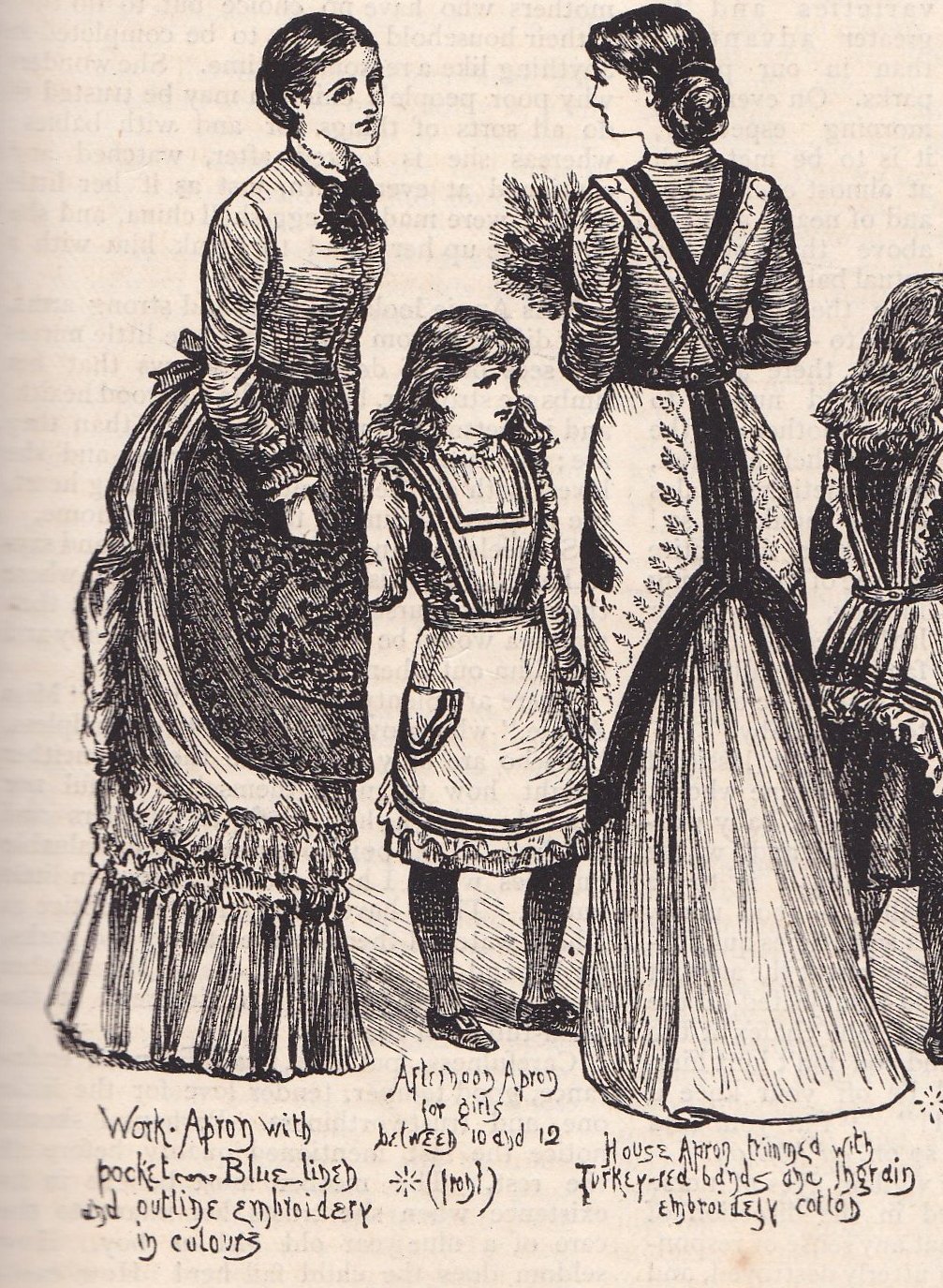
In our page of aprons we have tried to gather together all that is prettiest and most useful, too, of the modern styles, and in order to please every one of our girls we have taken all materials and aprons for all seasons and events.


The first three may be called "dress," or afternoon aprons, and they are suitable for that time of day when we are all supposed to have done work, and put on our best frocks. The first apron is of white muslin or nainsook; it has a gored centre, and two gores at the sides, and is trimmed with tatting and muslin puffings. The little girl's apron is of the well-known princess shape, and may be made of any white washing material, from muslin, to a figured brilliant or jaconet, trimmed with embroidery. The third figure wears a charming apron, both in style and trimming. It is of mull muslin, or Victorian lawn, trimmed with frills of the same, and a fancy-coloured washing braid.


The next two figures give the back and front of a housekeeping, and cooking apron, which is made of a coloured printed cotton, or a sateen, those with a white ground being the most suitable. It is edged all round with a frill of the same, and has a large pocket which may be placed either at the side, or in front, as the wearer pleases. The next figure wears a useful house-apron, which completely hides the dress, and so is equally valuable to protect a new or to hide an old one. The material may be unbleached Barnsley linen, brown Holland, or any of the new fancy materials, such as oatmeal cloth. The bands are of blue linen, with an appliqué pattern in vine leaves of Turkey-red cotton or cretonne flowers. Plain bands may be used.


The work-apron with a pocket will prove an immense comfort to those who do much needlework or knitting, as not only does it hold the balls of yarn, the cotton, scissors and needles, but the work itself can be safely put away in it, to be found in order for an immediate start when taken up again. The material of our illustrated apron is blue linen, with outline or cross-stitch embroidery in coloured ingrain cottons. The little girl's apron with a bib and bretelles, or shoulder straps, is a very pretty and stylish pattern, the back being especially effective. Any material, from muslin to silk, may be used, the pattern given being made of muslin, with a muslin and lace frilling, and three rows of narrow black ribbon, velvet all round, which of course requires to be taken off when the apron is washed. The young lady's house-apron is perhaps the most useful and practical of all. It is made of workhouse or Bolton sheeting, and has bands of Turkey-red twill laid on, and sewn down with the sewing machine. The little design above is worked with red and blue ingrain cotton. The front resembles that of the little girl's, but the shoulder straps cross behind instead of coming down straight to the belt.


The Roman apron is the newest of all that we have illustrated. It is made of fine unbleached linen, or it may be of pure white. It is cut lengthwise, and is about one yard and a half long, and folded over nearly half a yard from the top. The strings are sewn in under the fold three inches from the edge on each side. The decoration consists of two rows of embroidery, which may be done in drawn-work, cross-stitch, or even in crewels. The ends are fringed and then knotted evenly, and the sides are hemmed up. The width of the apron is three-quarters of a yard. The next apron is also called a Roman apron, although not doubled over at the top. It is made of black silk and is twenty-four inches long by twenty wide. The length is increased by the addition of the trimming and lace to over three-fourths of a yard. The trimming consists of strips of red, blue or white linen, worked in a border design of cross-stitch with ingrain cotton. The lace is an ordinary inexpensive lace, sewn on with very little fullness.


The small design at fig.1 is intended to give an idea of the new darned work, which has been revived from the seventeenth century styles of embroidery. The material used is huckaback; the price about 10d per yard. The ends are fringed, and the unworked end is turned over, like the usual Roman apron, the lower part alone being worked. The design chosen is a conventional pomegranate, from a series of designs lately published, which are copies of ancient needlework. The pattern is traced, and worked first in outline stitch in blue filoselle, which should be split to three strands only. The background is then put in by darning from every one of the double threads which appear on the surface of the huckaback. The square is, of course, traced first to keep it even in working. The colours chosen may be all blue, blue in two shades, yellow  for the grounding, and red for the outlining, or even a mixture of tints, if great cleverness be exercised in doing it.

The only apron I have left unnoticed is that in the well-known handkerchief style, which has now become so common, and is so cheaply purchased, that it has passed beyond the ken of our more artistic workers.


Monday, 24 October 2016

19 March 1881 - 'Mourning Attire' by S.F.A. Caulfield

The outward symbol of affliction has been dignified with the name of the reality which it so feebly portrays. In the reality, and in its external shadow, I find a rather extensive subject for our consideration.

It has been a necessity of our pour human nature to give vent to feelings of distress in some manner from the earliest period of the world's history, ever since the day that sin "brought death into the world, and all our woe." And in the history of nations - as in those of each individual being, from the cradle to the bier - various in character have been the expressions of mortal anguish when "it must have way."

It is my intention to take a three-fold view of the subject: historical, sentimental (in the best sense of the term) and practical, and further, to consider the case of those who find satisfaction in wearing black garments; those who find none in so doing; and those who, desiring to wear mourning, have not the means to purchase it.

The Israelites use dot fast and weep and rend their garments, clothe themselves with sackcloth, hair-cloth, or coarse black or brown cloth. They sat in ashes, threw them on their heads, tore and cut off their hair and their beards, smote on their breasts and tore them, made loud wailing, and went barefoot and bareheaded. All the time of their mourning they sat at home or went to mourn at the grave, and ate whatever they allowed themselves on the ground, their faces being covered. They further gave vent to their misery by leaving their beds unmade, abstaining from the use of a bath, and all the duties of the toilet. It was, of course, impossible to protract a mourning of this description, and the ordinary limit was restricted to a week, but extended to a month on special occasions. Contemporary nations used to "cut themselves with knives and lancets," and gave vent to loud, and what we should regard as extravagant grief; and, as we are informed in a Holy Writ, they "made themselves bald  for the dead" (Jer. XVI, 6, 7).  The mourning by Joseph and the Egyptians for Jacob was of seven days - "a great and very sore lamentation;" and in the Book of Daniel, tenth chapter, three weeks are named as a period for mourning. From what the prophet Zechariah tells us, it would seem that men and women used to part company on such occasions, and give vent to their sorrow. They "put on mourning apparel," and abstained from their "anointing with oil." (See 2 Sam, XIV, 2.) It was also a custom to hire public wailing women to mourn after a complimentary manner, just as we hire "mutes" to wear black, and long black or white bands from their hats, and scarves. See Jer. IX, 17, 18 where "mourning and cunning women" are mentioned; as likewise in the prophecies of Amos V, 16, where persons "skilful in lamentation" are named.

I spoke just now of "the cuttings" made in evidence of grief  for the dead by the ancient Israelites as not being peculiar to them. The custom of self-bleeding obtained amongst the Greeks, and also the Turks, and the cicatrices left  for the remainder of life served as mementoes of the departed. As to the Lacedaeomonians, they used to tear the flesh from each other's foreheads with pins and needles in honour of deceased monarchs. The making bald also was by no means peculiar to the Israelites and their contemporaries,  for the Greeks and Romans cut off their hair, as an offering of what they greatly esteemed, to a deceased relative; and sometimes it was laid upon the grave. The whole Greek army would do the same in honour of a much esteemed general. It was also their habit to retire into solitude, and to throw ashes on their heads, under which circumstances it was well that they did cut off their hair; and as natural also that they wore a veil whenever they appeared in public. Their dress was of black. The early Peruvians had an unpleasant prejudice in favour of pulling out the eyebrows and eyelashes as an offering to the dead; and in savage tribes of modern times the sacrifice of the hair, more or less, much prevails, as amongst the Carib and Dakota tribes of North America. The former sacrifice their long and precious scalplock, which is plaited down their backs, as the utmost expression of their respect and utter distraction; and the latter also cutting short, like their slaves and captives, that in which they glory. I have read of some uncivilised tribes who make their expression of grief a still more unpleasant affair, that of cutting off a joint of a finger. Indeed, the devotion of the Greeks to the memory of their commanders is thrown into the shade by some of these aboriginal tribes, whose magnates gave orders that a hundred fingers should be cut off to do honour to the memory of a chieftain just deceased.

The colours adopted in various parts of the world to express respect  for the dead have been various. We derived our idea from the Romans, who wore a black toga for mourning, and sometimes left it off altogether  for the same purpose. So far as the men were generally concerned, the colour did not change either under the Empire or the Republic, but under the former the women wore white, under the latter dark blue - a colour adopted by some of the men.

The Egyptians, in all probability, gave the custom of hiring "wailing women" to sing and lament, and beat tambourines, divested of the tinkling metal plates, to the Israelites. Two or more were engaged to mourn for an hour at a time. Strange to say, the colour adopted by them for their mourning is yellow.

In Turkey they adopt blue or violet, in China and Japan white, and in Ethiopia brown. In Bokhara they wear purple, as we are informed by Thomas Moore, in "Lalla Rookh."

"Not glittering o'er
With gems and wreaths, such as the others wore,
But in that deep-blue, melancholy dress,
Bokhara's maidens wear in mindfulness
Of friends or kindred - dead, or far away."

But throughout Europe, the United States of America, and our own colonies and dependencies, black is universal for deep mourning; and grey, or black with a little admixture of white, for slight mourning.

I have now reached the second division of my subject - the sentiment, which supplies the origin of all external exhibition of grief, whether of a positive or negative character.

I have related many extraordinary customs very uncongenial to our feelings, but it must not be supposed that hypocrisy was necessarily exhibited; for, custom having prescribed certain observances, to devote time, care, self-mortification, and money to their accomplishment was surely an indication of genuine respect of affection. And, however barbarous the ceremony, it might have indicated as much genuine feeling as the shedding of quiet tears unseen at home. Few of us "creatures of habit," as we are bound by the prejudices of our friends, care to be remarkable, any more than less civilised nations, by acting after a contrary fashion to them.

But, without scandalising them, a considerable amount of personal freedom is conceded to all. And, moreover, "necessity has no law;" and the pecuniary circumstances of one person might permit of much indulgence in the outward expression of distress, while those of another allow of little or none. It is scarcely possible to find two leaves alike on the same tree; and so even among members of the same family features and characters vary too. Therefore as others differ from us in disposition, we must check all unkindly criticism, misjudging of motives and personal vain-glory. There may be no difference whatever in the depth of feeling between the individual who is shrouded in crape, and one who wears but the most trifling expression of mourning; experience continually proves the fact that each alike may -

"...have that within which passeth show."

A strong prejudice against the wearing of black is consistent with great strength of feeling, yet those who entertain it are too often misjudged. In their behalf I would observe that there are no black flowers in Nature, although there are sombre hues. Still there is nothing really black in the beautiful garment with which our world is clothed. Even the firmament above it, though inky-dark at night, is wondrously glorified and gladdened with its stars. I have known a great lover of the beauties of Nature who mourned  for the loss of one beloved for years so acutely that she could scarcely endure to speak of that bereavement, even to the day of her death. And yet she had such an objection to being wrapped in black attire that she omitted to wear it on some occasions when custom required its adoption. A sincere feeling of sorrow was veiled under an ordinary garb, for she wished to look up from the narrow bed, where her dear ones were laid, to their happy place of rest beyond the charnel house, and to shake off as much as possible all depressing influences that her mind might be the more absorbed in thoughts of the beatific vision of the hereafter. In reference to these mourners after a fashion of their own, I may quote the words of one who had studied human nature more closely than most of his fellows -

"'Tis not my inky cloak, good mother,
Nor customary suits of solemn black
That can denote me truly...
These but the trappings and the suits of woe."

At the same time our sympathies may be as tenderly and truly enlisted in behalf of that still larger company feeling a necessity for a vent for grief. Like the outburst of tears and convulsive sobs, that medium  for the relief of the nerves provided for all living, so the adoption of a sable garb supplies something of consolation to mankind in general. And then if some appear to outstep the limits of ordinary custom, in the amount of their crape and the duration of its wear, we must not be censorious, and charge them with affectation nor even with folly. Leave them alone and undisturbed for a season. Let it suffice for you to know that the hand of God is upon them, how heavily, for their state of mind, of health, of nerves, of faith, He only and they themselves can realise. Doctors will sometimes prescribe crying, even aloud, under a certain amount of mental and physical strain. The nerves demand an "opening of the floodgates." The bereaved ones must be left to turn their sad faces to the wall, and to unburden their hearts for awhile unrestrained. "The heart knoweth its own bitterness," God only knows it as well. "In all their affliction He is afflicted," of whom it is recorded, when, in a scene of mourning -

"Jesus wept!"

It is a gracious act of Christian charity to supply those of your poor friends or relatives, lacking the means to purchase them, with a black dress, bonnet, or out-door covering which their position in life would demand on such an occasion. For amongst these indigent persons there are those who would derive much consolation from showing outward marks of respect for their loved and lost; and none are so keenly sensitive, as a general rule, as poor gentlefolks, who struggle to keep up a certain appearance suitable to their birth, both because they wish to associate with their own connections, and because they would rather bravely struggle on under unseen privations, than prove a burden to their relatives, however, unintentionally. "Withhold not thy hand" in such cases as these. Light up the poor wan faces with a gleam somewhat akin to a smile, by helping them to vent their sufferings in some little external exhibition, in harmony with the "shadow of death" brooding within. In Nature the heavier the shower, the sooner the break in the cloud, the clearer the light, and the warmer the sunshine that follows - a meet emblem for that calm that succeeds a stormy grief, in trustful anticipation of the blessed "clear shining after the rain," and that "reaping in joy" of "those that sow in tears" - "sorrowing after a godly sort." Show no impatience. Let them give free vent to their trouble in their own way, having this consummation in view.

I have now arrived at the third and last portion of my subject - the practical part of so-called "mourning." To many a few hints may prove of service.

As to the length of its duration  for the several relationships in life, there can be no fixed and unalterable law. A widow, however, could not, with ordinary propriety, leave off her "weed" under a twelvemonth; nor should deep mourning be left off for a parent under that time. A year is not too long to wear it for a brother or sister; but under any circumstances no change should be made from the first deep crape until six months have elapsed. From three to six months for an uncle or aunt would be within ordinary rules, unless under special circumstances, of early residence under the same roof, or close relations of much affection or obligation. There is a paltry affectation of mourning which is very objectionable for women for a two-fold reason, because, while acknowledging the wearer's feeling of obligation to wear it, the least possible expense and trouble are conceded to that feeling. Better make no sign at all, than one so poor and mean. I allude to the wearing of a band of cloth or crape round one arm, the wearer being otherwise dressed in colours. The second objection to this "freak of fancy" is that it is an aping of a masculine style. In many respects men are allowed more license than women, and often wear a coloured overcoat, if not entire suit, together with crape on the hat alone. Women are hedged about by stricter rules; they are expected to show a greater semblance of grief in family troubles, and to shed tears more freely. Thus, to show any hardness or indifference to the usages of society, is to throw off a certain amount of feminine propriety and tenderness, at once unnatural and repulsive. Wear a black bonnet or hat, and black gloves, in lieu of that strap round one arm; and your ulster, though not a black one, may be worn by as true a mourner, and as true a "lady," as any in the land.

All mourning should be plain, without ornamental trimmings. A widow's dress may be nearly or altogether covered with crape. Paramatta and crape-cloth are suitable for widows, and these, with cashmere, grenadine, camel's hair cloth, and barathea may be worn in mourning for other connections; white for slighter mourning, whether of widows or others. Plain black lustreless silk may be worn trimmed with crape. Plain grey stuff trimmed with black are suitable for slight mourning; also crepe lisse collars, serge, nuns' cloth, and mohair. For inexpensive mourning cashmerette and alpaca can be worn. Even in deep and expensive styles a slight introduction of white may be permitted; and, for economy's sake, widows may cover their white cuffs with single crape, to keep them clean. Satin, lace, and fringe must be excluded from the black dress worn as deep mourning, either for a husband or very near relative.

The only material exclusively appropriated to mourning is crape, and this is a most expensive item. Only the best in quality is worth purchase, as the inferior kinds wear badly. The former may be renovated. To persons to whom a certain amount of economy is an object, I advise that crape should be reserved for a best dress, and for out-of-door wear; and that a perfectly plain dull black material should be adopted for home wear, and for an ordinary walking costume. French people do not wear crape, except for bonnet and veil. They consider that a plain black crape-cloth which may be sent to a laundress  for the common washing, a black woollen shawl, and black woollen gloves - not kid - are full mourning. I also recommend all those who are not wealthy, and who feel themselves under weightier personal obligations than those of "encouraging trade," to have one black dress always on the list of their wardrobe, which will be ready on any emergency, and save some outlay when, perhaps, their purses may ill afford to make it. Such a dress might be worn with equal propriety out of mourning, as it has of late years been so much disassociated with it, if only worn with some coloured article.

And while on the subject of crape I should not omit to tell you that, since it has been known that arsenic is employed in the dyeing of this material, people are less disposed to wear it constantly, and some even send it to go through the process of renovation when quite new, as by this means all that is injurious is abstracted: and it is, moreover, rendered impervious to damp. A crape bonnet no longer new may be restored to its original condition, without being taken off the frame, nor even removed from a silk lining. But were the latter of any other material, the removal would be necessary. If a warmer material than cashmere be desired, merino may be a good substitute. Sealskin fur, black lynx, or sable jackets and cloaks, muffs, and collars may be worn in the very deepest black with perfect consistency, but not as mere trimmings; and chinchilla is a good selection for a slighter degree of mourning, but where not very deep, any fur may be worn the price of which may render it suitable  for the means of the wearer.

This last observation reminds me to add a few words for those of my readers whose slender resources preclude their indulgence in what would be to them so great a solace in their affliction. Genuine grief will make itself quite apparent without intentional effort, or any external exhibition in the colour of the dress, at least, to all those whose intimacy, or near relationship would make that sorrow a matter of any interest. Thus no disrespect to the dead will be charged by them to the amount of your coloured dress. And if to add a few black ribbons to your bonnet - in lieu of some faded trimming of a different hue - and one dark outer covering, be all the attempt within your power to make, to conceal your ordinary dress when out of doors, do not fret over your inability to do more. That poor black ribbon tells as much on behalf of your loving remembrance, as the costly and elegant costume a wealthy neighbour may purchase, who consoles herself by the greatest outlay her ample means may afford. Think of it as the utmost that the wise providence of God permits you to do. He who regarded the widow's mite as more than all that of the rich, of their abundance, had cast into the treasury, because it was "all that she had." Could your lost ones revisit your dwelling, they would but say approvingly, "She hath done what she could." Besides, as a matter of principle, it is wrong to purchase mourning when the money is due for rent, taxes, or other responsibilities, or when required for outlay on clothing essential for warmth, or for suitable food for yourself, or your family.

I have now no more to say on the question which we have under consideration, unless it be to remind you of the somewhat remarkable example left us by David, when he lost his child. While he yet lingered in life, the King fasted and wept and prayed; but when God took him, he "washed his face and anointed his head," and, laying aside all external expression of grief, he resumed his public duties. Few could act thus; yet the example is worthy of consideration, as well as that recorded in the sixtieth chapter of the prophecies of Isaiah, twentieth verse, referring to that blessed hereafter, when -

"The days of thy mourning shall be ended."

Wednesday, 5 October 2016

19 February 1881 - 'Seasonable Dress and How to Make It'


A few seasons ago the backs of our dress bodices were ornamented, or, perhaps, rather disfigured, by either six or seven seams, two or even three side forms, and a back seam being the ordinary number. Now as we have once again reverted to the old style of one centre seam, as, although three joins are allowed, the best cut dresses show only the centre one, the other being brought so far under the arm as to be practically invisible. This change will be a great comfort to the amateur dressmaker, and will be an encouragement to those of "Our girls" who aspire to make their dresses at home. In fact, if the promised change should be brought about, of having no seams under the arms at all, the work of manufacturing a bodice will be quite reduced to half the usual amount. The spring models seem to portend a reduction in the seams of our sleeves as well, for some of them have no join on the outside, from the shoulder to the elbow, the top and under parts of the sleeve, so far, being cut in one piece. Of course, below the elbow the shape could not be retained if there were not a seam both at the back and the front. The sleeve is set as high into the bodice as ever, as everyone still appears to wish to look square-shouldered and narrow-backed. Of course, a certain amount of adherence to the prevailing fashions, so as to avoid attracting attention, is desirable, but we trust that all our young readers will avoid extremes in this, as in all other matters connected with dress. Of course, the natural place  for the seam is at the point of the shoulder, and there is no doubt that our dear Princess of Wales recognised this fact when she insisted on having her dress shoulder-seams cut like the Prince's coats; and banished all long and ill-fitting shoulders from her wardrobe.

The prettiest shape of the season for bonnets is, perhaps, the very sensible and moderate-sized "Granny bonnet," which has sometimes a round front, and at other times one bent down in the centre, after the fashion of the well-known "Marie Stuart Head-dress." We saw a perfectly plain velvet one, the other day, edged with a row of medium-sized black beads all round it, and no other trimming save two silk pompoms, and a cord of black chenille. This form is very suitable  for the mantles, as they are now worn, as they prevent the head from assuming that pin-head shape, so often found fault with when the very small Princess-shaped bonnet is worn with a large cloak. We think these "Granny bonnets" will probably be great favourites all through the summer, and they can be manufactured at home by a clever girl. They require to be seen, however, and the shape is easily obtained. They are all of one material - velvet, plush, or satin; or the crown may be lighter than the front. The sole trimmings often consist of the satin ribbon strings, which are placed along the joining of the crown to the front, where they are tied in drooping bows on the top.

A young lady's small-sized bonnet is shown on p.321, beginning from the left side in our monthly illustration. The bonnet itself is of brown straw, with brown velvet trimmings and strings, and a wreath of autumn leaves in brown, red and yellow. The dress is a brown Vicuna, made with a long over-jacket of the same, which is edged with a brown fur trimming; a small cape of the same completes the costume. The front of the tunic is pointed, and the back of it is seen on the next figure. The skirt is of silk, satin or other material, the small hemmed flounces being placed on a stout foundation of alpaca. We have before now pointed out the economical nature of these tiny flounces, and how easily an old dress may be made into an excellent skirt with their help, the foundations only being new.

Fig.2 wears one of the new jacket-mantles, which, having been so lately introduced, will be much in use for the early spring; they are a most useful form of out-door covering. The jacket has loose fronts with pockets, the back being plain at the top, and the plaited portion added on to it to bring it even in length with the front. The material is a black and white checked tweed; the round cape is similar in shape to those worn some years ago and called "Inverness." The hood is of tweed, lined with striped silk.

Fig.3 is a simple walking dress, of blue serge, or cloth. The skirt being kilted, with a shawl drapery as an over-skirt, the bodice is a woven "Jersey" of a colour to match the skirt; the cuffs and capes are of blue velveteen. This dress requires no trimming, and is easily made up at home.

Fig.4 is a pretty at-home evening dress. The skirt and pointed bodice are made of velveteen, the under bodice and pointed tunic of some thin material, such as striped grenadine, Indian silk, or plain white cashmere. The pointed cuffs are also of velveteen, and the neck is finished by a ruching of lace and a black velvet band. There are lace frillings at the wrist.

The fifth figure is intended to be a representation of one of the much talked of aesthetic dresses. Perhaps the more proper name for them would really be "pictorial," for they generally may be found to be adaptations from a famous portrait of some historic beauty of past centuries. Any endeavour to improve dress in this way is much to be desired, as such fashions are not changeable and foolish as many of the ephemeral styles of the present day, and may be worn always, without fear of the beholder's fault-finding. The skirt has three flounces. The polonaise is plainly cut and slightly draped; the sleeves have two puffs above the elbow, and the square cut neck has a gathered top inserted into it, and a stand-up, wired, velvet collar, with a lace frill inside it. The small velvet bag at the side has the wearer's initials on it, or an embroidered spray of flowers if preferred. The pattern would be easily cut out in paper, and the bag could be made by anyone, with little trouble. The "Queen Anne" table is illustrated in deference to the wishes of many of our correspondents who have made inquiries as to the method of making and covering them. The legs, as well as the table and shelf are all covered with plush, which is likely to sit best if sewn on with needle and thread. The fringe may be made at home, if there be any one who understands the netting of fringes.

Bodices entirely in longitudinal puffs are amongst the new spring introductions. They are very becoming to the slight figures of young girls, and hide their extreme thinness, which is very painful at times to themselves and those who see them. Some little care is needed to shape them well, but otherwise they can be made over the plain pattern usually worn, the material being first cut in a square piece, then gathered, and lastly tacked on the shaped lining, and cut to the form of it.

For serge, Vicuna, and cloth dresses the narrow silver and gold braids arranged in several rows, form a very pretty and simple trimming round the jacket and overskirt. They also are excellent to brighten up an old dress, in which category plaids must be also mentioned, and we have no doubt, as the spring proceeds, that many girls will be looking about anxiously for some simple and inexpensive way of making up their winter dresses again. The plaids are put on in flat bands, and the effect would be much heightened if they were edged by a cording of the brightest colour composing the bright lines in the pattern of the plaid. The material may be very inexpensive of which they are made, the effect being the same as if it had cost a great deal.

Much use is made of the inexpensive brightly coloured French merinos or cashmeres, which can be obtained as low in price as 1s 8d per yard, yard wide. We were shown a wonderful dress the other day made up by a young lady of very limited means, for house and evening wear at home. The short kilted skirt of black cashmere was made up from an old long dress, and the black "Jersey" had cost her 8s 9d. The ornamental additions consisted of two yards of deep red cashmere, at 1s 8d per yard, from which she had made a prettily draped scarf, placed round the top of the skirt, over the edge of the "Jersey," and also a collar and cuffs, which she had embroidered in black silk, with a pattern of ivy leaves. The small lace frill at the neck finished as pretty a little costume as could be desired, at very little expense. On account of their great usefulness, we think that "Jerseys" will continue to be worn by young girls for some time, but for older people they have very decidedly gone out of date. They were very trying to bad figures, and not generally graceful. Very pretty little necklaces of plush leaves, green or variegated, are now manufactured by young ladies for evening wear. They are made up on a wire foundation.


The next illustrations consist of a pretty cap and a fichu. The border of the cap consists of a closely-gathered lace, or net, with an embroidered edge, which is laid in a series of shells. We have lately given two illustrations of caps, as so many of our girls make those of their mothers; and we much desire to encourage them in their useful and kindly work and to induce others to follow their example also.


We likewise give designs for those most useful aids to economical dressing, fichus, as we notice that they are used more and more each month, and serve to turn a morning dress into a useful and becoming one for evening wear without much expense and with very little trouble. There are so many pretty laces just now, and though called imitation, they really should be properly named "machine," in contra-distinction to "hand-made" laces. We use so many things now that are manufactured by machine which used to be made by hand that it seems an injustice to call lace, over which the same change in its working has come, "imitation." The lace used for the neck is now laid in flat box-plaitings, or else side-plaitings, and two rows are preferable to one. The most lady-like hue is a deep cream colour, the very yellow and the very brown laces having both rather gone out of fashion, which was rather a pity, as they kept much cleaner in this island of damp and this smoke-curtained city, with its incalculable number of coal fires.

Saturday, 17 September 2016

22 January 1881 - 'Seasonable Dress and How to Make It

Our patriotic feelings are naturally interested in the home-use of our own English manufactures, so we shall no doubt feel interested in knowing that the present taste for plush is a encouragement to English trade, as the plushes used are, to a great extent, of purely British manufacture. They are very beautiful both in colour and texture, and a plush bodice forms a most elegant and useful addition to the wardrobe of every girl, and is not too expensive to use to make an old dress look like a stylish new one. Plus is also a very excellent material to use to lengthen an old silk bodice which has become too short  for the present fashion, and it will quite metamorphose an old walking jacket if cleverly used. Plush collars and cuffs are put on dresses of another colour, and need not be used anywhere else on the dress. They are also used with out-of-door jackets and ulsters. They take about half a yard of plush; the collar is of a true sailor shape, square at the back, and rounded at the corners in front, where it fastens under a bow of plush or lace and ribbon. Black velvet sailor collars, cuffs, and pocket flaps are also worn on dresses of every kind of woollen texture and hue, and sometimes, instead of the collar, a long hood lined with a bright silk is added to the indoor bodice.

Black is not nearly so generally worn by day as it has been  for the last five years, colours being far more generally chosen than they were; and red, such as claret, wine, and plum colour, being in high favour, quite as much as they were last year. Satin is the favourite trimming with cashmere and serge, and also broche materials, but not plush, velvet or velveteen. Jackets and coat bodices are the most worn of any description of corsages for the daytime, but for evening dress the long pointed bodice is worn, both for young and old. Belted bodices have not become popular, and even with gathered dresses are not at all used. The new jerseys are very lady-like and pretty, and as they are now made there is nothing objectionable in them; they fasten down the front with a row of small cloth buttons very closely set, and large square collars and deep cavalier cuffs of plush are added; or else a hooded cape which matches the jersey in colour, or else it is of a distinct colour and matches the balayeuse, which now forms a part of every short dress.


A jacket intended for out-of-door wear, with the collar and cuffs and pockets in plush or velvet with embroidery on the edges, is illustrated at fig.1. This jacket will be most useful and popular  for the spring and will show our readers that the new ideas of the spring though a little different, have no very decided change in them.


The pretty bonnet illustrated at fig.2 is made of black straw and the new ribbed plush; it is as simple and unpretentious as possible, and could be easily accomplished by any girl. The plush on the bonnet is in the two full rouleaux, the front is lined with velvet and the strings are of ribbed plush or of ribbed plush ribbon. The shape is the close princesse, which may be purchased at any price, from one shilling to three and sixpence, according to the quality and fineness of the straw.


The large illustration represents a girls' skating party, and we hope that by this time the weather has proved favourable to this eminently healthy and delightful exercise, and that numbers of our girls will have learned to skate gracefully and well, not only the ordinary straightforward skating, but the Dutch roll, in outside and inside edge, and any forms of figure-skating that they can manage to acquire under tuition of father or brother.

Except from suffering and death it entails on the poor, by reason of our badly-built houses and inefficient powers of heating them, we might wish for a longer continuance of this pastime, but under those circumstances we cannot selfishly desire what occasions pain and sorrow to others.

Beginning from the left-hand side with the first figure, we find she wears a girlish-looking cloak and bonnet, which ware known by the name of the "Mother Hubbard" this winter. The cloak is made of either cloth or cashmere, and is lined with fur, or a quilted alpaca lining  for the winter, if the latter be used. The muff is of the material, trimmed with velvet or plush bands. Many Mother Hubbard cloaks are made of cloth, and the gathered portions round the neck and wrists are of satin or velvet. This is a very pretty addition to the cloak, and does not increase the expense of the cloth materially, because it does not require lining like the thinner cashmere. The bonnet is of plush and satin, to match the muff; it has a gathered crown, and at one side a tiny bouquet of velvet leaves and berries. The dress worn beneath is of sapphire-blue cashmere, trimmed with satin bands.

The second figure to the left wears a plaid dress made with a kilted flounce, and a long plainly-cut cloth jacket, double-breasted in front, with two rows of buttons and bands of narrow fur to edge the neck and the sleeves. The cap matches the cloak and is called the "Russian General's"; the crown is of cloth, and the band or border of fur.

The third and most distant figure wears an ulster with three small capes, and a cloth hat to match her ulster, the gossamer veil being tied beneath the chin.

The fourth and centre figure wears an ordinary walking dress of black cashmere, with two flounces, each with a gathered bouillone top. The scarf tunic is closely pleated across the front. The cloth jacket is prettily braided and edged with fur; it has a hood at the back. The hat is called the "boat shape", is made of rough beaver, and trimmed with velvet.

The fifth figure wears an extremely warm cloth cloak, trimmed with fur, and a fur muff; while her hat is a large one, slightly turned up at one side, lined with black velvet, and trimmed with a feather.

The little woman who stands in such an observant attitude at the back and looks on is attired in a plaid frock, edged with black fur, and a crochet Tam o' Shanter cap. Apropos of the latter articles, for which there has been such a rage during the last few months, they seem now to have been passed over entirely to the children, and both boys and little girls wear them alike. They make a very pretty and cheap headdress, and any mother or sister can make them for herself, and I really do not consider that any pattern is needed, as the increasing  for the crown are very easily managed, and must be just sufficient to make it lie flat. Fingering yarn and a coarse crochet-needle are all the implements needed, and a friend of mine informs me that her boys' caps cost her exactly sixpence each.

I must not forget to mention that self-coloured stuffs are more popular than figured ones, and that where the handkerchiefs are used for dresses the foundation consists of a plain, thick woollen material, such as diagonal cloth, Cheviot, or Indian cashmere.

Saturday, 27 August 2016

25 December 1880 - 'Seasonable Clothing and How to Make It'


There is no use in concealing from ourselves that multitudes of our girls marry, and that afterwards they take THE GIRL'S OWN PAPER just as regularly as before, and find all the information they need in it, with as much ease as their younger sisters. We know this from the questions  we receive and answer on many matronly subjects, and so we think we must help our girl brides to purchase the best wedding dress possible, one that will last a long time and that can be dyed if need be. Fortunately this winter very excellent material, Irish poplin, is much used for brides' dresses, the kind selected being that with very thick cord or double repped. The trimming used is plush, but very little is required for such a handsome thick fabric as Irish poplin. Bridesmaids, too, are fortunate as to the winter change in their dresses, which now have plain plush petticoats and full bodices of one of the moderately-priced Indian silks, t match the plush in colour, only paler. This dress will not be an extravagant one, as it will, if suitably made, answer for a best dress for a long time. The large hats and the mob caps have all grown old-fashioned for bridesmaids, and they have been quite supplants by the hat-caps, as they may be called, the "Tam o' Shanter," the "Henry VIII," and the "Leonardo da Vinci," all of which are made of plush, matching the colour of the dress.

It is delightful to hear that the over-frizzed heads are to disappear from amongst us and are no longer to be considered fashionable. We are to return to the prettily weaved bandeaux, with the centre parting clear and well defined. The knot behind remains the same, but short curls fall from it, in a graceful Greek fashion, such as we may see represented on classic busts.

The woollen stockings worn this winter must match the dress in colour, and some charming new merino ones have been introduced, which are nearly as finely woven as spun silk and are quite as soft. They are not ribbed, and so are more suitable to tender feet than if they were,  for the latter cling too tightly to be otherwise than irritating to sensitive skins. I trust that all the readers of THE GIRL'S OWN PAPER wear woollen stockings, and stout shoes or boots, with wide low heels and road toes, so as to be perfectly comfortable when they walk. I heard of a young lady the other day, who wore the fashionably-pointed toes and high narrow heels, who had had a succession of violent nervous headaches, which ended in floods of tears and hysterics. Her doctor, on being consulted, said that the boots she was wearing were the cause of her troubles, and he had had several similar cases; whereupon the sufferer ingenuously confessed that she was sure the doctor's opinion was correct, for she had indeed gone through agonies of distress every day that she had worn her fashionable boots.

White kid gloves are worn again at night, as well as lavender-coloured, and pink and black are worn as much as ever by day, a very good thing for those who are obliged to save their money, and consequently their gloves. On first putting on a pair of black kid gloves it is a good plan to rub them all over with some salad oil, pomade, or even butter, by means of a little piece of flannel, until they look lustrous and blacker than ever. Of course no grease is left on them that might rub off upon anything. after this preparation they will be found to wear much better and be softer and more flexible. Some gloves for evening wear are ornamented with beads at the back in a simple, conventional spray or scroll pattern. Any of our readers who are in mourning might do this little bit of extra decoration for themselves.

The favourite gloves of all are the almond and tan-coloured gants de Suede, and they appear to be worn both by night and by day equally well. They are, of course, less expensive than the real kid, but that they do not wear nearly as well nor keep clean as long, so are not to be recommended to careful girls.

The new bodice shape has as few seams as possible, and only one side piece, the joining of which is carried quite to the back of the arm, so as to have a plain piece under it. Three sizes of buttons may be worn on basque bodices, the largest being of the size of a penny piece, on the pockets. The next size is on the front, and the smallest, which are as big as a fourpenny piece, on the cuffs. The use of gathering (or gauging, as it is properly called) is much on the increase for the shoulders and fronts of dresses, muffs, millinery and sleeves, so that the readers of THE GIRL'S OWN PAPER should learn to do it for themselves, for it is one of the lost arts in ordinary needlework, though still used for surplices and the "smock frocks" of wagoners and the peasantry. The following is the description given in a very old needlework book: - "Take up the stitches at regular intervals of half an inch each  for the first row;  for the second, continue doing the same, letting the needle, however, take up the intermediate parts. The third row is like the first, and so on. For the purpose of securing the gathers firmly work them as follows, with very strong netting silk. Take on your needle the first two gathers, and the thread on which they run, pulling your thread firmly through.  For the next stitch again take two gathers and the thread upon your needle, letting the first of them be the last gather that was taken up at the former stitch, so that the work proceeds by one gather at a time. Observe to draw the netting-silk as tightly as possible, so as to make the stitches lie very closely together, in a slanting position."

Walking-dresses are still made with deep kiltings, but the plaits are very wide, which takes away much of their stiffness of appearance. A lightly arranged and bouffant scarf finishes the skirt below the basque bodice. I have no doubt that many girls will be glad to purchase and wear the very moderately-priced woollen Jerseys, of which there are so many in the shops this winter. They form a very pretty and easily-obtained bodice, and their plain appearance may be taken off by placing a plastron of plush or gathered ilk in a V shape in the front. A large velvet collar, something like a sailor's collar in form, much improves them, and cuffs to correspond are worn at the wrists. Jerseys are not now covered at their termination below the waist with the scarf, but are either left plainly hemmed in their original style or else they have a deep fringe generally of jet beads, which can be made by any one with clever fingers.


Our large illustration gives two costumes - an outdoor and a handsome indoor gown. Both show exactly the present fashions. The cloak worn is of a simple cloth dolman shape, trimmed with black fox fur, both warmly lined and wadded. The dress of the other figure shows the profuse use of gauging in dresses. There is one great comfort in this style of making, that old dresses can be turned to use admirably in trimming each other, provided they be not faded. No amount of wear (we were told the other day) seems to matter, as the close gathers hide it all; so, if it be a trouble to do, you may have this consolation. Cheaper material can also be bought for trimmings, for a very poor silk is good enough to use in this way.

Wednesday, 10 August 2016

27 November 1880 - 'Seasonable Clothing, and How to Make It'

Our bonnets and hats are usually a question of very deep consideration to all of us, and it is most natural they should be so; when we consider for a moment how really important they are as being the frames and shelters to our faces, and adding to or detracting from the pleasantness of our looks. A cheap bonnet or hat is hardly to be had unless we are fortunate enough to make them ourselves, when, I am sure, we have all been surprised at the great show which can be made at very little cost. This has been my own case this very season, when I have made two lovely creations (as the French milliners would call them), starting with one elderly bonnet, which, purchased in May, had lasted through the season. It was a very pretty and good black-jetted one, trimmed handsomely with jet, but it had quite done its duty and seen its best days. However, there was a new bonnet to be made from it, I was sure, and some little assistance toward another, perhaps, and my expenditure over both must be limited if other parts of the wardrobe were to be supplied as well.

Now my rule is to make such purchases invariably at a large shop - never where there is only a limited stock - as I am then sure of cheaper and better materials, and much newer and fresher things. On this occasion I followed my usual rule, and here is my bill in extenso -

1 black straw bonnet - 1s 1/2d
1 shape bonnet - 6 3/4d
1/2 yard black velvet, at 2s 11 1/2d per yard - 1s 5 3/4d
4 yard black ribbon, at 1s 1/2d a yard - 4s 1d
1 flower and leaves - 2s 6d
11s 1 1/2d

The black straw bonnet was one of coarse straw in the princess shape, small and closely fitting. A rummage in my bag of odds and ends soon found me enough black silk to line it with, and then it was bound all round back and front with a gathered bias of black velvet, which was slightly full, and was about half an inch on the edge of the bonnet. Above this all round were sewn on my strings of beads, which were as big as peas, and were kept on the thread on which they were strung, which was caught down at intervals with a stitch or two. On the front of the bonnet I placed one of the long knots or bows now so much worn cut from my half-yard of velvet, which I forgot to say was bought on the bias. This bow was about three inches wide, and was "slip stitched" round to prevent the stitches showing on the right side. A narrow band of velvet crossed the back above the beads. Then the strings were sewn on, and my little bonnet had reached completion.

I then turned to my old bonnet, which I carefully unpicked and brushed with a bonnet brush, before reconstructing it. After this I covered the coronet front of the new shape with some new black velvet, and bound the back with the same, first transferring the silk lining, which was quite clean and nice. Then the crown was covered with the embroidered bugle covering of the other bonnet, and the velvet coronet was quite covered with the deep-jetted fringe, which was sufficient to go all round to the back also. Lastly, my pretty old gold flowers were put deftly on the top of the front, the strings sewn on, and my second bonnet was done, the expense of both bonnets being 11s 1 1/2d - 5s 6 3/4d each. One, of course, was entirely new, but did not cost any more than the other with the flower and new strings. Now this little account has been given with a view of showing what can be done, either for ourselves or for others, if we choose to take the trouble of thinking about the matter.

I have always been thankful for my knowledge of millinery and dressmaking, which I derived from my nurse, who had been apprenticed to a milliner and dressmaker. Under her instructions I dressed and redressed my dolls, who went to endless entertainments, and altered and re-arranged their clothes with a boundless extravagance, which would have brought their male relations to the verge of bankruptcy if they had been anything but dolls. I do not remember either to have had any new things for my dolls in those happy busy days; nothing but a big band-box full of scraps of every kind, to which everyone seemed to contribute bits of lace, ribbon, and silk, besides anything and everything which could be turned to account for a doll or a doll's house. For my dolls lived in a big cupboard for a house, every room of which had been furnished by nurse and myself with wonderful home-made contrivances, much of which knowledge I have made use of in after life. But I fear very few girls have nurses like mine, and they must acquire their knowledge later in life, even if they are lucky enough to acquire it at all.

But to return to our "Seasonable Clothing." Now that we have disposed of our bonnets  for the moment, I am very anxious to help those amongst our girls who have just begun to have allowances, and do not yet know how to use them to the best advantage. There is no doubt that without a fixed plan we shall waste our money, and we must begin by making a fixed rule that we will try to buy everything we want at once, and not be always buying, or else we shall never get anything really good. There are a few rules which I think may be useful, and the first thing is to have as few dresses as possible, and nothing but what is good. One winter and one summer dress are quite sufficient to add to your stock yearly. Two bonnets and two hats are also enough; two pairs of shoes, and two pairs of boots. Four pairs of gloves will be found sufficient, if you buy only the very best, as 3s 9d, or 4s, and having worn a pair three months for best, take them for second best, and get a new pair to replace them as best. You should always manage to have two pairs of boots in wear at once, and two pairs of shoes, and never wear your best boots in wet weather. Stockings are another thing it is foolish to be saving in, as nothing really good in woollen can be obtained under 3s 6d or 4s. Three pairs are enough, and if of the best will wear for three winters. As occasion offers, take out the worst from your stock and replace them with new ones.  For the summer you will require six pairs at least; and if you darn and wear them carefully they will last three summers also, observing the same rule of replacing them.

All underclothing is kept in good order by the same rule, and every girl should always have some articles in hand, and endeavour to keep her stock of chemises and drawers up to six, while three or four night-dresses are quite enough. Flannels, too, are treated by the same rule, adding one at intervals (generally every autumn) to the stock, and using the thin petticoats in the summer. Summer petticoats are a very small item in the expenses, as they can be purchased by the yard as low as 10d and ready made for 3s, and they do not last beyond the season. Winter ones are rather more; I think that black moreen, or that satin-faced woollen material used to line gentleman's coats, are the best to use, but they may frequently be made from old black dresses. Black silk dresses are most economical wear, and, as a rule, one every four years is quite enough to keep anyone in best dresses. A few yards of new brocade, satin, or velvet will make a half-worn dress look like a new one. French merino and cashmere are also materials that will wash and wear to the last thread.


For those who require them I give two flannel (figs.1 and 2) dressing-gowns, which will be most useful to invalids. About eight yards will be required for each, and the trimmings may be of old black silk or cashmere for either, with a little cheap lace or work to enliven them, which can be taken off and washed.


Fig.3 is a flannel dressing-jacket, trimmed with flannel embroidery bands, or with torchon lace, and rows of herring-bone embroidery done with coarse purse silk.


The large illustration gives an idea of the winter fashions. A small coat-like jacket is in much favour, which reminds one of what is known, I believe, as a gentleman's "Newmarket" coat. The cheapness of Ulsters is quite astonishing in London this winter; I have seen them well made and of wonderfully good material for 12s 6d, and very excellent ones of a better class at 19s 6d.