Showing posts with label needlework. Show all posts
Friday, 6 January 2017
21 May 1881 - 'Seasonable Dress, and How to Make It'
Welcome back!
The prevailing tendency of the summer materials is towards extreme softness and lack of "dress." Everything hangs in graceful folds, and more drapery is used than has been seen for some time past. Gathers, or as they are now called, "reevings," form the most popular way of making up all the thin materials, such as nun's cloth, grenadine, zephyrs, or ginghams, as they were once called. The little girl's dress in our monthly illustration shows the newest and prettiest way of making in this manner. It is gathered at the neck, waist, and sleeves, and the style is as suitable to sixteen and eighteen summers as to six. The "zephyr cloth," or old-fashioned gingham, is, as it always was, a delightfully pretty and becoming dress for all ages, and from its excellent washing and wearing qualities is extremely economical, and it costs from 1s 2d to 1s 4d per yard. It is made in pink, blue, and a soft grey. The favourite trimming for it now is one of the Nottingham or "Calais" laces, which are coarse in texture, but very strong, and wear well even for children, while they are moderate in price, and do not add to the trouble of washing.
The numbers of non-washing materials prove how useful they were found to be last year, and though the patterns are improved, the way of making up a figured sateen or print, with a plain petticoat and trimmings, is unchanged, the ground of the former being generally chosen as the colour for the latter. This style is a great help to those who have old summer dresses to alter and enlarge to suit growing girls, because if the old dress be figured, a plain sateen, gingham, or cotton can usually be found to go with it. A small bodice can be enlarged by putting in a gathered front and back, and a circular collar-like piece can also be added at the neck to increase the length. A puffing at the shoulder and elbow will give length to the sleeve, and the skirt may be lengthened by means of a kilted flounce at the edge. A little consideration and cleverness are needed to make these changes, but I hope that the readers of THE GIRL'S OWN PAPER have improved so much in the art of dressmaking during this last year that they will be able to accomplish any alterations required. Of the excellence of their needlework there can be no doubt, as it is sufficiently proved by the work sent in to the "plain needlework competition."
Dresses ornamented with crewel embroidery are as much used as ever, although the manner of its application has slightly changed. The embroider is applied to a pointed plastron down the front of the bodice, or to a circular yoke at the neck, into which the top of the bodice is gathered. An embroidered band is also used, and similar bands on the sleeves, with narrow puffs in the centre of every second band.
The long "Newmarket coat," as it is called, shown upon the second figure, supplies the most stylish shape for ulsters of light summer cloth, and also for those useful dust cloaks which are made either of thin tweed, pongee, or tussore silk, or alpaca of quiet colours. For travelling their use is nearly imperative, as they protect the dress from being utterly ruined by the dust and blacks of the railway and steamer; while for those who walk much, or have to make shopping expeditions at home, they are equally useful. The turndown hat that is worn by this figure shows a quiet ladylike shape for morning wear.
The third figure wears a handkerchief dress of summer alpaca, or a thin woollen nun's cloth. The method of making is clearly shown. As these handkerchiefs can be purchased separately at so much a piece in all good drapers' shops, they form an economical means of doing up old dresses, for which the style of the illustration might be adopted as a guide. The handkerchiefs require no trimming, and are simply hemmed round, either by machine or hand.
The fourth figure shows the present style of the jersey, which continues to be worn by young girls, but not by married nor older women. This jersey is of dark blue merino, very thin in texture, the overskirt being a plain shawl-shaped scarf, tied at the side; the under skirt is of plaid. The material is a very light tweed, the colours dark blue, green and threads of yellow and red. The plaids used are of the most quiet and modest description, and they are in keeping with the present quiet taste in colour. This figure wears a "Mother Hubbard," or more properly a "Grannie" bonnet. These will be made to match the summer dresses, and are gathered, or drawn in deep puffs in front, the crown being high and loose. The last new shape of this kind is called "Under the Window," and is copied from one of the bonnets in Kate Greenaway's book.
The summer costume worn by the young lady gardening may be made of sateen, cotton, batiste, or pique, and is trimmed round with Swiss embroidery. It is made with a full bodice and waistband. The skirt is decorated with two kilted flounces. A small coarse straw hat is worn with it, trimmed with India muslin and Valenciennes lace. Capes, resembling the top of the "Mother Hubbard cloak," are made for all washing dresses. The stockings and gloves are of plain colours, and will probably be worn to match the costume by those who can afford them. Dark blue stockings with coloured clocks are excellent for summer use, and if carefully washed in tepid, or even cold water, they do not lose their colour, but they must be wrung out till perfectly dry to avoid a "streaky" appearance, and look better if rinsed in salt and water.
Oxford shoes are worn, as usual, this summer, and are the most economical foot-gear for those who are obliged likewise to think of their pence. Care should always be taken to avoid extremely pointed toes, as no style could be more unbecoming, or injurious to the foot. The shoes should be selected of a long and rather narrow shape, instead of being very short and broad. Greater comfort will ensue if this rule be followed.
Galatea stripes have returned to fashion, the material being rather thinner than it was formerly. Plain blue is used for the petticoats and trimmings; and the "sailor costume," a kind of loose blouse, is the favourite way of making. Very large round collars of lace or Swiss embroidery are much worn by all young people. Some very recent novelties are made of a plaid gingham, the edges being trimmed with Swiss embroidery – these would certainly keep the longest.
The most sensible, as well as the prettiest garments for every day out-of-door use for girls of all ages are the long, closely-fitting jackets made of black, grey, navy or drab stockingette cloth.
They are untrimmed save for the buttons, and the neat rows of machine-stitching around them, and have collars at the necks. No hoods appear to be worn with them, and their whole appearance is most becoming and simple. Parasols and sunshades are made to match the cotton and sateen dresses, in pretty pompadour and Japanesque patterns, but those of our readers who must think of economy should select a parasol with a black ground, and any colour about it must accord with the principal dresses they are in the habit of wearing.
Tuesday, 13 December 2016
7 May 1881 - Button-Hole and Satin Stitch
Most of you girls have some knowledge of crewel work, the mania of the day, both from the instructions you have received and from your own practice, but I daresay that very few amongst you have ever tried your skill in the white embroidery, or white work, as it was once called. This style, however, should be quite familiar to young ladies who have any ambition to wear tidy and dainty linen, and more so now when there is such a return of worked muslin gowns, fichus, and collarettes of all kinds.
I will therefore give you a few hints on this branch of stitchery of modern introduction, specially when compared with the long stitch of almost unknown origin. To confine my remarks to the two fundamental varieties, button-hole and satin-stitch, I must first make you observe the great contrast between the formal regularity of their direction and the broken, dove-tailed surface offered by the embroidery stitch. This very uniformity of stitch prevents any shading, and to be set off at its best requires the richness of relief. The swelling or undulating appearance is obtained by padding or stuffing. Taking coarser cotton and needle than those intended for embroidery, you commence by running the outline of the flower, leaf, &c. Do not make the stitches too long, for the nicety of curves and angles – indeed of the entire shape – rests on this careful outlining. Proceed to fill in the vacant space by row after row of long loose running stitches, piercing the needle through the merest trifle of the ground in order to leave nearly all the cotton above the surface. Guided by the shape you increase or decrease the rows at will, in such a way that they merge into one another (fig.1) and form a soft compact underlay.
Quicker modes of padding are resorted to when special rapidity is imperative, but these, like all other makeshifts, require the skill of an adept to manage them satisfactorily. Hence I will simply mention them: stuffing by chain-stitch, herringbone, tacked braid, and loose strands of cotton, guided by the hand whilst working. The chief object of the padding is to give the embroidery a slight convexity or gentle rise to the centre, and as a general rule the stuffing runs in a contrary direction to the overlaying stitches, as will be proved by a glance at our illustrations. So in fig.1 the running stitches are horizontal and the feston vertical in the spots, the filling is circular, whilst the sewing over crosses it. Again, in the leaf (fig.7) the padding runs lengthways, and the covering widthways. In the case of delicate scallops the tracing and stuffing reduce themselves to three, two, and even a single line, as seen in fig.2.
These preliminaries well understood and followed, you will have mastered the greatest difficulty and can proceed to the concealment of the underlay either by button-hole or satin stitch. The former is sometimes wrought in a straight line either for ornament or flat seaming so invaluable in patching, in hiding two overlapping edges, or in bringing two edges face to face, thus avoiding ridges or imparting a width of a few extra threads. It also shapes entire letters, leaves, and flowers; in the latter case padding is dispensed with. Edging, however, constitutes the real use of the button-hole stitch purposely called in France feston, i.e. festoon. The word at once explains itself and brings to your mind scallops, loops, semicircles, &c. The first three illustrations afford good specimens of the diversity in single festoons.
Fig.3, the "wolf's teeth," is decidedly the most difficult of execution on account of its sharp Vandyke, which has so much resemblance to the teeth of a wolf.
The crescent-shaped scallop of fig.1 can easily be drawn out, either with the help of compasses or a coin of the desired size. To make the stitch itself, begin on the left hand at the extreme point, and secure the thread by passing it through the few stitches of the stuffing, for remember no knot is ever allowed in any kind of embroidery, still less in delicate white work. Pass the thread downward and hold it firmly under your left thumb, while you pierce the needle just above the upper outline to slip it underneath, and bring it out just beyond the lower outline, opposite the thumb, and in the centre of the loop formed by the cotton. With the thumb and forefinger pull the needle straight towards you, gently raise the left-hand thumb and draw the thread to tighten the knot, at the same time inclining it to the left by the little finger. Practice alone will teach you how to turn your work and to regulate the stitches with the perfect evenness indispensible to the task; they must lie against each other, neither too closely nor too far apart, in order not to disclose a single under thread. The outline should be as bold and undeviating as if pencilled by an expert hand. Keep the work well stretched on the fingers of the left hand in such a manner that the embroidery itself rests on the forefinger. When the border is finished, with sharp embroidery scissors shave off the superfluous material, cutting into every crevice yet without snipping any of the stitches. If the work has to go to the wash before being worn I should advise you to leave this cutting out until it has returned from the laundress.
Often very large scallops are prettily pinked out into festoons of all shapes and sizes, some resembling the notches of a cock's comb, others peaked or gradually rounded, like the petals of a rose, &c. In olden times, when feston was very much used for the muslin embroidery employed on net, the worker had the trouble of making the picot or purl whilst button-holding; this she did by working round a long horsehair, which served as a mesh. Now industry spares us the most fidgety details, and ready-made purls are sold by yard.
I believe these few particulars on the button-hole stitch are all you require, so we will pass at once to the satin stitch, so called from its smooth sheeny surface. The previous remarks on tracing and padding apply equally to this stitch, but here only the darned stuffing, or occasionally the chain-stitched, is admissible. The satin stitch, in its origin, was invariably worked in horizontal lines; later on an exception was made for the petals of the rose, wrought perpendicularly as shown in fig.4.
In many cases the two directions are combined, as in fig.5.
To execute this flower, pierce the eyelet-hole with a stiletto, and closely overcast it; then darn straight rows of padding, and cover them by sewing over, commencing at the widest part and carrying the cotton right round at the back to bring it up again in front. By this means the wrong side will be like the top one, except that the stitches will lie flat. Next shape the oval frames, previously stuffing them in the same way as in fig.6.
On the underlay I cannot put too much stress, and for this very reason I have taken care that you should have plenty of examples, which convey more than any description of mine. If nicely done, your embroidery will be softly rounded off, and the leaves, &c., will bear being bent without the stitches showing the least tendency to separate.
The veining of a leave is generally traced first, but is only marked out by the twist stitch as the finishing touch. See figs.7 and 8.
In delicate foliage you will find the lightest plan is to merely suggest the midrib by a furrow, produced by working the two sides of the leaf separately. Outline the veining, pad on each side, and start with the sharp point for a few stitches until you meet the midrib; then cover one side, only working from edge to centre, turn the work and proceed to the opposite side (fig.9).
It requires some knack to define the centre hollow, which is of frequent occurrence in satin stitch embroider, not only for veining, but also for Vandykes such as figs.1, 3, 4 and 10.
The stitches must just meet without interfering or encroaching in any way with the opposite one, else the beauty of the line will be spoilt. When scallops are in this way fitted into one another, the outside one is properly padded, while the others, necessarily, are much less so or not at all. Another difficulty of this straight stitch lies in the proper shaping of the spikes of the leaves; some just out in triple leaflets as in fig.6, or in a series of teeth, as exemplified by fig.11.
This jagged edge you have all had the opportunity of noticing in the petals of the bluebottle and the foliage of the vine, the daisy, and the rose, &c. There is really no rule to give you as to the clear defining of the various dents; your eye will be the best guide for the gradual increase and decrease of the stitch as well as its correct tightness. Here, too, I find the supporting touch of the little finger a great help when drawing out the thread.
To lighten the general effect leaves are often satin-stitched on one side, whilst the other is filled up with straight rows of back-stitch, the notches and midribs having beforehand been outlined by twist stitch (fig.12).
But a still lighter and truly artistic ornament would be to cut out this part and fill it up with lace-stitches, a variation which would charmingly enhance the centres of figs.4, 6, 10 and 13.
Long ago, in my schooldays, crewel stitch was little known, and all the attention was directed to satin stitch, or plumetis. My needlework teacher, a dear old maid, would have everything learned systematically, and never swerved from her established rules, which obliged the pupils to conquer each stitch in its own rotation. We first learned the twist or stem-stitch in all its meanderings, then we passed to the straight plain leaves, after this to the spots, next roses and all blossoms, &c., wrought with the perpendicular stitch, and last the efficient ones were privileged to venture upon the jagged foliage and a few elect pupils on the lace frilling. This routine was not completed in one year, I can assure you.
I just perceive that I have spoken very little of the spots. Their direction varies to harmonise with the annexed design. When very small they are termed "beads," or "dots," and need no filling; if very close together you had better not break your cotton at each, but pass from one to the other, not drawing the connecting thread too tight for fear of puckering the fabric.
Open spots are called eyelets, some being quite round, as I have already mentioned in figs.5 and 13, and others rather berry-shaped (fig.14).
These eyelets are button-holed all round, but the wide part alone has any padding, the narrow edge merely being worked over a double outline. To form the whole you slit the material with scissors, four times describing a cross, and with the needle you turn back the four underpieces, which will eventually disappear beneath the over-sewing. The ribs of the leaves are wrought in satin-stitch, but I will recommend you a much quicker mode, fitly named point de poste, or railway stitch. For this bring your needle out at the base of the stem, carry it across to the extremity of the rib, slip it underneath, to emerge again at the starting point, and before you draw it out coil the cotton ten or twelve times round; press the thumb on this, coiling sufficiently to keep it in place, yet not so tightly as to prevent the needle from sliding through; then with thumb and forefinger carefully bring the thread and coil up, along the place of the rib; again prick the needle into the point of this rib, and pull it out a thread above the first starting-point. This time draw needle and thread gently together, and your coil, if well made, will e a very good imitation of the real stitch. The needle is now ready for the second ascending rib.
I hope you will thoroughly practise my instructions, because I intend to give you soon a nice collection of such pretty letters that will at once tempt you to immediately set to work and lavish your elegant stitchery on all your surroundings.
I will therefore give you a few hints on this branch of stitchery of modern introduction, specially when compared with the long stitch of almost unknown origin. To confine my remarks to the two fundamental varieties, button-hole and satin-stitch, I must first make you observe the great contrast between the formal regularity of their direction and the broken, dove-tailed surface offered by the embroidery stitch. This very uniformity of stitch prevents any shading, and to be set off at its best requires the richness of relief. The swelling or undulating appearance is obtained by padding or stuffing. Taking coarser cotton and needle than those intended for embroidery, you commence by running the outline of the flower, leaf, &c. Do not make the stitches too long, for the nicety of curves and angles – indeed of the entire shape – rests on this careful outlining. Proceed to fill in the vacant space by row after row of long loose running stitches, piercing the needle through the merest trifle of the ground in order to leave nearly all the cotton above the surface. Guided by the shape you increase or decrease the rows at will, in such a way that they merge into one another (fig.1) and form a soft compact underlay.
Quicker modes of padding are resorted to when special rapidity is imperative, but these, like all other makeshifts, require the skill of an adept to manage them satisfactorily. Hence I will simply mention them: stuffing by chain-stitch, herringbone, tacked braid, and loose strands of cotton, guided by the hand whilst working. The chief object of the padding is to give the embroidery a slight convexity or gentle rise to the centre, and as a general rule the stuffing runs in a contrary direction to the overlaying stitches, as will be proved by a glance at our illustrations. So in fig.1 the running stitches are horizontal and the feston vertical in the spots, the filling is circular, whilst the sewing over crosses it. Again, in the leaf (fig.7) the padding runs lengthways, and the covering widthways. In the case of delicate scallops the tracing and stuffing reduce themselves to three, two, and even a single line, as seen in fig.2.
These preliminaries well understood and followed, you will have mastered the greatest difficulty and can proceed to the concealment of the underlay either by button-hole or satin stitch. The former is sometimes wrought in a straight line either for ornament or flat seaming so invaluable in patching, in hiding two overlapping edges, or in bringing two edges face to face, thus avoiding ridges or imparting a width of a few extra threads. It also shapes entire letters, leaves, and flowers; in the latter case padding is dispensed with. Edging, however, constitutes the real use of the button-hole stitch purposely called in France feston, i.e. festoon. The word at once explains itself and brings to your mind scallops, loops, semicircles, &c. The first three illustrations afford good specimens of the diversity in single festoons.
Fig.3, the "wolf's teeth," is decidedly the most difficult of execution on account of its sharp Vandyke, which has so much resemblance to the teeth of a wolf.
The crescent-shaped scallop of fig.1 can easily be drawn out, either with the help of compasses or a coin of the desired size. To make the stitch itself, begin on the left hand at the extreme point, and secure the thread by passing it through the few stitches of the stuffing, for remember no knot is ever allowed in any kind of embroidery, still less in delicate white work. Pass the thread downward and hold it firmly under your left thumb, while you pierce the needle just above the upper outline to slip it underneath, and bring it out just beyond the lower outline, opposite the thumb, and in the centre of the loop formed by the cotton. With the thumb and forefinger pull the needle straight towards you, gently raise the left-hand thumb and draw the thread to tighten the knot, at the same time inclining it to the left by the little finger. Practice alone will teach you how to turn your work and to regulate the stitches with the perfect evenness indispensible to the task; they must lie against each other, neither too closely nor too far apart, in order not to disclose a single under thread. The outline should be as bold and undeviating as if pencilled by an expert hand. Keep the work well stretched on the fingers of the left hand in such a manner that the embroidery itself rests on the forefinger. When the border is finished, with sharp embroidery scissors shave off the superfluous material, cutting into every crevice yet without snipping any of the stitches. If the work has to go to the wash before being worn I should advise you to leave this cutting out until it has returned from the laundress.
Often very large scallops are prettily pinked out into festoons of all shapes and sizes, some resembling the notches of a cock's comb, others peaked or gradually rounded, like the petals of a rose, &c. In olden times, when feston was very much used for the muslin embroidery employed on net, the worker had the trouble of making the picot or purl whilst button-holding; this she did by working round a long horsehair, which served as a mesh. Now industry spares us the most fidgety details, and ready-made purls are sold by yard.
I believe these few particulars on the button-hole stitch are all you require, so we will pass at once to the satin stitch, so called from its smooth sheeny surface. The previous remarks on tracing and padding apply equally to this stitch, but here only the darned stuffing, or occasionally the chain-stitched, is admissible. The satin stitch, in its origin, was invariably worked in horizontal lines; later on an exception was made for the petals of the rose, wrought perpendicularly as shown in fig.4.
In many cases the two directions are combined, as in fig.5.
To execute this flower, pierce the eyelet-hole with a stiletto, and closely overcast it; then darn straight rows of padding, and cover them by sewing over, commencing at the widest part and carrying the cotton right round at the back to bring it up again in front. By this means the wrong side will be like the top one, except that the stitches will lie flat. Next shape the oval frames, previously stuffing them in the same way as in fig.6.
On the underlay I cannot put too much stress, and for this very reason I have taken care that you should have plenty of examples, which convey more than any description of mine. If nicely done, your embroidery will be softly rounded off, and the leaves, &c., will bear being bent without the stitches showing the least tendency to separate.
The veining of a leave is generally traced first, but is only marked out by the twist stitch as the finishing touch. See figs.7 and 8.
In delicate foliage you will find the lightest plan is to merely suggest the midrib by a furrow, produced by working the two sides of the leaf separately. Outline the veining, pad on each side, and start with the sharp point for a few stitches until you meet the midrib; then cover one side, only working from edge to centre, turn the work and proceed to the opposite side (fig.9).
It requires some knack to define the centre hollow, which is of frequent occurrence in satin stitch embroider, not only for veining, but also for Vandykes such as figs.1, 3, 4 and 10.
The stitches must just meet without interfering or encroaching in any way with the opposite one, else the beauty of the line will be spoilt. When scallops are in this way fitted into one another, the outside one is properly padded, while the others, necessarily, are much less so or not at all. Another difficulty of this straight stitch lies in the proper shaping of the spikes of the leaves; some just out in triple leaflets as in fig.6, or in a series of teeth, as exemplified by fig.11.
This jagged edge you have all had the opportunity of noticing in the petals of the bluebottle and the foliage of the vine, the daisy, and the rose, &c. There is really no rule to give you as to the clear defining of the various dents; your eye will be the best guide for the gradual increase and decrease of the stitch as well as its correct tightness. Here, too, I find the supporting touch of the little finger a great help when drawing out the thread.
To lighten the general effect leaves are often satin-stitched on one side, whilst the other is filled up with straight rows of back-stitch, the notches and midribs having beforehand been outlined by twist stitch (fig.12).
But a still lighter and truly artistic ornament would be to cut out this part and fill it up with lace-stitches, a variation which would charmingly enhance the centres of figs.4, 6, 10 and 13.
Long ago, in my schooldays, crewel stitch was little known, and all the attention was directed to satin stitch, or plumetis. My needlework teacher, a dear old maid, would have everything learned systematically, and never swerved from her established rules, which obliged the pupils to conquer each stitch in its own rotation. We first learned the twist or stem-stitch in all its meanderings, then we passed to the straight plain leaves, after this to the spots, next roses and all blossoms, &c., wrought with the perpendicular stitch, and last the efficient ones were privileged to venture upon the jagged foliage and a few elect pupils on the lace frilling. This routine was not completed in one year, I can assure you.
I just perceive that I have spoken very little of the spots. Their direction varies to harmonise with the annexed design. When very small they are termed "beads," or "dots," and need no filling; if very close together you had better not break your cotton at each, but pass from one to the other, not drawing the connecting thread too tight for fear of puckering the fabric.
Open spots are called eyelets, some being quite round, as I have already mentioned in figs.5 and 13, and others rather berry-shaped (fig.14).
These eyelets are button-holed all round, but the wide part alone has any padding, the narrow edge merely being worked over a double outline. To form the whole you slit the material with scissors, four times describing a cross, and with the needle you turn back the four underpieces, which will eventually disappear beneath the over-sewing. The ribs of the leaves are wrought in satin-stitch, but I will recommend you a much quicker mode, fitly named point de poste, or railway stitch. For this bring your needle out at the base of the stem, carry it across to the extremity of the rib, slip it underneath, to emerge again at the starting point, and before you draw it out coil the cotton ten or twelve times round; press the thumb on this, coiling sufficiently to keep it in place, yet not so tightly as to prevent the needle from sliding through; then with thumb and forefinger carefully bring the thread and coil up, along the place of the rib; again prick the needle into the point of this rib, and pull it out a thread above the first starting-point. This time draw needle and thread gently together, and your coil, if well made, will e a very good imitation of the real stitch. The needle is now ready for the second ascending rib.
I hope you will thoroughly practise my instructions, because I intend to give you soon a nice collection of such pretty letters that will at once tempt you to immediately set to work and lavish your elegant stitchery on all your surroundings.
Thursday, 24 November 2016
23 April 1881 - 'Aprons'
I'm guessing that for the working class, aprons didn't actually appear between the 18th and 17th centuries. Just saying.
There is nothing so pretty as an apron for home wear. It seems to give an air of pleasant homeliness to the wearer, and at once stamps her character s careful, economical, and exquisitely tidy – qualities which she will surely carry into everything she undertakes in life. She is perhaps a little precise too, which will show itself in punctuality as to time, and as to business-like habits in keeping her engagements, and we feel nearly sure that the apron-wearer will neither disappoint, nor vex us with any unreliability. The word itself is a strange blunder, being "a napperon" converted into "an apperon", - napperon being the French for a "napkin," from nappe, "cloth". In many counties in England it is said that the word "apperon" is still used.
Perhaps the most interesting part of the apron is its extreme antiquity. It appears to have been worn from the Fall until the present day In our own country Strutt, who wrote on the "Dress and Habits of the People of England," gives an illustration of it as used in his time, the thirteenth century. His picture shows us a blacksmith at work, in an apron precisely similar to the leathern one still worn. It is tied round the waist, and thence rises to the breast, which it completely covers, and is secured round the neck by a tie. This shape had been in use long previously by women, and continued so long afterwards. It was also worn at that date by the upper classes as an ornamental addition to the dress. In the fourteenth century the apron was called a "barme cloth" in England, and in "The Miller's Tale" Chaucer gives a description of it as worn by the carpenter's wife. She wore –
"A barme cloth, eke as white as moe milk,
Upon her lendes, full of many a gore."
These many gores are thought to mean "plaits," or perhaps gathers, which were done in the way we now call "honey combing."
After this period the apron was confined to good housewives in the country, until the sixteenth century, when the ladies took them again into favour as articles of decoration; and used them of so fine a texture that a poet of the day says –
"These aprons white, or finest thread,
So choicilie tied, so dearly bought,
So finely fringed, so nicely spread,
So quaintly cut, so richly wrought;
Were they in work to save their coats,
They need not cost so many groats."
- Stephen Gosson's "Pleasant Quippes for Upstart Gentlewomen," 1596
These aprons were edged with lace, and one of them may be seen on the monumental effigy of Mistress Dorothy Strutt, in Whalley Church, Essex, who died in 1641.
In the days of King William III, they again became an indispensable part of a lady's dress, and were very small, edged round with the finest and most costly lace, and covered the top of the petticoat, the front of which was fully displayed by the open gown then in use. Good Queen Anne herself wore an apron later on, and in her reign they were richly decorated with needlework, gold lace, and spangles; and occasionally these ornaments formed a framework for a small picture, which was painted on satin and sewn on the apron. One of the aprons of this date, which has descended to me from an ancestress, is in my possession, and is a beautiful example of needlework. The ground is of white silk, the apron being about half a yard square. The border is of leaves in coloured silks, and vines and flourishes round them in silver thread and cord. The fineness of the work is a subject of wonder to all who see it. It was worn under the pointed bodice, and they sometimes had a stomacher to match in colour.
In George II's reign they were worn very long and quite plain, without lace or ornament, but occasionally fringed at the end. The material seems to have been white muslin or lawn. A curious anecdote is told of these aprons. It appears that Beau Nash, the Master of Ceremonies and the celebrated "King of Bath," had the strongest aversion to them, and excluded all ladies who ventured to appear at the Bath assemblies dressed in that manner. In Goldsmith's "Life of Nash" it is said that "at one assembly he went so far as to strip the Duchess of Queensberry's apron off, and, throwing it down on one of the back benches, declared that none but abigails appeared in white aprons." How strange a picture of the mixture of rudeness, and extreme ceremony in the manners of that day!
Short aprons of cambric were worn in full dress in 1788, and after that we do not hear of aprons being much in use until 1830 to 1850, when all ladies wore them, made generally of black silk, and though decorated and ornamented in various ways, they were not the entirely useless articles of dress of the preceding century, but were intended to combine the useful and the ornamental.
A great revival of aprons took place when art needlework commenced to be applied to them about the year 1874. Since then they have been in constant use for the household-work and lawn-tennis, and they will in all probability retain their hold on our fickle fashions for some time to come; but whether this be so or not all young girls should make a practice of wearing them, as they add much to their appearance both at work and at play.
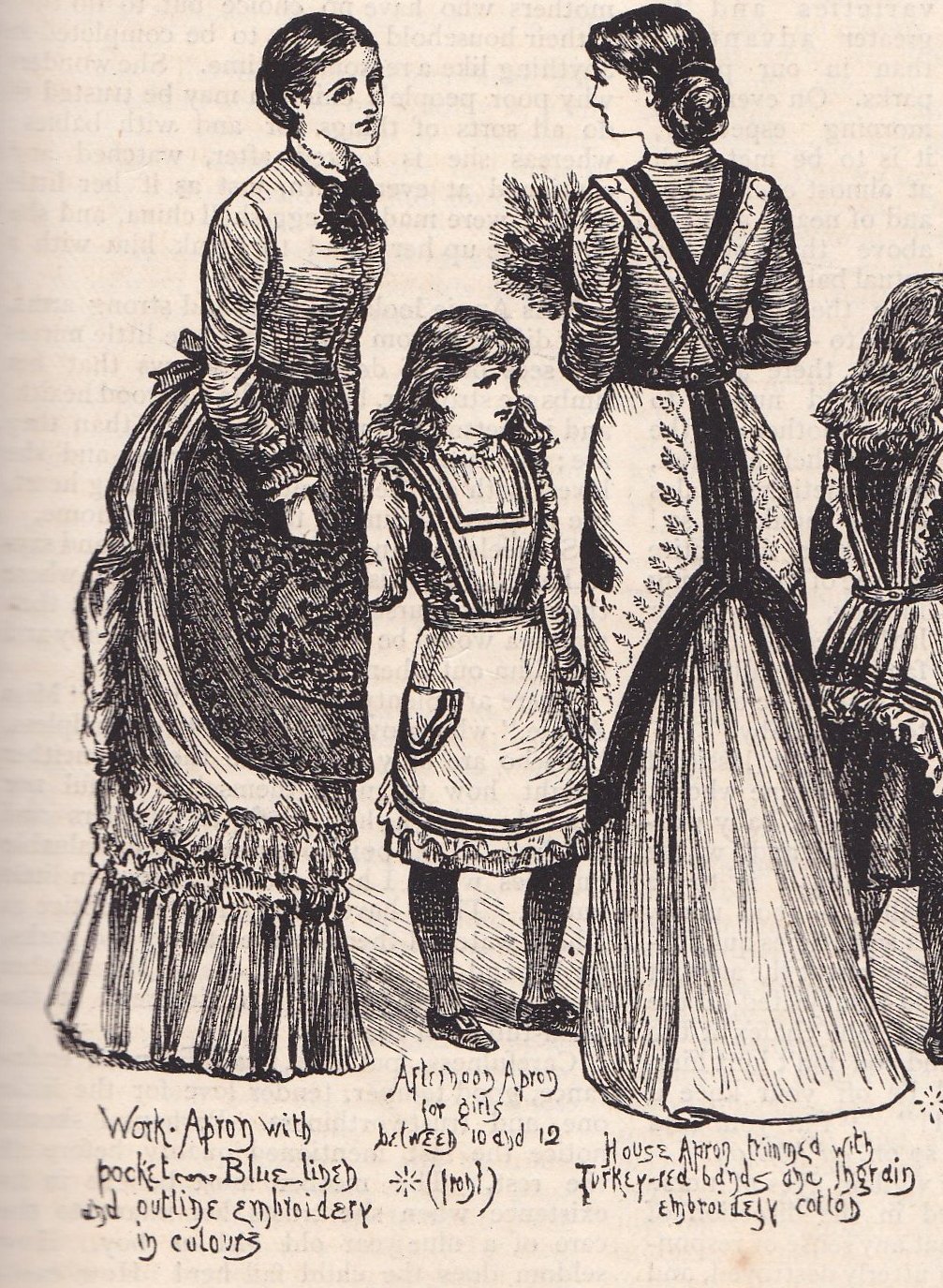
In our page of aprons we have tried to gather together all that is prettiest and most useful, too, of the modern styles, and in order to please every one of our girls we have taken all materials and aprons for all seasons and events.
The first three may be called "dress," or afternoon aprons, and they are suitable for that time of day when we are all supposed to have done work, and put on our best frocks. The first apron is of white muslin or nainsook; it has a gored centre, and two gores at the sides, and is trimmed with tatting and muslin puffings. The little girl's apron is of the well-known princess shape, and may be made of any white washing material, from muslin, to a figured brilliant or jaconet, trimmed with embroidery. The third figure wears a charming apron, both in style and trimming. It is of mull muslin, or Victorian lawn, trimmed with frills of the same, and a fancy-coloured washing braid.
The next two figures give the back and front of a housekeeping, and cooking apron, which is made of a coloured printed cotton, or a sateen, those with a white ground being the most suitable. It is edged all round with a frill of the same, and has a large pocket which may be placed either at the side, or in front, as the wearer pleases. The next figure wears a useful house-apron, which completely hides the dress, and so is equally valuable to protect a new or to hide an old one. The material may be unbleached Barnsley linen, brown Holland, or any of the new fancy materials, such as oatmeal cloth. The bands are of blue linen, with an appliqué pattern in vine leaves of Turkey-red cotton or cretonne flowers. Plain bands may be used.
The work-apron with a pocket will prove an immense comfort to those who do much needlework or knitting, as not only does it hold the balls of yarn, the cotton, scissors and needles, but the work itself can be safely put away in it, to be found in order for an immediate start when taken up again. The material of our illustrated apron is blue linen, with outline or cross-stitch embroidery in coloured ingrain cottons. The little girl's apron with a bib and bretelles, or shoulder straps, is a very pretty and stylish pattern, the back being especially effective. Any material, from muslin to silk, may be used, the pattern given being made of muslin, with a muslin and lace frilling, and three rows of narrow black ribbon, velvet all round, which of course requires to be taken off when the apron is washed. The young lady's house-apron is perhaps the most useful and practical of all. It is made of workhouse or Bolton sheeting, and has bands of Turkey-red twill laid on, and sewn down with the sewing machine. The little design above is worked with red and blue ingrain cotton. The front resembles that of the little girl's, but the shoulder straps cross behind instead of coming down straight to the belt.
The Roman apron is the newest of all that we have illustrated. It is made of fine unbleached linen, or it may be of pure white. It is cut lengthwise, and is about one yard and a half long, and folded over nearly half a yard from the top. The strings are sewn in under the fold three inches from the edge on each side. The decoration consists of two rows of embroidery, which may be done in drawn-work, cross-stitch, or even in crewels. The ends are fringed and then knotted evenly, and the sides are hemmed up. The width of the apron is three-quarters of a yard. The next apron is also called a Roman apron, although not doubled over at the top. It is made of black silk and is twenty-four inches long by twenty wide. The length is increased by the addition of the trimming and lace to over three-fourths of a yard. The trimming consists of strips of red, blue or white linen, worked in a border design of cross-stitch with ingrain cotton. The lace is an ordinary inexpensive lace, sewn on with very little fullness.
The small design at fig.1 is intended to give an idea of the new darned work, which has been revived from the seventeenth century styles of embroidery. The material used is huckaback; the price about 10d per yard. The ends are fringed, and the unworked end is turned over, like the usual Roman apron, the lower part alone being worked. The design chosen is a conventional pomegranate, from a series of designs lately published, which are copies of ancient needlework. The pattern is traced, and worked first in outline stitch in blue filoselle, which should be split to three strands only. The background is then put in by darning from every one of the double threads which appear on the surface of the huckaback. The square is, of course, traced first to keep it even in working. The colours chosen may be all blue, blue in two shades, yellow for the grounding, and red for the outlining, or even a mixture of tints, if great cleverness be exercised in doing it.
The only apron I have left unnoticed is that in the well-known handkerchief style, which has now become so common, and is so cheaply purchased, that it has passed beyond the ken of our more artistic workers.
There is nothing so pretty as an apron for home wear. It seems to give an air of pleasant homeliness to the wearer, and at once stamps her character s careful, economical, and exquisitely tidy – qualities which she will surely carry into everything she undertakes in life. She is perhaps a little precise too, which will show itself in punctuality as to time, and as to business-like habits in keeping her engagements, and we feel nearly sure that the apron-wearer will neither disappoint, nor vex us with any unreliability. The word itself is a strange blunder, being "a napperon" converted into "an apperon", - napperon being the French for a "napkin," from nappe, "cloth". In many counties in England it is said that the word "apperon" is still used.
Perhaps the most interesting part of the apron is its extreme antiquity. It appears to have been worn from the Fall until the present day In our own country Strutt, who wrote on the "Dress and Habits of the People of England," gives an illustration of it as used in his time, the thirteenth century. His picture shows us a blacksmith at work, in an apron precisely similar to the leathern one still worn. It is tied round the waist, and thence rises to the breast, which it completely covers, and is secured round the neck by a tie. This shape had been in use long previously by women, and continued so long afterwards. It was also worn at that date by the upper classes as an ornamental addition to the dress. In the fourteenth century the apron was called a "barme cloth" in England, and in "The Miller's Tale" Chaucer gives a description of it as worn by the carpenter's wife. She wore –
"A barme cloth, eke as white as moe milk,
Upon her lendes, full of many a gore."
These many gores are thought to mean "plaits," or perhaps gathers, which were done in the way we now call "honey combing."
After this period the apron was confined to good housewives in the country, until the sixteenth century, when the ladies took them again into favour as articles of decoration; and used them of so fine a texture that a poet of the day says –
"These aprons white, or finest thread,
So choicilie tied, so dearly bought,
So finely fringed, so nicely spread,
So quaintly cut, so richly wrought;
Were they in work to save their coats,
They need not cost so many groats."
- Stephen Gosson's "Pleasant Quippes for Upstart Gentlewomen," 1596
These aprons were edged with lace, and one of them may be seen on the monumental effigy of Mistress Dorothy Strutt, in Whalley Church, Essex, who died in 1641.
In the days of King William III, they again became an indispensable part of a lady's dress, and were very small, edged round with the finest and most costly lace, and covered the top of the petticoat, the front of which was fully displayed by the open gown then in use. Good Queen Anne herself wore an apron later on, and in her reign they were richly decorated with needlework, gold lace, and spangles; and occasionally these ornaments formed a framework for a small picture, which was painted on satin and sewn on the apron. One of the aprons of this date, which has descended to me from an ancestress, is in my possession, and is a beautiful example of needlework. The ground is of white silk, the apron being about half a yard square. The border is of leaves in coloured silks, and vines and flourishes round them in silver thread and cord. The fineness of the work is a subject of wonder to all who see it. It was worn under the pointed bodice, and they sometimes had a stomacher to match in colour.
In George II's reign they were worn very long and quite plain, without lace or ornament, but occasionally fringed at the end. The material seems to have been white muslin or lawn. A curious anecdote is told of these aprons. It appears that Beau Nash, the Master of Ceremonies and the celebrated "King of Bath," had the strongest aversion to them, and excluded all ladies who ventured to appear at the Bath assemblies dressed in that manner. In Goldsmith's "Life of Nash" it is said that "at one assembly he went so far as to strip the Duchess of Queensberry's apron off, and, throwing it down on one of the back benches, declared that none but abigails appeared in white aprons." How strange a picture of the mixture of rudeness, and extreme ceremony in the manners of that day!
Short aprons of cambric were worn in full dress in 1788, and after that we do not hear of aprons being much in use until 1830 to 1850, when all ladies wore them, made generally of black silk, and though decorated and ornamented in various ways, they were not the entirely useless articles of dress of the preceding century, but were intended to combine the useful and the ornamental.
A great revival of aprons took place when art needlework commenced to be applied to them about the year 1874. Since then they have been in constant use for the household-work and lawn-tennis, and they will in all probability retain their hold on our fickle fashions for some time to come; but whether this be so or not all young girls should make a practice of wearing them, as they add much to their appearance both at work and at play.
In our page of aprons we have tried to gather together all that is prettiest and most useful, too, of the modern styles, and in order to please every one of our girls we have taken all materials and aprons for all seasons and events.
The first three may be called "dress," or afternoon aprons, and they are suitable for that time of day when we are all supposed to have done work, and put on our best frocks. The first apron is of white muslin or nainsook; it has a gored centre, and two gores at the sides, and is trimmed with tatting and muslin puffings. The little girl's apron is of the well-known princess shape, and may be made of any white washing material, from muslin, to a figured brilliant or jaconet, trimmed with embroidery. The third figure wears a charming apron, both in style and trimming. It is of mull muslin, or Victorian lawn, trimmed with frills of the same, and a fancy-coloured washing braid.
The next two figures give the back and front of a housekeeping, and cooking apron, which is made of a coloured printed cotton, or a sateen, those with a white ground being the most suitable. It is edged all round with a frill of the same, and has a large pocket which may be placed either at the side, or in front, as the wearer pleases. The next figure wears a useful house-apron, which completely hides the dress, and so is equally valuable to protect a new or to hide an old one. The material may be unbleached Barnsley linen, brown Holland, or any of the new fancy materials, such as oatmeal cloth. The bands are of blue linen, with an appliqué pattern in vine leaves of Turkey-red cotton or cretonne flowers. Plain bands may be used.

The work-apron with a pocket will prove an immense comfort to those who do much needlework or knitting, as not only does it hold the balls of yarn, the cotton, scissors and needles, but the work itself can be safely put away in it, to be found in order for an immediate start when taken up again. The material of our illustrated apron is blue linen, with outline or cross-stitch embroidery in coloured ingrain cottons. The little girl's apron with a bib and bretelles, or shoulder straps, is a very pretty and stylish pattern, the back being especially effective. Any material, from muslin to silk, may be used, the pattern given being made of muslin, with a muslin and lace frilling, and three rows of narrow black ribbon, velvet all round, which of course requires to be taken off when the apron is washed. The young lady's house-apron is perhaps the most useful and practical of all. It is made of workhouse or Bolton sheeting, and has bands of Turkey-red twill laid on, and sewn down with the sewing machine. The little design above is worked with red and blue ingrain cotton. The front resembles that of the little girl's, but the shoulder straps cross behind instead of coming down straight to the belt.
The Roman apron is the newest of all that we have illustrated. It is made of fine unbleached linen, or it may be of pure white. It is cut lengthwise, and is about one yard and a half long, and folded over nearly half a yard from the top. The strings are sewn in under the fold three inches from the edge on each side. The decoration consists of two rows of embroidery, which may be done in drawn-work, cross-stitch, or even in crewels. The ends are fringed and then knotted evenly, and the sides are hemmed up. The width of the apron is three-quarters of a yard. The next apron is also called a Roman apron, although not doubled over at the top. It is made of black silk and is twenty-four inches long by twenty wide. The length is increased by the addition of the trimming and lace to over three-fourths of a yard. The trimming consists of strips of red, blue or white linen, worked in a border design of cross-stitch with ingrain cotton. The lace is an ordinary inexpensive lace, sewn on with very little fullness.
The small design at fig.1 is intended to give an idea of the new darned work, which has been revived from the seventeenth century styles of embroidery. The material used is huckaback; the price about 10d per yard. The ends are fringed, and the unworked end is turned over, like the usual Roman apron, the lower part alone being worked. The design chosen is a conventional pomegranate, from a series of designs lately published, which are copies of ancient needlework. The pattern is traced, and worked first in outline stitch in blue filoselle, which should be split to three strands only. The background is then put in by darning from every one of the double threads which appear on the surface of the huckaback. The square is, of course, traced first to keep it even in working. The colours chosen may be all blue, blue in two shades, yellow for the grounding, and red for the outlining, or even a mixture of tints, if great cleverness be exercised in doing it.
The only apron I have left unnoticed is that in the well-known handkerchief style, which has now become so common, and is so cheaply purchased, that it has passed beyond the ken of our more artistic workers.
Labels:
1881,
aprons,
clothes,
fashion,
fashion history,
history,
housekeeping,
needlework
Wednesday, 5 October 2016
19 February 1881 - 'Seasonable Dress and How to Make It'
A few seasons ago the backs of our dress bodices were ornamented, or, perhaps, rather disfigured, by either six or seven seams, two or even three side forms, and a back seam being the ordinary number. Now as we have once again reverted to the old style of one centre seam, as, although three joins are allowed, the best cut dresses show only the centre one, the other being brought so far under the arm as to be practically invisible. This change will be a great comfort to the amateur dressmaker, and will be an encouragement to those of "Our girls" who aspire to make their dresses at home. In fact, if the promised change should be brought about, of having no seams under the arms at all, the work of manufacturing a bodice will be quite reduced to half the usual amount. The spring models seem to portend a reduction in the seams of our sleeves as well, for some of them have no join on the outside, from the shoulder to the elbow, the top and under parts of the sleeve, so far, being cut in one piece. Of course, below the elbow the shape could not be retained if there were not a seam both at the back and the front. The sleeve is set as high into the bodice as ever, as everyone still appears to wish to look square-shouldered and narrow-backed. Of course, a certain amount of adherence to the prevailing fashions, so as to avoid attracting attention, is desirable, but we trust that all our young readers will avoid extremes in this, as in all other matters connected with dress. Of course, the natural place for the seam is at the point of the shoulder, and there is no doubt that our dear Princess of Wales recognised this fact when she insisted on having her dress shoulder-seams cut like the Prince's coats; and banished all long and ill-fitting shoulders from her wardrobe.
The prettiest shape of the season for bonnets is, perhaps, the very sensible and moderate-sized "Granny bonnet," which has sometimes a round front, and at other times one bent down in the centre, after the fashion of the well-known "Marie Stuart Head-dress." We saw a perfectly plain velvet one, the other day, edged with a row of medium-sized black beads all round it, and no other trimming save two silk pompoms, and a cord of black chenille. This form is very suitable for the mantles, as they are now worn, as they prevent the head from assuming that pin-head shape, so often found fault with when the very small Princess-shaped bonnet is worn with a large cloak. We think these "Granny bonnets" will probably be great favourites all through the summer, and they can be manufactured at home by a clever girl. They require to be seen, however, and the shape is easily obtained. They are all of one material - velvet, plush, or satin; or the crown may be lighter than the front. The sole trimmings often consist of the satin ribbon strings, which are placed along the joining of the crown to the front, where they are tied in drooping bows on the top.
A young lady's small-sized bonnet is shown on p.321, beginning from the left side in our monthly illustration. The bonnet itself is of brown straw, with brown velvet trimmings and strings, and a wreath of autumn leaves in brown, red and yellow. The dress is a brown Vicuna, made with a long over-jacket of the same, which is edged with a brown fur trimming; a small cape of the same completes the costume. The front of the tunic is pointed, and the back of it is seen on the next figure. The skirt is of silk, satin or other material, the small hemmed flounces being placed on a stout foundation of alpaca. We have before now pointed out the economical nature of these tiny flounces, and how easily an old dress may be made into an excellent skirt with their help, the foundations only being new.
Fig.2 wears one of the new jacket-mantles, which, having been so lately introduced, will be much in use for the early spring; they are a most useful form of out-door covering. The jacket has loose fronts with pockets, the back being plain at the top, and the plaited portion added on to it to bring it even in length with the front. The material is a black and white checked tweed; the round cape is similar in shape to those worn some years ago and called "Inverness." The hood is of tweed, lined with striped silk.
Fig.3 is a simple walking dress, of blue serge, or cloth. The skirt being kilted, with a shawl drapery as an over-skirt, the bodice is a woven "Jersey" of a colour to match the skirt; the cuffs and capes are of blue velveteen. This dress requires no trimming, and is easily made up at home.
Fig.4 is a pretty at-home evening dress. The skirt and pointed bodice are made of velveteen, the under bodice and pointed tunic of some thin material, such as striped grenadine, Indian silk, or plain white cashmere. The pointed cuffs are also of velveteen, and the neck is finished by a ruching of lace and a black velvet band. There are lace frillings at the wrist.
The fifth figure is intended to be a representation of one of the much talked of aesthetic dresses. Perhaps the more proper name for them would really be "pictorial," for they generally may be found to be adaptations from a famous portrait of some historic beauty of past centuries. Any endeavour to improve dress in this way is much to be desired, as such fashions are not changeable and foolish as many of the ephemeral styles of the present day, and may be worn always, without fear of the beholder's fault-finding. The skirt has three flounces. The polonaise is plainly cut and slightly draped; the sleeves have two puffs above the elbow, and the square cut neck has a gathered top inserted into it, and a stand-up, wired, velvet collar, with a lace frill inside it. The small velvet bag at the side has the wearer's initials on it, or an embroidered spray of flowers if preferred. The pattern would be easily cut out in paper, and the bag could be made by anyone, with little trouble. The "Queen Anne" table is illustrated in deference to the wishes of many of our correspondents who have made inquiries as to the method of making and covering them. The legs, as well as the table and shelf are all covered with plush, which is likely to sit best if sewn on with needle and thread. The fringe may be made at home, if there be any one who understands the netting of fringes.
Bodices entirely in longitudinal puffs are amongst the new spring introductions. They are very becoming to the slight figures of young girls, and hide their extreme thinness, which is very painful at times to themselves and those who see them. Some little care is needed to shape them well, but otherwise they can be made over the plain pattern usually worn, the material being first cut in a square piece, then gathered, and lastly tacked on the shaped lining, and cut to the form of it.
For serge, Vicuna, and cloth dresses the narrow silver and gold braids arranged in several rows, form a very pretty and simple trimming round the jacket and overskirt. They also are excellent to brighten up an old dress, in which category plaids must be also mentioned, and we have no doubt, as the spring proceeds, that many girls will be looking about anxiously for some simple and inexpensive way of making up their winter dresses again. The plaids are put on in flat bands, and the effect would be much heightened if they were edged by a cording of the brightest colour composing the bright lines in the pattern of the plaid. The material may be very inexpensive of which they are made, the effect being the same as if it had cost a great deal.
Much use is made of the inexpensive brightly coloured French merinos or cashmeres, which can be obtained as low in price as 1s 8d per yard, yard wide. We were shown a wonderful dress the other day made up by a young lady of very limited means, for house and evening wear at home. The short kilted skirt of black cashmere was made up from an old long dress, and the black "Jersey" had cost her 8s 9d. The ornamental additions consisted of two yards of deep red cashmere, at 1s 8d per yard, from which she had made a prettily draped scarf, placed round the top of the skirt, over the edge of the "Jersey," and also a collar and cuffs, which she had embroidered in black silk, with a pattern of ivy leaves. The small lace frill at the neck finished as pretty a little costume as could be desired, at very little expense. On account of their great usefulness, we think that "Jerseys" will continue to be worn by young girls for some time, but for older people they have very decidedly gone out of date. They were very trying to bad figures, and not generally graceful. Very pretty little necklaces of plush leaves, green or variegated, are now manufactured by young ladies for evening wear. They are made up on a wire foundation.
The next illustrations consist of a pretty cap and a fichu. The border of the cap consists of a closely-gathered lace, or net, with an embroidered edge, which is laid in a series of shells. We have lately given two illustrations of caps, as so many of our girls make those of their mothers; and we much desire to encourage them in their useful and kindly work and to induce others to follow their example also.
We likewise give designs for those most useful aids to economical dressing, fichus, as we notice that they are used more and more each month, and serve to turn a morning dress into a useful and becoming one for evening wear without much expense and with very little trouble. There are so many pretty laces just now, and though called imitation, they really should be properly named "machine," in contra-distinction to "hand-made" laces. We use so many things now that are manufactured by machine which used to be made by hand that it seems an injustice to call lace, over which the same change in its working has come, "imitation." The lace used for the neck is now laid in flat box-plaitings, or else side-plaitings, and two rows are preferable to one. The most lady-like hue is a deep cream colour, the very yellow and the very brown laces having both rather gone out of fashion, which was rather a pity, as they kept much cleaner in this island of damp and this smoke-curtained city, with its incalculable number of coal fires.
Saturday, 27 August 2016
25 December 1880 - 'Seasonable Clothing and How to Make It'
There is no use in concealing from ourselves that multitudes of our girls marry, and that afterwards they take THE GIRL'S OWN PAPER just as regularly as before, and find all the information they need in it, with as much ease as their younger sisters. We know this from the questions we receive and answer on many matronly subjects, and so we think we must help our girl brides to purchase the best wedding dress possible, one that will last a long time and that can be dyed if need be. Fortunately this winter very excellent material, Irish poplin, is much used for brides' dresses, the kind selected being that with very thick cord or double repped. The trimming used is plush, but very little is required for such a handsome thick fabric as Irish poplin. Bridesmaids, too, are fortunate as to the winter change in their dresses, which now have plain plush petticoats and full bodices of one of the moderately-priced Indian silks, t match the plush in colour, only paler. This dress will not be an extravagant one, as it will, if suitably made, answer for a best dress for a long time. The large hats and the mob caps have all grown old-fashioned for bridesmaids, and they have been quite supplants by the hat-caps, as they may be called, the "Tam o' Shanter," the "Henry VIII," and the "Leonardo da Vinci," all of which are made of plush, matching the colour of the dress.
It is delightful to hear that the over-frizzed heads are to disappear from amongst us and are no longer to be considered fashionable. We are to return to the prettily weaved bandeaux, with the centre parting clear and well defined. The knot behind remains the same, but short curls fall from it, in a graceful Greek fashion, such as we may see represented on classic busts.
The woollen stockings worn this winter must match the dress in colour, and some charming new merino ones have been introduced, which are nearly as finely woven as spun silk and are quite as soft. They are not ribbed, and so are more suitable to tender feet than if they were, for the latter cling too tightly to be otherwise than irritating to sensitive skins. I trust that all the readers of THE GIRL'S OWN PAPER wear woollen stockings, and stout shoes or boots, with wide low heels and road toes, so as to be perfectly comfortable when they walk. I heard of a young lady the other day, who wore the fashionably-pointed toes and high narrow heels, who had had a succession of violent nervous headaches, which ended in floods of tears and hysterics. Her doctor, on being consulted, said that the boots she was wearing were the cause of her troubles, and he had had several similar cases; whereupon the sufferer ingenuously confessed that she was sure the doctor's opinion was correct, for she had indeed gone through agonies of distress every day that she had worn her fashionable boots.
White kid gloves are worn again at night, as well as lavender-coloured, and pink and black are worn as much as ever by day, a very good thing for those who are obliged to save their money, and consequently their gloves. On first putting on a pair of black kid gloves it is a good plan to rub them all over with some salad oil, pomade, or even butter, by means of a little piece of flannel, until they look lustrous and blacker than ever. Of course no grease is left on them that might rub off upon anything. after this preparation they will be found to wear much better and be softer and more flexible. Some gloves for evening wear are ornamented with beads at the back in a simple, conventional spray or scroll pattern. Any of our readers who are in mourning might do this little bit of extra decoration for themselves.
The favourite gloves of all are the almond and tan-coloured gants de Suede, and they appear to be worn both by night and by day equally well. They are, of course, less expensive than the real kid, but that they do not wear nearly as well nor keep clean as long, so are not to be recommended to careful girls.
The new bodice shape has as few seams as possible, and only one side piece, the joining of which is carried quite to the back of the arm, so as to have a plain piece under it. Three sizes of buttons may be worn on basque bodices, the largest being of the size of a penny piece, on the pockets. The next size is on the front, and the smallest, which are as big as a fourpenny piece, on the cuffs. The use of gathering (or gauging, as it is properly called) is much on the increase for the shoulders and fronts of dresses, muffs, millinery and sleeves, so that the readers of THE GIRL'S OWN PAPER should learn to do it for themselves, for it is one of the lost arts in ordinary needlework, though still used for surplices and the "smock frocks" of wagoners and the peasantry. The following is the description given in a very old needlework book: - "Take up the stitches at regular intervals of half an inch each for the first row; for the second, continue doing the same, letting the needle, however, take up the intermediate parts. The third row is like the first, and so on. For the purpose of securing the gathers firmly work them as follows, with very strong netting silk. Take on your needle the first two gathers, and the thread on which they run, pulling your thread firmly through. For the next stitch again take two gathers and the thread upon your needle, letting the first of them be the last gather that was taken up at the former stitch, so that the work proceeds by one gather at a time. Observe to draw the netting-silk as tightly as possible, so as to make the stitches lie very closely together, in a slanting position."
Walking-dresses are still made with deep kiltings, but the plaits are very wide, which takes away much of their stiffness of appearance. A lightly arranged and bouffant scarf finishes the skirt below the basque bodice. I have no doubt that many girls will be glad to purchase and wear the very moderately-priced woollen Jerseys, of which there are so many in the shops this winter. They form a very pretty and easily-obtained bodice, and their plain appearance may be taken off by placing a plastron of plush or gathered ilk in a V shape in the front. A large velvet collar, something like a sailor's collar in form, much improves them, and cuffs to correspond are worn at the wrists. Jerseys are not now covered at their termination below the waist with the scarf, but are either left plainly hemmed in their original style or else they have a deep fringe generally of jet beads, which can be made by any one with clever fingers.
Our large illustration gives two costumes - an outdoor and a handsome indoor gown. Both show exactly the present fashions. The cloak worn is of a simple cloth dolman shape, trimmed with black fox fur, both warmly lined and wadded. The dress of the other figure shows the profuse use of gauging in dresses. There is one great comfort in this style of making, that old dresses can be turned to use admirably in trimming each other, provided they be not faded. No amount of wear (we were told the other day) seems to matter, as the close gathers hide it all; so, if it be a trouble to do, you may have this consolation. Cheaper material can also be bought for trimmings, for a very poor silk is good enough to use in this way.
Saturday, 21 May 2016
17 July 1880 - 'What Our Girls May Do' by Alice King
You may do anything that is good and proper and useful - except anything that men do, that would be wrong.
We do not want to say what our girls may not do, because "may not" has a sound of the schoolroom about it which would take away from the pleasant freedom of the little chat we mean to have with our girls today. That our talk together may be more cheery and hearty we will ask our girls to fancy themselves sitting with us around the Christmas fire, with the frosty air outside filled with the glitter of stars and the melody of bells; or wandering through the summer woods, with their hands filled with honeysuckle and yellow pimpernel and musk-scented stork's-bill, with bird and brook making fair harmony hard by.
In the first place, our girls may try to do anything which is useful. They love to play at being useful from the time when they can first toddle, and they may begin to do it in earnest as soon as ever they are able. But how can we be useful, they will ask? They can begin very early to do a deal of good in their families by influencing their younger brothers and sisters, by keeping the rough word off the little boy's lips, by showing the tiny maiden that to be a Christian girl means to be as bright as the flowers, as full of their sweetness that spreads perfume round; is to be as pure as the dewdrop, as blithe as the skylark's song. The little ones are far more free n talk and manner with you than they are with elder people, and so you have opportunities with them which do not belong even to their mothers.
Our girls may also do much in the way of influencing their schoolboy brothers, and instilling into them reverence for womanhood. Girls are too much inclined to look upon it as a merit to give themselves up patiently to be teased by their brothers. Far from this, they should show them that even the sweetest tempered girl has a touch of queenliness about her, which demands a certain degree of careful, tender respect from men, which forbids rude acts and words in her presence. Thus will our lads learn early from their sisters the meaning of chivalry, and every woman whom they shall meet in their life's journey will bless those sisters for what they did long ago.
There is good work at home for our girls in giving a high, right tone of thought and feeling to young female servants. Girls, perhaps, are not aware how much their dress and manners form the dress and manners of the servants' hall and kitchen; and there is no truer saying than that servants grow like their mistresses. They should, therefore, endeavour to show any girls of a lower social rank than their own what is the meaning of modest grace, of Christian womanliness. They should seek to make them feel that they are their friends, and to win their confidence, so that they will tell them all their little troubles and difficulties, and let themselves be helped by the young ladies' superior intelligence and education. They should provide, as far as they can, rational amusements for them; they should send or take them to places of interest, Bible classes, and sewing parties.
A wide and beautiful field of work and influence opens before our girls as we take them to the doors of our Sunday-schools and bid them enter there. Here is a task that angels smile to look upon. Here is a garden in which seeds may be planted that will bring forth flower and fruit - first for man below, then for heaven above. Here are earnest young faces, who will catch their first ray of God's light from their teacher's eyes; and our girls, with their bright looks and pretty winning ways, are so much more able and likely to attract children than graver and older folks; their young fancies will find such congenial exercise in weaving Bible stories into word-pictures for the little ones to gaze at and learn from; their fresh, brave, living courage will break down barriers of dullness, and make its way into sluggish brains, where other and more jaded teachers would fail. Yes, our girls are the God-appointed teachers of our English Sunday-schools.
This work of Sunday-school teaching may lead on our girls as they grow older, and, if they feel that they have real talent and love for the business, to yet a broader and higher sphere of influence in keeping adult classes for men and women. What a light and a sweetness come into the daily life of mothers and maidens who are toiling along bearing a heavy burden made up of small pressing household cares and wants, when a sister, from a different station from their own, steps down to walk for a while at their side to cheer them with glance and word of sympathy.
The men, too, when they gather round their lady teacher, what refinement do they draw from mere contact with her gentle voice and manners - refinement that gradually colours their home lives, their intercourse with sweethearts and wives and daughters. How do they gradually learn to yield to her soft but queenly influence, and to be ashamed of coarse vices when they enter her presence. How ready do they grow to listen while she shows them the upward way - to follow her kindly yet steadfast leading. If our girls want work that will call out every noblest most earnest faculty of heart and soul, let them strive to train themselves for work like this.
We have dwelt thus on what our girls may do in different ways in the matter of influence, because in these days, when there is so much said and written about what women may and may not do, we do not think that our young ladies are sufficiently shown the beauty and the importance of what is woman's highest earthly mission - the mission of influence.
Sweet English girls, as you go forward in life never forget or waste this mighty power which lies in your hands, but hold and prize it as a solemn, precious trust from God; and use it so that one day your ears may hear with joy the blessed words, "Well done, good and faithful servants."
With regard to learning language, music, and drawing, we would tell our girls that they may most decidedly do any of these things if they have a talent for them, but that if they have no talent they had just as decidedly better leave them untried. There exists a sort of traditional belief in many respectable English families that all daughters of the house must be taught to play on the piano. We would advise our girls resolutely to strive to break down this notion; for by so doing they will spare the ears of friends and guests a deal of unmerited suffering, and will save for themselves much valuable time, which they can employ in things that they can really do with will and pleasure.
And we would strongly caution our girls against learning too many things at once, as a quick, vivid young female mind is always too apt to try to do; they should recollect that the concentration of every faculty on one point has been the chief secret of all the greatest and best work that has been done in the world; that we make much more mark in society by doing one thing well than twenty things tolerably.
In these days, when literary work is so readily given to women, our girls may try their hand at composition in prose or verse, if they have a real talent for either; but we would emphasise that *if most strongly. We would caution our girls to be very severe with themselves on this point; for in the matter of authorship, nothing is easier than to fancy, especially if our minds are young and ardent, that our bits of coloured glass are real jewels. The path of literature is often at first an uphill, weary path, even for genius; and we would most earnestly warn our dear girls, as they value their own happiness, unless they are very sure that they have a decided call in a gift given by God for treading it, to pause before they enter upon it.
To go from intellectual work to work with the hands, needlework is a thing which every girl ought to do, and which never ought to be left out of female education. As for fancy work, that may be done by a girl in her hours of amusement if she does not waste too much time over it. In fancy work we do not of course include the beautiful art needlework of the present day, which needs just as much a special talent in those who undertake it as painting or music.
Our girls may do a deal of fair and excellent work for both God and man in visiting the sick and poor and aged. It will bring their sweet young lives into contact with gloom and sadness; but they may go fearlessly into those dark places, since Christian girls will carry with them there a lamp lit at the flame of the "Light of the world." Let them take their Bibles in their hands; let them speak boldly out of the words of eternal life in the homes of want and disease; let them add a few simple drops of sympathy that fall from their warm young hearts; and for those they seek to comfort and for themselves "it shall be well." Work of this sort may also lead them on in after life, if they form no close ties, and if they have a real gift for the task, to become sick nurses - a branch of female duty in which women with cultivated minds and soft ladies' hands and delicate ladies' tact are so needed.
If a girl has a liking for cookery she will be putting herself in the way of doing probable good work in her future by attending classes on the subject, and trying little experiments at home. In such interests there is nothing beneath the dignity of a lady; the woman who thinks there is must have more foolish pride in her than good sense. Health, and especially the health of men of sedentary employments, depends in a great measure, on the way in which food is prepared; women should remember that the preservation of health is no mean object. If it is to be a girl's fate to be the mistress of a family, where there is only a limited income, skill in cookery may prove a real blessing to all around her.
In conclusion, we would say to our girls one earnest warning word about what they may not do. They may not do any of those things which make them imitators of men; they may not try to break down the God-appointed fence which divides their departments in the world's great workshop from the departments of men; by so doing they only lose their own queenliness without gaining a single ray of male royalty in its place. Let our girls aim at being nothing but women - noble, brave, broad-hearted women - active alike with mind and hands; strong, earnest workers for God and man, and theirs shall be a fair and radiant story, that shall grow ever brighter and yet more bright.
We do not want to say what our girls may not do, because "may not" has a sound of the schoolroom about it which would take away from the pleasant freedom of the little chat we mean to have with our girls today. That our talk together may be more cheery and hearty we will ask our girls to fancy themselves sitting with us around the Christmas fire, with the frosty air outside filled with the glitter of stars and the melody of bells; or wandering through the summer woods, with their hands filled with honeysuckle and yellow pimpernel and musk-scented stork's-bill, with bird and brook making fair harmony hard by.
In the first place, our girls may try to do anything which is useful. They love to play at being useful from the time when they can first toddle, and they may begin to do it in earnest as soon as ever they are able. But how can we be useful, they will ask? They can begin very early to do a deal of good in their families by influencing their younger brothers and sisters, by keeping the rough word off the little boy's lips, by showing the tiny maiden that to be a Christian girl means to be as bright as the flowers, as full of their sweetness that spreads perfume round; is to be as pure as the dewdrop, as blithe as the skylark's song. The little ones are far more free n talk and manner with you than they are with elder people, and so you have opportunities with them which do not belong even to their mothers.
Our girls may also do much in the way of influencing their schoolboy brothers, and instilling into them reverence for womanhood. Girls are too much inclined to look upon it as a merit to give themselves up patiently to be teased by their brothers. Far from this, they should show them that even the sweetest tempered girl has a touch of queenliness about her, which demands a certain degree of careful, tender respect from men, which forbids rude acts and words in her presence. Thus will our lads learn early from their sisters the meaning of chivalry, and every woman whom they shall meet in their life's journey will bless those sisters for what they did long ago.
There is good work at home for our girls in giving a high, right tone of thought and feeling to young female servants. Girls, perhaps, are not aware how much their dress and manners form the dress and manners of the servants' hall and kitchen; and there is no truer saying than that servants grow like their mistresses. They should, therefore, endeavour to show any girls of a lower social rank than their own what is the meaning of modest grace, of Christian womanliness. They should seek to make them feel that they are their friends, and to win their confidence, so that they will tell them all their little troubles and difficulties, and let themselves be helped by the young ladies' superior intelligence and education. They should provide, as far as they can, rational amusements for them; they should send or take them to places of interest, Bible classes, and sewing parties.
A wide and beautiful field of work and influence opens before our girls as we take them to the doors of our Sunday-schools and bid them enter there. Here is a task that angels smile to look upon. Here is a garden in which seeds may be planted that will bring forth flower and fruit - first for man below, then for heaven above. Here are earnest young faces, who will catch their first ray of God's light from their teacher's eyes; and our girls, with their bright looks and pretty winning ways, are so much more able and likely to attract children than graver and older folks; their young fancies will find such congenial exercise in weaving Bible stories into word-pictures for the little ones to gaze at and learn from; their fresh, brave, living courage will break down barriers of dullness, and make its way into sluggish brains, where other and more jaded teachers would fail. Yes, our girls are the God-appointed teachers of our English Sunday-schools.
This work of Sunday-school teaching may lead on our girls as they grow older, and, if they feel that they have real talent and love for the business, to yet a broader and higher sphere of influence in keeping adult classes for men and women. What a light and a sweetness come into the daily life of mothers and maidens who are toiling along bearing a heavy burden made up of small pressing household cares and wants, when a sister, from a different station from their own, steps down to walk for a while at their side to cheer them with glance and word of sympathy.
The men, too, when they gather round their lady teacher, what refinement do they draw from mere contact with her gentle voice and manners - refinement that gradually colours their home lives, their intercourse with sweethearts and wives and daughters. How do they gradually learn to yield to her soft but queenly influence, and to be ashamed of coarse vices when they enter her presence. How ready do they grow to listen while she shows them the upward way - to follow her kindly yet steadfast leading. If our girls want work that will call out every noblest most earnest faculty of heart and soul, let them strive to train themselves for work like this.
We have dwelt thus on what our girls may do in different ways in the matter of influence, because in these days, when there is so much said and written about what women may and may not do, we do not think that our young ladies are sufficiently shown the beauty and the importance of what is woman's highest earthly mission - the mission of influence.
Sweet English girls, as you go forward in life never forget or waste this mighty power which lies in your hands, but hold and prize it as a solemn, precious trust from God; and use it so that one day your ears may hear with joy the blessed words, "Well done, good and faithful servants."
With regard to learning language, music, and drawing, we would tell our girls that they may most decidedly do any of these things if they have a talent for them, but that if they have no talent they had just as decidedly better leave them untried. There exists a sort of traditional belief in many respectable English families that all daughters of the house must be taught to play on the piano. We would advise our girls resolutely to strive to break down this notion; for by so doing they will spare the ears of friends and guests a deal of unmerited suffering, and will save for themselves much valuable time, which they can employ in things that they can really do with will and pleasure.
And we would strongly caution our girls against learning too many things at once, as a quick, vivid young female mind is always too apt to try to do; they should recollect that the concentration of every faculty on one point has been the chief secret of all the greatest and best work that has been done in the world; that we make much more mark in society by doing one thing well than twenty things tolerably.
In these days, when literary work is so readily given to women, our girls may try their hand at composition in prose or verse, if they have a real talent for either; but we would emphasise that *if most strongly. We would caution our girls to be very severe with themselves on this point; for in the matter of authorship, nothing is easier than to fancy, especially if our minds are young and ardent, that our bits of coloured glass are real jewels. The path of literature is often at first an uphill, weary path, even for genius; and we would most earnestly warn our dear girls, as they value their own happiness, unless they are very sure that they have a decided call in a gift given by God for treading it, to pause before they enter upon it.
To go from intellectual work to work with the hands, needlework is a thing which every girl ought to do, and which never ought to be left out of female education. As for fancy work, that may be done by a girl in her hours of amusement if she does not waste too much time over it. In fancy work we do not of course include the beautiful art needlework of the present day, which needs just as much a special talent in those who undertake it as painting or music.
Our girls may do a deal of fair and excellent work for both God and man in visiting the sick and poor and aged. It will bring their sweet young lives into contact with gloom and sadness; but they may go fearlessly into those dark places, since Christian girls will carry with them there a lamp lit at the flame of the "Light of the world." Let them take their Bibles in their hands; let them speak boldly out of the words of eternal life in the homes of want and disease; let them add a few simple drops of sympathy that fall from their warm young hearts; and for those they seek to comfort and for themselves "it shall be well." Work of this sort may also lead them on in after life, if they form no close ties, and if they have a real gift for the task, to become sick nurses - a branch of female duty in which women with cultivated minds and soft ladies' hands and delicate ladies' tact are so needed.
If a girl has a liking for cookery she will be putting herself in the way of doing probable good work in her future by attending classes on the subject, and trying little experiments at home. In such interests there is nothing beneath the dignity of a lady; the woman who thinks there is must have more foolish pride in her than good sense. Health, and especially the health of men of sedentary employments, depends in a great measure, on the way in which food is prepared; women should remember that the preservation of health is no mean object. If it is to be a girl's fate to be the mistress of a family, where there is only a limited income, skill in cookery may prove a real blessing to all around her.
In conclusion, we would say to our girls one earnest warning word about what they may not do. They may not do any of those things which make them imitators of men; they may not try to break down the God-appointed fence which divides their departments in the world's great workshop from the departments of men; by so doing they only lose their own queenliness without gaining a single ray of male royalty in its place. Let our girls aim at being nothing but women - noble, brave, broad-hearted women - active alike with mind and hands; strong, earnest workers for God and man, and theirs shall be a fair and radiant story, that shall grow ever brighter and yet more bright.
Thursday, 14 April 2016
15 May 1880 - 'The Dress of the Month' by Dora de Blacquiere
The new dresses produced for the warmer weather have already enabled us to see that the dark hues, hitherto supposed to be suitable alone to the winter months, are to be worn quite as much now. A very comfortable conclusion for many of y readers who have not quite worn out their winter dresses, and that thus can make them available to bridge over the gap between winter and summer.
A really good costume of any colour will clean and do-up like new, and is always worth sending to a dyer's. Black can be washed at home with ox-gall or fig-leaves, and pressed careful on the wrong side. Black cords of various kinds - such as the Russell and James - are excellent, both for washing and waring and are the same on both sides, so that they can be turned when slightly worn. They require no more care in washing than ordinary dresses; a tepid lather, one rinsing water, and one strong blue water being used. The dress should then be rolled up when partly dry, and should then ironed on the wrong side when damp.
I have been thus particular in my chat about old black dresses, as I know how fond everyone has been of wearing the this last three or four years; and I also know that a shabby, greasy, black dress is a great puzzle to most girls. An old black kid glove, boiled in a pint of water till reduced to half a pint, and then used to rub on an old black dress, using the liquor, will often be found a wonderful reviver It is a very usual recipe with the negresses in the Southern States of America, who are amongst the most clever managers in the world. Black dresses are quite as fashionable as they were this spring; and so, perhaps, our elderly dress, well cleaned or washed, and trimmed with bands of Indian broche, spotted black and white foulard, or a jetted galloon, will appear as good as a new one.
The new colours in dresses and bonnets are so much brighter than anything we have had of late that it takes some time to get reconciled to them. Old gold in all shades and materials is used for bonnets and hats more than ever; in fact, every description of yellow, cowslip, primrose, lemon, orange, and an odd yellow called yeux de chat, are all most fashionable. The number of new shades of pink is also great, rose, rose cendre, blush-pink and also "shrimp" will be worn for hats, bonnets and dresses. Every possible shade of lilac, the deepest royal-purple to the old shade worn by our granddames under the name of "peach-bloom"; grey-blues and blues are also much in favour.
Nothing can exceed the brightness of the sunshades and parasols. Red, red and black, red and yellow, in stripes, patterns, and dots, black and white ones embroidered with flowers in their natural hues, and old gold trimmed with black lace. Satteen and cotton parasols, trimmed with white embroidery and torchon lace, are made to wear with costumes of those materials, and the same as regards foulard. Some very stylish-looking parasols have been brought out, trimmed round and round with black or white lace, in rows one above the other to the top of the parasol. This would be an excellent method of doing up an old parasol, either light or dark in colour, and as plenty of cheap lace may be had it would be also very economical.
Some very pretty and inexpensive jerseys, made of bead netting, have been brought out, which form a complete evening costume over a black silk skirt. They are of black beads, as well as every other hue, and are got up in cheap imitation of the bead-embroidered cuirasses which have been worn in Paris so long. Stockingette, or jersey-cloth, is made into jackets, which are worn with hoods of the same lined with gay Indian handkerchiefs. This material has the advantage of sitting closely to the figure when made up into an out-of-door garment. These hoods are made to take off, and are only buttoned on the neck of the jacket, so that they need not be worn always. They also accompany ulsters and costumes made with a waistcoat front, and will form one of the out-of-door garments of the summer season, as they are being made in black and white lace, to be used either with or without satin or cashmere mantles. Small capes will be used again this year; however, they are longer than they were the last, and come quite to the elbow, in order to give the tightened-in appearance which is so desired. Capes with long pointed fronts are also still used, and have hoods. Quantities of black lace are used to trim all mantles, jackets and capes; and camels'-hair and cashmere are the favourite materials for them. Youthful-looking scarf mantelets are made of the figured material of the dresses, and are trimmed with bands of the plain stuff, a collar of the same being used at the neck. Jackets similar to the dress are also used, but they are quite tight-fitting, and are figured - never plain.
A new idea in both short and long costume is the narrow kilting of bright colour which is added to the edge of the skirt, below the hem, or just below the lower flounce. On plain grey, drab, brown or black costumes this little addition is very effective, and gives a piquant effect to an otherwise plain dress. It will be pretty for the short, black dresses of young people. The same hue should be used for the bow in the hat.
One of the fabrics of this season will be the undyed silks of India and China These yellow Indian and Chinese "Pongees," and the Indian "Corah," were much worn at one time, but of late years have been neglected. The first-named wash beautifully, and wear for ever as every-day dresses; while the same may be said of the Corah, which is white, for evening wear. All of them are inexpensive, and last so long that they are an excellent investment for those of moderate means. The Tussore silk is put up in pieces of 9 1/2 yards, and ranges from 21s to 45s the piece.
I have given an illustration of a pretty handkerchief embroidered in colour, the pattern being simple and easily drawn. These little additions to the toilette are not difficult to work, and the satin and stem-stitch in which they are done are very speedy work in the hands of a good worker. The summer or spring waistcoat, next illustrated may be made of any washing or unwashable material. The pattern used for it might be that of an old, long basque, or even of a petticoat-bodice. The material might be of pique and nainsook for a summer waistcoat; thin muslin for the evening, and silk or brocade for day wear. Waistcoats appear quite as much in vogue at present as they were last year.
The ruff, jabot and cuffs are made of sprigged muslin or yet, the method of putting together being clearly shown. They are intended for afternoon or evening wear, with a high bodice; and may be made in lace, if it be preferred or considered more dressy. Black and white lace, mixed gold outlined and coloured lace may all be used, or painted and embroidered lace. This high ruff is quite one of the great fashions of the day, and many ladies who desire to keep it stiff and high use a tiny invisible wire to keep it up round the neck. Of course the hair must be coiled higher on the head, and, for this new fashion combs are very much used.
The Corah is in lengths of seven yards, is thirty-four inches wide, and costs from 17s 6d to 25s the piece. Three pieces should be sufficient to make two dresses, and the cheapest plan is to purchase them in this way, with a friend, if there be not two sisters to share the material, as it is not sold by the yard. For best summer dresses for young girls this pretty cream-coloured India silk is most useful, and it can be done up and retrimmed over and over again.
The illustrations of the month give a walking dress with a long walking jacket and waistcoat, to which a hood may be added of the figured material. The hat or bonnet is also made of it; the edges of both must be bound with satin or velvet.
The other illustration shows a simple method of making a young girl's evening or home costume in a manner which partakes somewhat of our fashionable "high art" proclivities. The materials used may be cashmere, Corah silk, or any soft stuff which flows in harmonious lines, and the effect is at once graceful and youthful - two qualities which should be aspired to by all young girls.
Sunday, 3 April 2016
17 April 1880 - 'How to Dress Dolls' by Dora Hope
In an old cookery book, much admired by our grandfathers, is the very true and practical remark that you must first "catch your hare, and then cook it".
This statement, true of hares, is even more true of dolls, since there are so many more varieties of the latter than of the former. The materials provided for dressing one hare would probably serve equally well for another, while the very idea of dressing the aristocratic French doll in the stuff grown of her wooden sister recalls the fair Saccharissa's horrified exclamation:
"Odious! In woollen! 'Twould a saint provoke."
There is, indeed, a vast difference between the old piece of rag with one corner tied in a knot to make a head, and supplied with eyes and mouth of ink, which delights the village baby, and the elegant waxen creature whose real hair is arranged after the latest fashion, and whose hands and feet are a triumph of artistic modelling; yet both alike are dolls.
There are many simple ways of dressing dolls, beginning with the very summary process of nailing or sewing the clothes right through the poor creature's body, the hat and hair being fastened on at one fell swoop by a nail, which must have seriously disturbed the victim's mental arrangements. Then there are the dolls whose dress is arranged to suit the convenience of our baby brothers and sisters, who always seem to me as if nature had originally intended them to be cannibals, for however life-like and natural their doll is, they instantly put it into their mouths, with an air of enjoyment worthy of a starving savage. For these omnivorous little people it is better to avoid too much bright paint, as it is apt to be poisonous; and, though they cannot obtain much nourishment from eating their toys, we can at least prevent them being poisoned by them. Unfortunately, too, little children have generally such a thirst for information that they persist in tearing everything to pieces to satisfy themselves as to how it is made; but for any who are blessed with an uninquisitive mind the most comfortable dolls to nurse are those dressed entirely in wadding. Of course the clothes cannot be made to take off and on, but that is not necessary for babies. The skirt is made first; a straight piece of wadding, button-holed along the bottom with red worsted, and then sewn together on the doll. Another straight piece is used for the body in the same way, only button-holed up the front as well as round the bottom. A hood and cape cut in one piece, and button-holed all round, and a muff, makes the comfortable little creature complete. But for girls who have come to years of discretion, and value their dolls as they deserve, much more elaborate dressing is required. They must have at least one dress and complete set of underclothes to take off and on, and if the doll is the happy possessor of a cradle, there should be a prettily-made night-dress, and of course she will require a hat and jacket for her daily walks.
But it is a great mistake to dress dolls too grandly; they do not give half so much pleasure as plainer ones. One wax doll in my possession was most elegantly dressed in fine cambric underclothes, trimmed with real lace, and sewed with almost microscopic stitches. Her silk underdress was made very long, and covered by a lace and gauze polonaise, looped up with bows of scarlet velvet and golden butterflies. That doll was an utter failure. I never could persuade any of my numerous child visitors to do anything but gaze with solemn awe upon the gorgeous vision, till, one happy day, some schoolboys seized her in my absence, and she returned to me with her poor nose melted away, great spots of wax on her dress, and one arm broken and hanging by a single thread. Of course I did not spare those wicked youths, but poured forth my wrath upon them freely; but they were in truth the doll's best friends, for ever since she has been the object of the tenderest sympathy and the most gentle nursing that motherly little hands can give. Her wounds have atoned for her extravagant splendour. It is a good thing for a young beginner in plain needlework to make a set of clothes for her doll, as a trial, before attempting a set for herself. True, the little things are rather awkward to hold, but the seams are shorter, and the rows of stitching do not appear so endless as in the worker's own garments.
If your doll is often taken out to tea, or on any other visits, she certainly ought to have two dresses - one of serge, or something plain of that sort for hard wear, and a more dressy one for visiting. It is rather difficult to advise anyone what kind of dress to make, as they can be copied not only from any English lady's dress, but from all sorts of foreign ones too; and a doll's tea-party, when the visitors are all dressed in the costumes of different nations, is almost as amusing as a fancy-dress ball. But, as a general rule, I find it is better to make some style of dress which can have a separate body and skirt, because if it is anything like a princess dress it is so difficult not to break the dolls' arms while putting them into the sleeves, and with a separate body you have more room to move the arms.
For the every-day dress, a kilted skirt with a sash round looks as nice as anything, with a plain jacket-body made to button down the front. Some girls always make their dolls' dresses to hook, to save the trouble of making button-holes; but they never look neat, and the hooks always come undone.
For the better dress you might work a small pattern in crewels on a long cashmere skirt, and make a jacket-body with a silk waistcoat, as they have been so much worn lately, and work the same pattern round the body as you have on the skirt. Suppose your cashmere is grey, blue forget-me-nots would look very pretty, and the waistcoat might be of blue sulk to match. The skirt should have a small kilted flounce round the bottom, and the embroidery just above it.
A princess who was married a little while ago had a doll dressed in exact copy of each costume in her trousseau including even gloves and stockings, so that she might know just how the dressmaker intended them to be worn. I hope she will give them to some one who will appreciate them when she has done with them, for they must look very beautiful.
Girls who can knit will, of course, make their dolls' stockings themselves. They are not difficult, and look very pretty. It is best to knit them of silk; such a small quantity is used that it is not extravagant, and it looks much better than cotton. I advise girls who are fond of dolls, and cannot knit, to learn to do so; there are so many pretty things to be made in that way that it is well worth the small amount of trouble required.
The long fur-lined cloaks which ladies wear now can be made of either silk or cashmere, and lined with swansdown calico instead of fur, while in place of clasps a common hook and eye sewn over and over with coloured silk, and stitched on outside the cloak, looks quite grand.
It is hardly worth while to make dolls' hats, as they can be bought so very cheaply, but for those who prefer to make their own the simplest way is to crochet them. I have one before me now, of white Berlin wool, with a brim and feather of blue Shetland. It is begun in the centre of the crown and worked round and round till the hat is large enough, but where the crown and brim join there should be one row of one treble and one chain stitch alternately. The feather is formed of a series of little loops made by twisting the wool several times round the finger between each chain stitch. Make this about three times as long as you want the feather to be, and then sew it on to a foundation of chain stitch, the extra fullness making it look rich and thick.
A very small piece of fur will make a muff by lining it with silk, and then simply sewing it up into the right shape. It should be fastened round the doll's neck with a small cord and tassels, such as you see on umbrellas. If you have not even a morsel of fur, silk or satin, or the material of the dress will do quite as well. Cut the lining of the muff just the right size, only leaving enough for turnings; then cut the silk about three times too long, and gather it on to the lining; and if you have a little lace or a tiny bow to finish it off with you will have a most elegant and fashionable muff. I have never succeeded in making dolls' gloves to my own satisfaction, but mittens, with a separate hold for the thumb, can be knitted in fine silk. Mob caps, too, can be made in imitation of the prevailing fashion; but if the doll is made of china they are difficult to fasten on, and I have sometimes, in despair, been reduced to gum.
Boys are always supposed to be troublesome creatures, and certainly boy-dolls bear out the character of their originals, for few things are more troublesome to make than a suit of clothes for a small masculine doll. But here again knitting is useful, for instead of making a coat, which is the greatest difficulty of all, you can dress your boy as a sailor, and knit him a jersey and cap. A friend of mine, who cannot knit and refuses to learn, has given up English boy-dolls in despair, and dresses them in all the costume of some foreign nation. Her favourite style is that of the Chinese, because, as she says, "They are just as easy to cut out as English ladies' dresses, and there is only half the work in them." A glance at the pictures of Chinese gentlemen in THE GIRL'S OWN PAPER for the first week in February will show how simple their dress is to make; but they should be, if possible, composed of rather rich material, as the dress of the native gentlemen is generally of brocades satin, or some other equally gorgeous fabric.
I have also seen a boy-doll dressed as a gentleman of the reign of Queen Elizabeth with very good effect. The long hose were, in this case, made of pieces of white silk, tightly wrapped round the legs and sewed up; but would of course, look better knitted. The shoes were also of white silk, and very large green and crimson rosettes concealed their rather faulty shape, for the skill of the dresses had been hardly equal to the task of shoe-making. The short trousers were of green silk slashed with white, very wide, and gathered into band at the waist and above the knee, so as to give the full and puffed-out look peculiar to the style. The jacket, of white silk slashed with green, was rather long, and had a belt of green round the waist and a sword belt across the breast. On the front of the jacket a heraldic lion was neatly painted, and a crimson cloak was fastened on to the left shoulder by a large gold spangle.
Many girls who are quite too old to play with dolls have yet a pleasant recollection of happy hours spent in nursing them, and are not at all sorry to have an excuse for going back to old habits. IF they have no little sisters to delight with triumphs of the dolls' dressmaker's art, or if they have supplied them with everything they can possibility desire, let me remind them that there are many poor children in our hospitals and workhouses who have never had even a rag doll, and whose delight at the gift of one for "their very own" would well repay the pleasant labour of the kind donor.
Labels:
1880,
children,
dolls,
dora hope,
needlework,
recreation,
sewing
Subscribe to:
Posts (Atom)