There is nothing so pretty as an apron for home wear. It seems to give an air of pleasant homeliness to the wearer, and at once stamps her character s careful, economical, and exquisitely tidy – qualities which she will surely carry into everything she undertakes in life. She is perhaps a little precise too, which will show itself in punctuality as to time, and as to business-like habits in keeping her engagements, and we feel nearly sure that the apron-wearer will neither disappoint, nor vex us with any unreliability. The word itself is a strange blunder, being "a napperon" converted into "an apperon", - napperon being the French for a "napkin," from nappe, "cloth". In many counties in England it is said that the word "apperon" is still used.
Perhaps the most interesting part of the apron is its extreme antiquity. It appears to have been worn from the Fall until the present day In our own country Strutt, who wrote on the "Dress and Habits of the People of England," gives an illustration of it as used in his time, the thirteenth century. His picture shows us a blacksmith at work, in an apron precisely similar to the leathern one still worn. It is tied round the waist, and thence rises to the breast, which it completely covers, and is secured round the neck by a tie. This shape had been in use long previously by women, and continued so long afterwards. It was also worn at that date by the upper classes as an ornamental addition to the dress. In the fourteenth century the apron was called a "barme cloth" in England, and in "The Miller's Tale" Chaucer gives a description of it as worn by the carpenter's wife. She wore –
"A barme cloth, eke as white as moe milk,
Upon her lendes, full of many a gore."
These many gores are thought to mean "plaits," or perhaps gathers, which were done in the way we now call "honey combing."
After this period the apron was confined to good housewives in the country, until the sixteenth century, when the ladies took them again into favour as articles of decoration; and used them of so fine a texture that a poet of the day says –
"These aprons white, or finest thread,
So choicilie tied, so dearly bought,
So finely fringed, so nicely spread,
So quaintly cut, so richly wrought;
Were they in work to save their coats,
They need not cost so many groats."
- Stephen Gosson's "Pleasant Quippes for Upstart Gentlewomen," 1596
These aprons were edged with lace, and one of them may be seen on the monumental effigy of Mistress Dorothy Strutt, in Whalley Church, Essex, who died in 1641.
In the days of King William III, they again became an indispensable part of a lady's dress, and were very small, edged round with the finest and most costly lace, and covered the top of the petticoat, the front of which was fully displayed by the open gown then in use. Good Queen Anne herself wore an apron later on, and in her reign they were richly decorated with needlework, gold lace, and spangles; and occasionally these ornaments formed a framework for a small picture, which was painted on satin and sewn on the apron. One of the aprons of this date, which has descended to me from an ancestress, is in my possession, and is a beautiful example of needlework. The ground is of white silk, the apron being about half a yard square. The border is of leaves in coloured silks, and vines and flourishes round them in silver thread and cord. The fineness of the work is a subject of wonder to all who see it. It was worn under the pointed bodice, and they sometimes had a stomacher to match in colour.
In George II's reign they were worn very long and quite plain, without lace or ornament, but occasionally fringed at the end. The material seems to have been white muslin or lawn. A curious anecdote is told of these aprons. It appears that Beau Nash, the Master of Ceremonies and the celebrated "King of Bath," had the strongest aversion to them, and excluded all ladies who ventured to appear at the Bath assemblies dressed in that manner. In Goldsmith's "Life of Nash" it is said that "at one assembly he went so far as to strip the Duchess of Queensberry's apron off, and, throwing it down on one of the back benches, declared that none but abigails appeared in white aprons." How strange a picture of the mixture of rudeness, and extreme ceremony in the manners of that day!
Short aprons of cambric were worn in full dress in 1788, and after that we do not hear of aprons being much in use until 1830 to 1850, when all ladies wore them, made generally of black silk, and though decorated and ornamented in various ways, they were not the entirely useless articles of dress of the preceding century, but were intended to combine the useful and the ornamental.
A great revival of aprons took place when art needlework commenced to be applied to them about the year 1874. Since then they have been in constant use for the household-work and lawn-tennis, and they will in all probability retain their hold on our fickle fashions for some time to come; but whether this be so or not all young girls should make a practice of wearing them, as they add much to their appearance both at work and at play.
In our page of aprons we have tried to gather together all that is prettiest and most useful, too, of the modern styles, and in order to please every one of our girls we have taken all materials and aprons for all seasons and events.

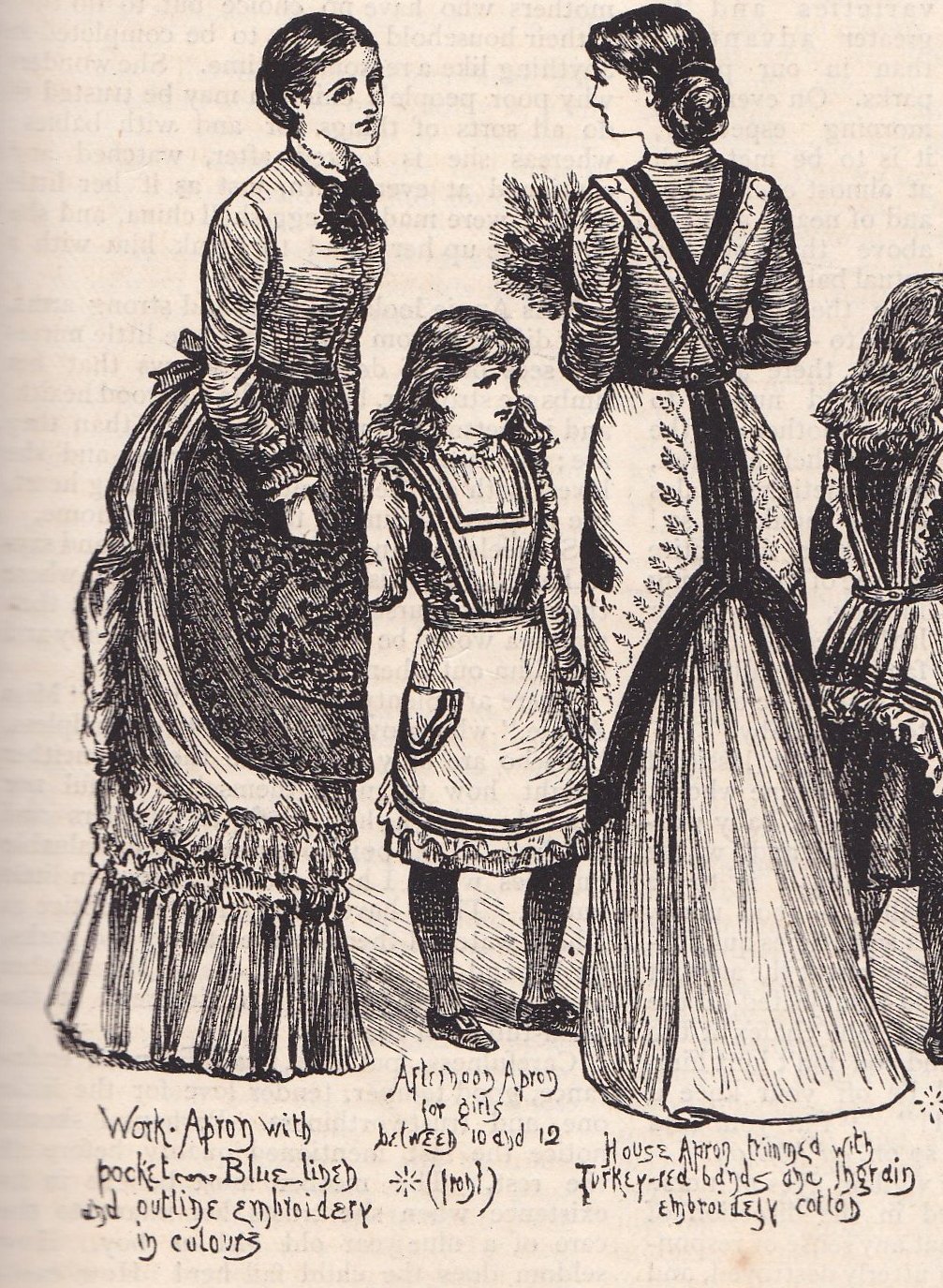
The first three may be called "dress," or afternoon aprons, and they are suitable for that time of day when we are all supposed to have done work, and put on our best frocks. The first apron is of white muslin or nainsook; it has a gored centre, and two gores at the sides, and is trimmed with tatting and muslin puffings. The little girl's apron is of the well-known princess shape, and may be made of any white washing material, from muslin, to a figured brilliant or jaconet, trimmed with embroidery. The third figure wears a charming apron, both in style and trimming. It is of mull muslin, or Victorian lawn, trimmed with frills of the same, and a fancy-coloured washing braid.

The next two figures give the back and front of a housekeeping, and cooking apron, which is made of a coloured printed cotton, or a sateen, those with a white ground being the most suitable. It is edged all round with a frill of the same, and has a large pocket which may be placed either at the side, or in front, as the wearer pleases. The next figure wears a useful house-apron, which completely hides the dress, and so is equally valuable to protect a new or to hide an old one. The material may be unbleached Barnsley linen, brown Holland, or any of the new fancy materials, such as oatmeal cloth. The bands are of blue linen, with an appliqué pattern in vine leaves of Turkey-red cotton or cretonne flowers. Plain bands may be used.

The work-apron with a pocket will prove an immense comfort to those who do much needlework or knitting, as not only does it hold the balls of yarn, the cotton, scissors and needles, but the work itself can be safely put away in it, to be found in order for an immediate start when taken up again. The material of our illustrated apron is blue linen, with outline or cross-stitch embroidery in coloured ingrain cottons. The little girl's apron with a bib and bretelles, or shoulder straps, is a very pretty and stylish pattern, the back being especially effective. Any material, from muslin to silk, may be used, the pattern given being made of muslin, with a muslin and lace frilling, and three rows of narrow black ribbon, velvet all round, which of course requires to be taken off when the apron is washed. The young lady's house-apron is perhaps the most useful and practical of all. It is made of workhouse or Bolton sheeting, and has bands of Turkey-red twill laid on, and sewn down with the sewing machine. The little design above is worked with red and blue ingrain cotton. The front resembles that of the little girl's, but the shoulder straps cross behind instead of coming down straight to the belt.

The Roman apron is the newest of all that we have illustrated. It is made of fine unbleached linen, or it may be of pure white. It is cut lengthwise, and is about one yard and a half long, and folded over nearly half a yard from the top. The strings are sewn in under the fold three inches from the edge on each side. The decoration consists of two rows of embroidery, which may be done in drawn-work, cross-stitch, or even in crewels. The ends are fringed and then knotted evenly, and the sides are hemmed up. The width of the apron is three-quarters of a yard. The next apron is also called a Roman apron, although not doubled over at the top. It is made of black silk and is twenty-four inches long by twenty wide. The length is increased by the addition of the trimming and lace to over three-fourths of a yard. The trimming consists of strips of red, blue or white linen, worked in a border design of cross-stitch with ingrain cotton. The lace is an ordinary inexpensive lace, sewn on with very little fullness.

The small design at fig.1 is intended to give an idea of the new darned work, which has been revived from the seventeenth century styles of embroidery. The material used is huckaback; the price about 10d per yard. The ends are fringed, and the unworked end is turned over, like the usual Roman apron, the lower part alone being worked. The design chosen is a conventional pomegranate, from a series of designs lately published, which are copies of ancient needlework. The pattern is traced, and worked first in outline stitch in blue filoselle, which should be split to three strands only. The background is then put in by darning from every one of the double threads which appear on the surface of the huckaback. The square is, of course, traced first to keep it even in working. The colours chosen may be all blue, blue in two shades, yellow for the grounding, and red for the outlining, or even a mixture of tints, if great cleverness be exercised in doing it.
The only apron I have left unnoticed is that in the well-known handkerchief style, which has now become so common, and is so cheaply purchased, that it has passed beyond the ken of our more artistic workers.