Showing posts with label history. Show all posts

Thursday, 24 November 2016

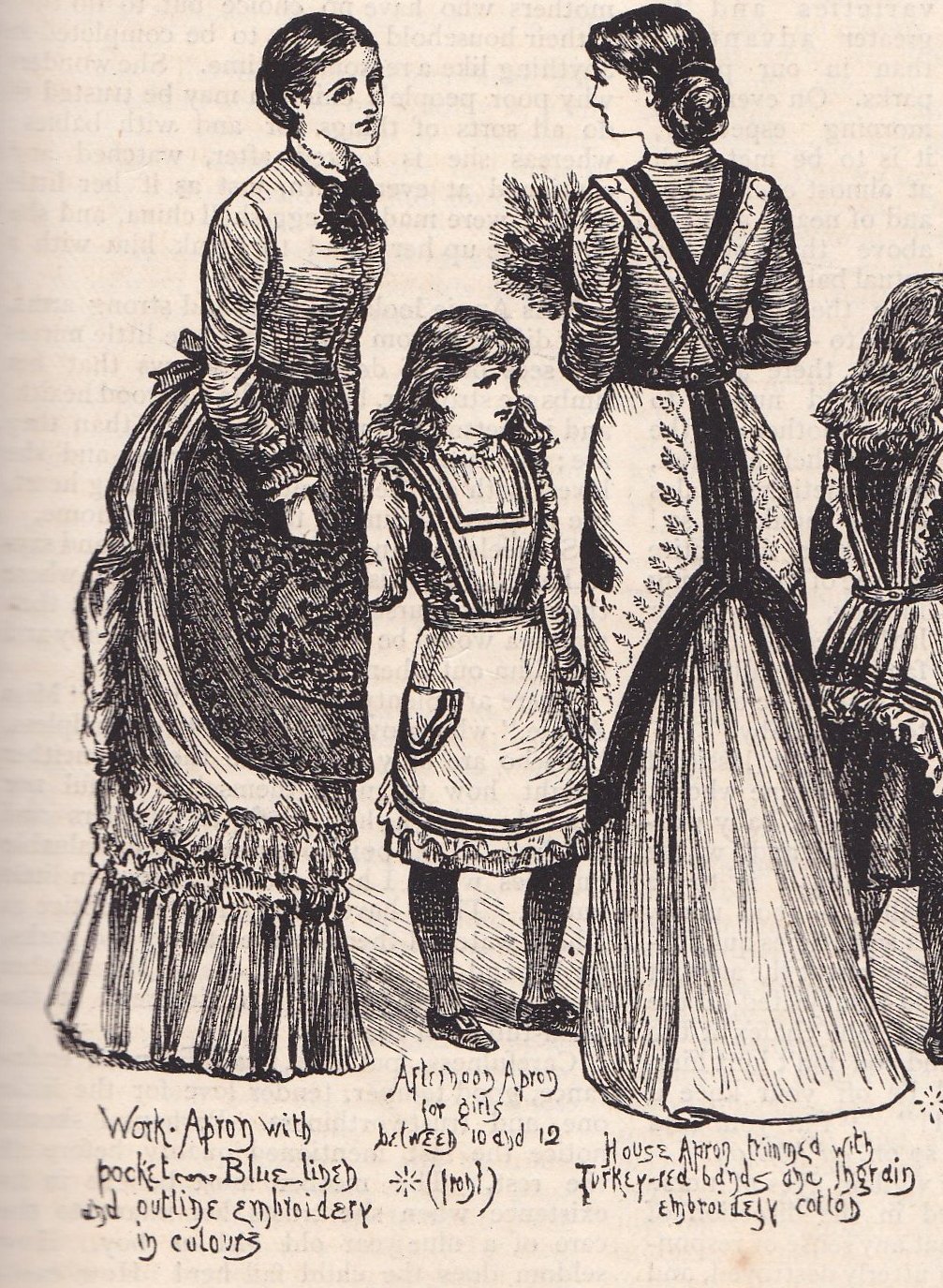
23 April 1881 - 'Aprons'

I'm guessing that for the working class, aprons didn't actually appear between the 18th and 17th centuries. Just saying.

There is nothing so pretty as an apron for home wear. It seems to give an air of pleasant homeliness to the wearer, and at once stamps her character s careful, economical, and exquisitely tidy – qualities which she will surely carry into everything she undertakes in life. She is perhaps a little precise too, which will show itself in punctuality as to time, and as to business-like habits in keeping her engagements, and we feel nearly sure that the apron-wearer will neither disappoint, nor vex us with any unreliability. The word itself is a strange blunder, being "a napperon" converted into "an apperon", - napperon being the French for a "napkin," from nappe, "cloth". In many counties in England it is said that the word "apperon" is still used.

Perhaps the most interesting part of the apron is its extreme antiquity. It appears to have been worn from the Fall until the present day In our own country Strutt, who wrote on the "Dress and Habits of the People of England," gives an illustration of it as used in his time, the thirteenth century. His picture shows us a blacksmith at work, in an apron precisely similar to the leathern one still worn. It is tied round the waist, and thence rises to the breast, which it completely covers, and is secured round the neck by a tie. This shape had been in use long previously by women, and continued so long afterwards. It was also worn at that date by the upper classes as an ornamental addition to the dress. In the fourteenth century the apron was called a "barme cloth" in England, and in "The Miller's Tale" Chaucer gives a description of it as worn by the carpenter's wife. She wore –

"A barme cloth, eke as white as moe milk,
Upon her lendes, full of many a gore."

These many gores are thought to mean "plaits," or perhaps gathers, which were done in the way we now call "honey combing."

After this period the apron was confined to good housewives in the country, until the sixteenth century, when the ladies took them again into favour as articles of decoration; and used them of so fine a texture that a poet of the day says –

"These aprons white, or finest thread,
So choicilie tied, so dearly bought,
So finely fringed, so nicely spread,
So quaintly cut, so richly wrought;
Were they in work to save their coats,
They need not cost so many groats."
- Stephen Gosson's "Pleasant Quippes for Upstart Gentlewomen," 1596

These aprons were edged with lace, and one of them may be seen on the monumental effigy of Mistress Dorothy Strutt, in Whalley Church, Essex, who died in 1641.

In the days of King William III, they again became an indispensable part of a lady's dress, and were very small, edged round with the finest and most costly lace, and covered the top of the petticoat, the front of which was fully displayed by the open gown then in use. Good Queen Anne herself wore an apron later on, and in her reign they were richly decorated with needlework, gold lace, and spangles; and occasionally these ornaments formed a framework for a small picture, which was painted on satin and sewn on the apron. One of the aprons of this date, which has descended to me from an ancestress, is in my possession, and is a beautiful example of needlework. The ground is of white silk, the apron being about half a yard square. The border is of leaves in coloured silks, and vines and flourishes round them in silver thread and cord. The fineness of the work is a subject of wonder to all who see it. It was worn under the pointed bodice, and they sometimes had a stomacher to match in colour.

In George II's reign they were worn very long and quite plain, without lace or ornament, but occasionally fringed at the end. The material seems to have been white muslin or lawn. A curious anecdote is told of these aprons. It appears that Beau Nash, the Master of Ceremonies and the celebrated "King of Bath," had the strongest aversion to them, and excluded all ladies who ventured to appear at the Bath assemblies dressed in that manner. In Goldsmith's "Life of Nash" it is said that "at one assembly he went so far as to strip the Duchess of Queensberry's apron off, and, throwing it down on one of the back benches, declared that none but abigails appeared in white aprons." How strange a picture of the mixture of rudeness, and extreme ceremony in the manners of that day!

Short aprons of cambric were worn in full dress in 1788, and after that we do not hear of aprons being much in use until 1830 to 1850, when all ladies wore them, made generally of black silk, and though decorated and ornamented in various ways, they were not the entirely useless articles of dress of the preceding century, but were intended to combine the useful and the ornamental.

A great revival of aprons took place when art needlework commenced to be applied to them about the year 1874. Since then they have been in constant use  for the household-work and lawn-tennis, and they will in all probability retain their hold on our fickle fashions for some time to come; but whether this be so or not all young girls should make a practice of wearing them, as they add much to their appearance both at work and at play.

In our page of aprons we have tried to gather together all that is prettiest and most useful, too, of the modern styles, and in order to please every one of our girls we have taken all materials and aprons for all seasons and events.


The first three may be called "dress," or afternoon aprons, and they are suitable for that time of day when we are all supposed to have done work, and put on our best frocks. The first apron is of white muslin or nainsook; it has a gored centre, and two gores at the sides, and is trimmed with tatting and muslin puffings. The little girl's apron is of the well-known princess shape, and may be made of any white washing material, from muslin, to a figured brilliant or jaconet, trimmed with embroidery. The third figure wears a charming apron, both in style and trimming. It is of mull muslin, or Victorian lawn, trimmed with frills of the same, and a fancy-coloured washing braid.


The next two figures give the back and front of a housekeeping, and cooking apron, which is made of a coloured printed cotton, or a sateen, those with a white ground being the most suitable. It is edged all round with a frill of the same, and has a large pocket which may be placed either at the side, or in front, as the wearer pleases. The next figure wears a useful house-apron, which completely hides the dress, and so is equally valuable to protect a new or to hide an old one. The material may be unbleached Barnsley linen, brown Holland, or any of the new fancy materials, such as oatmeal cloth. The bands are of blue linen, with an appliqué pattern in vine leaves of Turkey-red cotton or cretonne flowers. Plain bands may be used.


The work-apron with a pocket will prove an immense comfort to those who do much needlework or knitting, as not only does it hold the balls of yarn, the cotton, scissors and needles, but the work itself can be safely put away in it, to be found in order for an immediate start when taken up again. The material of our illustrated apron is blue linen, with outline or cross-stitch embroidery in coloured ingrain cottons. The little girl's apron with a bib and bretelles, or shoulder straps, is a very pretty and stylish pattern, the back being especially effective. Any material, from muslin to silk, may be used, the pattern given being made of muslin, with a muslin and lace frilling, and three rows of narrow black ribbon, velvet all round, which of course requires to be taken off when the apron is washed. The young lady's house-apron is perhaps the most useful and practical of all. It is made of workhouse or Bolton sheeting, and has bands of Turkey-red twill laid on, and sewn down with the sewing machine. The little design above is worked with red and blue ingrain cotton. The front resembles that of the little girl's, but the shoulder straps cross behind instead of coming down straight to the belt.


The Roman apron is the newest of all that we have illustrated. It is made of fine unbleached linen, or it may be of pure white. It is cut lengthwise, and is about one yard and a half long, and folded over nearly half a yard from the top. The strings are sewn in under the fold three inches from the edge on each side. The decoration consists of two rows of embroidery, which may be done in drawn-work, cross-stitch, or even in crewels. The ends are fringed and then knotted evenly, and the sides are hemmed up. The width of the apron is three-quarters of a yard. The next apron is also called a Roman apron, although not doubled over at the top. It is made of black silk and is twenty-four inches long by twenty wide. The length is increased by the addition of the trimming and lace to over three-fourths of a yard. The trimming consists of strips of red, blue or white linen, worked in a border design of cross-stitch with ingrain cotton. The lace is an ordinary inexpensive lace, sewn on with very little fullness.


The small design at fig.1 is intended to give an idea of the new darned work, which has been revived from the seventeenth century styles of embroidery. The material used is huckaback; the price about 10d per yard. The ends are fringed, and the unworked end is turned over, like the usual Roman apron, the lower part alone being worked. The design chosen is a conventional pomegranate, from a series of designs lately published, which are copies of ancient needlework. The pattern is traced, and worked first in outline stitch in blue filoselle, which should be split to three strands only. The background is then put in by darning from every one of the double threads which appear on the surface of the huckaback. The square is, of course, traced first to keep it even in working. The colours chosen may be all blue, blue in two shades, yellow  for the grounding, and red for the outlining, or even a mixture of tints, if great cleverness be exercised in doing it.

The only apron I have left unnoticed is that in the well-known handkerchief style, which has now become so common, and is so cheaply purchased, that it has passed beyond the ken of our more artistic workers.


Saturday, 15 October 2016

5 March 1881 - 'Female Names' No.3 - 'Edith'


Yes, there have been two previous 'Female Names' papers, but this is the name of my favourite Crawley sister, so we are skipping right to it, especially omitting name number one, as this is my blog. (Okay, I will transcribe the others too if anybody wants me to, just email me or leave a comment.) 

How very little most of us think of our Christian names! Yet, if we would only see it, every name is a little poem in itself, and every name contains a moral lesson which we all of us should be the better for attending to. Our name may, it is true, have been given to us somewhat at haphazard; we may have been called after one of our godparents or relatives, or possibly after some illustrious personage. Or again a name may have been chosen because it is pretty or romantic. But however we may have come by our Christian name, we cannot change it, much as we may wish to, so let us make the best of it, and try to learn what we can about its meaning and its associations.

It is a good sign that at the present day we are returning to our fine old English names once more; we have done with the Letitias, Euphemias, Clarissas, Arabellas, and Sophonisbas of the last century, and even such names as Julia and Amelia are becoming less common every year. We consider this a very decided improvement, for why should we go to Latin or Greek for names when our own English tongue supplies us with such a variety of beautiful appellations? Our surnames are  for the most part pure English, and  for the future let our Christian names be English likewise.

Surely such a name as that of Edith is not inferior in sound to any grandiloquent classical appellation, and it has the advantage of being pure Anglo-Saxon, and of possessing a most beautiful meaning. The earliest form of the name may sound somewhat harsh to modern ears, but to those who first used it the meaning it conveyed was so apparent as to atone for any defect in the sound. Eadgyth, as the name was first written, meant "a noble gift," and was a name very frequently given to the princesses of the West Saxon Royal house. Indeed, our early kings were very fond of the first syllable of this name, and it occurs in a great many of the Royal cognomens. Thus we have three kings before the Conquest called Ead-ward, two Ead-munds, one Ead-wig, and one Ead-gar, and besides these there are found such names as Ead-ric, Ead-bald, and Ead-bert among the various members of the Royal house. This prefix ead, then, was a widely used one, and very beautiful it is, signifying "noble," "pleasant," "happy," "prosperous." And so when a fair daughter was born to one of our Anglo-Saxon kings, he often called her Ead-gyth, "the noble gift from God," just as the Greeks gave their children the name of Dorothea. Of these early Ead-gyths, or Ediths, the most famous were the daughter of Edward the Elder, who became the wife of the mighty Emperor Otto the Great; and the daughter of King Edgar whose holy life and good deeds earned for her the title of Saint Edith. The wife of the Confessor was Edith, daughter of Earl Godwine, whose virtues were praised by English and Normans alike. The latter, who hated Godwine, because he had once driven all the Normans out of England, made a verse which said that as a rose springs from a thorn, so had Edith sprung from Godwine. Of another Edith, whose beauty gave her the name of Swan's-neck, it is told that she, and she alone, recognised the body of her lover Harold as he lay dead on the fatal field of Hastings.

When the Normans got hold of England, of course all English names were dropped, and instead of Edwards and Harolds we find Roberts and Williams, and so strange did the English names seem that when Edith of Scotland, who was the niece of Edgar Etheling, was brought into England to be married to King Henry, her name was changed to Matilda, or Maud, which was as favourite an appellation with the Normans as Edith had been with the Anglo-Saxons. So that we must not forget that the real name of "Good Queen Maud" was Edith. Many are the stories told by the old chroniclers of her piety and her charity, how she washed the feet of the poor, and tended the lepers, relieved the wretched and studied to increase her holiness. Everyone who saw her was the better  for the sight, and when she died the whole nation mourned as if each man had lost his mother.

Of Edith, King Edgar's daughter, a story is told which shows her to have possessed a degree of common sense in religious matters very uncommon in those days. She possessed a natural love for fair attire, for which he was one day rebuked by a monk, who thought by his untidiness and slovenliness to manifest his great devotion and unworldliness. But Edith quickly answered that she thought a mind might be as pure and devout under seemly raiments as beneath tattered rags.

From the time of Good Queen Maud we hardly meet with any Ediths till we come to the present century when the grand old name began to be revived, and we find Charles Lamb, after enumerating some fashionable names of the day, declare, "These all than Saxon Edith please me less." Since his time Edith has gradually been getting into favour, and it bids fair to be, as it really deserves to be, one of the most popular of our female names. All those girls who bear the name should never forget its meaning, and should try to be in reality happy, blessed gifts to their parents, while from "Saint" Edith and from Good Queen Maud they may learn lessons which are not altogether unneeded in our day.

Friday, 29 July 2016

13 November 1880 - 'The Weddings of the World - a Wedding in Egypt'


I'm not sure of the relevance of this (very lovely) illustration, as the wedding described below is obviously not Christian, Coptic or otherwise. 

The beauty and charms of the women of ancient Egypt are gravely recorded in history and sung in poetry, and modern travellers have been as earnest and elegant in admiring their descendants. Their accomplishments were music, dancing and singing. They had an extravagant love of jewellery. They had their picnic parties, they paid house-to-house visits, they frequented the fashionable drives and promenades in their handsome chariots, and they carried the arts of dress and the toilette to an extreme never since exceeded. They were fond of gardening, practised gymnastic exercises, played games with balls, embroidered and did various kinds of work with their bronze needles. There is no reason for believing that they did not make excellent wives and mothers.

The social and legal rights of women were first recognised in ancient Egypt. Hermes, the great founder of its government and laws, decreed that a man should have but one wife. Diodorus, who wrote his history of Egypt about forty-four years before the birth of Christ, says that anciently the marriage contract was regarded amongst the Egyptians as one of grave importance, in which the husband pledged himself to yield implicit obedience to the wife, and she, as solemnly, promised to place his claims upon her love and fidelity before all other claims, including those of her children, should their union be productive of a family. It is most probable that the occasion of ratifying such a contract was, even in the earliest times, accompanied by some festive, religious, or legal ceremonies, but if so, we have nothing to show what they were. The barbarous conquerors who destroyed the written records of old Egypt have left us nothing belonging to those early times but monumental hieroglyphics. I can only tell you that the bride wore a wedding ring, that in their matrimonial unions ties of consanguinity were disregarded, and that marriages between relatives were frequent and common.

How superstition and polygamy dishonoured and degraded the female sex in Egypt is another and a later, and yet a very ancient, story. What the result was is a lesson too sad to be dwelt upon - the pages of Diodorus which chronicle it seem to be written in blood and tears - and that influence, alas! Is still in existence.

Passing along the downward course of Egyptian history, we come to the Egypt of a hundred years ago, and enter, by virtue of our invisibility, a great place of public assembly for women - the bath - into which, while they are present, it is death by the law for a man to introduce.

We are in the midst of a noisy crowd of women, old and young, laughing and chattering and talking of their domestic or private affairs, all proudly displaying their fine clothes and jewellery. A great number of active little children are romping and playing with the salve girls in their midst. The mistress of the ceremonies is settling a dispute between some rival beauties; the attendants, accustomed to the noise and confusion, run here and there to take this or fetch that, render assistance in one place or supply refreshments in another. The humid air is heavy with perfume, and here and there the smoke of burning incense ascends.

Some are richly attired in muslins and silks interwoven with threads of gold, rich European brocade, and the flowered stuffs of Aleppo, with trimmings of choice furs, &c, and with head-dresses heavy with pearls, jewels, flowers and small golden coins. Others are stripped  for the water and putting on their bathing wrappers, or having their long jet-black hair carefully braided into numerous small, or a few large, plaits, or the edges of their eye-lids blackened, or their finger nails newly stained with henne. A few are preparing to depart, enveloping themselves from head to foot in capacious mantles of white linen or black taffety, leaving nothing visible but their eyes.

Yonder on the divan, partaking of the chibouk or cup of coffee, are a pair of portly matrons engaged in very earnest conversation, which they interlard with the most extravagant flattery. They have been sighing to see each other ever since they last parted. They have been pining to death  for the honour of receiving each other's visit. The greatest possible happiness to them is that of their frequent meeting.

When each matron kisses and bids the other adieu before gathering together her own and going home, each riding astride, a shapeless mass of drapery upon a magnificently caparisoned donkey, and each with the chief officer of the harem riding before her on horseback, there has been done a deed of mighty note - the first step for a marriage between Fatima, aged seventeen, to a young man she has never seen and one who has never seen her, Seid Abdalkadan, the youngest son of Seid Mustafa, has been arranged.

Soon after the male relatives of both families have a formal meeting, at which each side appoints a representative to discuss preliminaries and draw up the contract of betrothal, which binds the bridegroom to pay a given sum as a dowry and settle upon the bride a regular payment as bath money, a kind of wedding by proxy. The iman, or priest, being present, asks one proxy if he is willing to take the fair Fatima for a wife and pay down the sum agreed upon by way of portion. If the reply is an affirmative, a similar question is put to the other proxy, whose consent being received, a purse containing, or supposed to contain, the bride's dowry is given to her father by the bridegroom's father. Then, the contract being duly signed, sealed and witnessed, the ceremony is concluded by the iman's reading some verses from the Koran.

The next step is that of taking this legally confirmed contract to the cadi, who grants his licence  for the wedding in the form following:-

"Our Lord and Legal Judge, Seid Husseyn, grants permission to Fatima, the daughter of Hadge Abdalkadan, dwelling in, &c., she having been legally betrothed, to marry Seid Abdalkadan, youngest son of Seid Mustafa, granting always that there is no lawful impediment to their union."

To this is appended the date with, at the top, the seal of the cadi.

The father of the bride usually adds to the bridegroom's dowry a second sum of money, which, with the first, is expended in purchasing the young lady's bridal apparel and jewels.

Then, indeed, the entire harem breaks into a state of wild confusion. The preparations employ every hour and every thought amongst its inmates. Every relative, friend, and acquaintance receives the good news, and from each a wedding gift is expected. Curiosity is on tiptoe to know in what forms and numbers these presents will arrive. During the several days preceding the nuptials the betrothed maiden is carried with great pomp to the bath, attended by all her female relatives, her sisters, and her cousins, and her aunts. Everybody is anxious to see, and all who know her are anxious to present their congratulations.  It is the delight of everybody to please and amuse her. They describe the handsome looks of the husband to be, tell her of his goodness and his wealth, for she, poor thing! Knows nothing about him. They dress her up in male attire, by way of fun, making her first a janissary, then a mameluke, and then some other male character, until the harem rings with their mirth, and laughter. They sing songs to her, songs special to the occasion; and so the time flits rapidly away.

The day before the wedding is devoted exclusively to the mysteries of the toilet, and in the evening a rich supper is sent from the house of the bridegroom, where he is being entertained at a special feast.


At sunset on the wedding day there comes a grand procession from the bridegroom's harem led by his female relatives, by whom the bride is torn, as it were, from the arms of her weeping mother, and conducted in triumph to her new home. The return procession is led by dancers on stilts, who carry ornamental balancing poles; then come the bearers of great feather fans, which bend and wave gracefully in the air; some sprinkle scented waters on the path; conjurers and mountebanks perform feats of skill, strength, and agility as they pass; troops of alme, or dancing girls, follow, their lithe bodies languidly swaying in slow movements, which keep time to their music and singing. Then the matrons of the united families appear in their richest attire gravely walking, and after the, concealed under a magnificent canopy upheld by four slaves, comes the bride, sustained by her mothers and sisters, and entirely covered with a veil embroidered with gold, pearls and diamonds.

After them march a long file of torch bearers, followed by slaves carrying the dowry and bridal gifts, clothes, furniture, jewels, &c., &c., all separated and spread out to make as fine and as long a display as possible. This being the grandest and most interesting feature of the bridal procession, and that concerning which the most curiosity is displayed, much care is taken in exhibiting the various articles to the greatest advantage, and by the greatest possible number of bearers. The procession advances slowly and by the most circuitous and longest route, pausing here and there to give every opportunity to the crowds of sightseers, while the alme sing songs in praise of the bride and bridegroom. Guns are fired at intervals, and every now and then is heard that peculiarly sharp, shrill warbling cry of female exultation peculiar to the East, and called ziraleet.


At last the pompous bridal procession reaches the bridegroom's house, and the exulting women take possession of the harem to presently witness the festivities in which they have otherwise no part, those of the bridegroom and his friends.

At these the dancing girls again appear, and, throwing off their veils, dance to the sounds of tabours, cymbals, and castinets. Nuptial songs are sung, and choruses are chanted which extol the allurements of the bride. She is more beautiful than the moon of a summer night, more lovely than the rose, sweeter than the jasmine. How fortune and happy must be the bridegroom who is united to so charming a creature! Between the verses "shrill ecstasies of joy," the ziraleet rings out, and is heard to a great distance.

During the evening the bride assumes her male masquerading disguises, and passes before the bridegroom, the matrons display their wealth and finery by frequent changes of dress, and the younger part of the assembly amuse themselves with sprightly gambols and games.

When, at a late hour, the guests are about to depart, the bridegroom appears in a fresh and costly dress, and is taken in procession, with music and loud shouts of exultation, to the outer door of the harem, where the women receive him and conduct him in procession to meet the bride, who is in her rich wedding dress and veiled in red gauze. When she appears at the top of the stairs he pauses at the bottom, and her attendants begin a dispute with those of her husband as to which party shall first advance to meet the other. A compromise is arranged; she descends, he ascends, and they meet in the middle of the stairs. There he receives her hand and they ascend together, and soon after the bridal veil is removed, and  for the first time Seid Abdalkadan looks upon the face of Fatima his bride, in the midst of a wild outburst of music and joyous voices.

The feasting usually continues during the remainder of the night, and is resumed on the following day, lasting sometimes the entire week.

Such is a wedding as performed in Egypt. How different from the pious and beautiful ceremony in use in our own beloved country!

Tuesday, 1 March 2016

21 February 1880 - 'Hats and Bonnets of the Nineteenth Century' by S.F.A. Caulfield

In which we invite the readers of the G.O.P. to LOL at the ridiculous things people used to wear on their heads.

The extraordinary freaks of fashion in olden times scarcely exceed the absurdities into which we have been led since the first development of a bonnet out of the hat. This variation in our out-of-door head-dress dates from the year 1795. The original bonnet was shaped like a jockey-cap, the brim in front spreading out rather far on a line, with the top of the ear. It was tied on with lavender-coloured strings without ends, was composed of straw, the dome-shaped crown, decorated with red perpendicular stripes, meeting at the top (still jockey fashion) while the projecting brim was plain, and a wreath of laurel leaves surrounded the head.


Small-sized bonnets continued to be worn, as well as hats, up to about the year 1820, when, as our illustration will show you, the brim had expanded and there was no cap border to fill up the empty space underneath it. Some kind of ribbon ruching decorated the brim all round, the latter reaching down below the ear; and there was also a ribbon trimming for back round the crown.


Ten years afterwards a very plain and unbecoming style came into fashion - trimmings were almost at a discount. One plain piece of ribbon was passed round the middle of the coarse straw bonnet, the ends of which were tied under the chin; while, at the back and under the flat-lying crown, there was a frilling of the ribbon or of a piece of silk of the same colour, as a finish to the bonnet, and a shade to the back of the neck, called a "curtain". The straw was either of the natural colour, or else dyed black or brown. Sometimes a plainly-tied bow was placed, like a butterfly, on the top of the head, midway between the crown and the brim. Such a bonnet as this may still be seen on the girls of some of the "charity schools".

A few years afterwards young people often wore beaver bonnets, which were shaped much in the form of the above-named "cottage". These were trimmed with thick silk cords and tassels, matching them in colour.


Simultaneously with the wearing of these two descriptions of bonnets, turbans were in fashion amongst the dowagers, and these were transmitted from a still earlier date. A beautiful satin of a delicate shade of French plum-colour, or violet-grey, was sometimes manufactured into a high turban kind of cap, having a flat band of the material across the head, a high "caul" standing up at the back, and a narrow frill of lace round the face. Others wore a loosely-twisted and more Turkish-looking turban; either of velvet, or silk, or of both folded together and usually very bright in colour .These were decorated, as in the illustration, with feathers or other ornaments.


It is scarcely surprising that the hideous article known as the "cottage bonnet" of 1830 ceased to have any attractions after a reign of some seven years, and that we flew into another, and just opposite, extreme of fashion, when the immense flaring bonnet, assigned to the year 1837, the year of the accession of Queen Victoria, took the economical amongst us so painfully by surprise, with its floral decorations inside the deep front, and the three or four nodding ostrich plumes, towering high above the crown. The strings securing it were tied, in bows on one side, and, as you may imagine, it was a matter of some inconvenience to walk out on a rough day, as the preposterous front acted quite as a wind-sail, and it was with no little difficulty that it could be kept on the head. The name of this ill-contrived head-covering was an "opera hat", though "hat" it really was not; and it was either made of plain velvet or of silk. It is also worth observing that they were worn not merely out of doors and at the opera, but also at balls.


In a couple of years from the first appearance of the "opera hat", some modifications took place; the shape was a little changed, but the dimensions were reduced, and the trimming was omitted - at least, a plain band round the crown, a binding round the brim, a curtain, and a bow or two at the back, replaced the costly plumage of the previous two years. A cap border was also worn, very slight round the upper part over the hair, and very wide and thick at each side of the face.


Passing over some few years, and the trifling varieties, regulated by individual fancy, either of the milliner or the wearer, helping to fill a gap in the history of fashion, we find that a soupcon of the discarded "cottage" appeared about the year 1846, rather less unsightly, yet meagre in design, lying flat on the head, brim and crown being run into one, and parallel respectively with each other. A wreath of leaves or flowers enlivened its dullness outside, together with some narrow bands of ribbon or velvet laid across it at equal distances apart. No cap-border was worn with this head-gear, but the vacant space between the front and the face was partially filled up by large sausage-like rolls of hair, laid against the cheek and extending to the jaw, while a comb confined the braids across the forehead just above the eyebrows. These very unpretentious bonnets were made of straw, and were tied on, under the chin, with a bow of broad ribbon, the shallow curtain being of straw. Very pretty fancy straw bonnets were worn within the years 1840 and 1850, with trimmings of the same. These were Tuscan straws, of a buff colour, and sometimes the bonnets were made in alternate bands of straw plait, and gathered quillings of silk.


 Gathered silk bonnets, of plain or checked material, in various colours, came into fashion in the year 1848, and with them the whisker-like cap-borders, lying on each cheek, and unconnected one with the other by any upper border. Ribbons and flowers embellished these quillings, which could be seen in profile below the rim of the bonnet-front, which was a good deal cut away from the cheeks on either side. Broad strings were tied in a bow under the chin, but no trimming decorated the exterior. The brim was moderately deep, spreading at the sides, and depressed at the top.


In about the year 1850 the brims of our bonnets were very wide, round, and deep, and the deep cap-frill of the previous style was still retained. These bonnets were of straw, and had very broad strings, tied in a large bow under the chin.

I do not pretend to give an unbroken list of all the out-of-door head coverings worn in each successive year, from the beginning of this century up to the present time; but so far only as any great varieties of fashion cropped up, from time to time, during that period. Of course there can be but one opinion respecting the fact that no fashion of the 19th century has ever been so extravagantly bizarre as those of the head-dresses that immediately preceded the creation of the bonnet. For example, if the "fair Mary Anne Robinson' otherwise known as the "Bird of Paradise", (an engraving of which may be seen in Fairholt's "Costumes of England") and others quite as monstrous, that excited no surprise nor disapproval in the year 1728. Those were the trying days when our unfortunate grandmothers or great-grandmothers used to require the services of a hairdresser on every occasion that their hair had to be "taken down", turned up again, and stuck all over with ribbons, flowers, feathers, and lace. What with all the false hair, pomatum, powder, and pinnings on all of the decorations in their right position upon a cushion laid on the top of the head, no one could rear up such an amazing erection for herself; nor could any ordinary maid do it for her. To save expense, therefore, a hairdresser had to be engaged monthly, or by those who could not economise in such a matter, weekly; and the operation he then performed was called "opening a lady's head"; when, as they significantly expressed it, "it would keep o longer!" At night, a large "net fillet" was put over all this grandeur, combining indoor head-dress, and outdoor bonnet, and hat all in one; and this bag was tied closely with a drawing string  for the night. I suppose that at no period of the world's history did women suffer so acutely  for the satisfaction of looking each like her neighbour.


Weary of the round broad brims and heavy cap-borders of the year 1864, we seem to have returned to our craze for height. Straw was still in vogue, and cutting away the brim at the ears, we raised up the centre to such a degree that, at a little distance, and regarded "full-face" it looked like a sugar-loaf. The whole of the inside was a mass of flowers and ribbons, and a broad pair of strings were tied under the chin. These bonnets were called "spoons".


Look at the hideous hat of 1865.

After a reign of about two years the style of our bonnets again underwent a complete change, and the cone-shaped brim was seen no more, Then came in a very reasonable and pretty little cap-shaped head-dress, made of lace or tulle, upon a shape of buckram and wire. A small trimming of flowers decorated the exterior but the bonnet lying flat down on the top of the head, there was no room for embellishment inside the brim. A pair of tulle or lace-veil-like strings were connected together, at some distance below the chin, with a small bouquet or single flower.


In the year 1869 as you will observe from the illustration supplied, this pretty article of dress was deformed into a sort of patch, made of wire and buckram, covered with tulle and lace, worn like a saddle, and looking like a basket women's "pad" on the top of her head, to save it from injury in carrying her burden. A pair of silk lappet-strings, laced or fringed-out at each side, were brought together in the same style as those previously worn; the hair being elaborately dressed, and made the most of, to supply the deficiencies of this apology for a bonnet at the back.


Excepting the elderly ladies, hats appear to have aided considerably in filling-in the space of time between the introduction of the last style and the two nondescripts - half bonnet and half hat - that succeeded it in the years 1875-76. The first was of silk, and was perched on the back hair, showing a plait or coil of it in front. The brim was rather wide, and turned up all round. A large rose or bouquet was worn underneath it, over the left ear; and a large ostrich feather inserted in front, fell back over the crown. The hair was no longer brought down on either side of the forehead, but continued, as in the patch-bonnet, to be brushed back from the face; and the short-cut fringe of that over the forehead, so worn in 1866, remained in fashion til 1876.


The year last-named saw a change in our head coverings. Straw reigned once more, but there was a little of it in the saucer shapes that again served only to cover the back-hair, and to leave one plait of it visible in front. Feathers, silk bows, and bunches of fruit nearly hid their foundation from view; and a pair of broad tulle or net strings were brought round from the centre of the back, to be united on the chest of the wearer. These two last-named bonnets were in very bad taste, and had an indescribably vulgar effect, perhaps to be accounted for by its peculiar associations, i.e., the great tenacity with which the lower classes have retained these shapes, with their dirty, gaudy finery, and the bold look of suck a lack of covering, and shade to the face out of doors - placing them on the back hair as they still do, up to the present time.


It would be impossible to say what style of head-gear more than another distinguishes the taste of to-day; so many are the forms adopted to suit the faces or fancies of the wearers; nor would it always be possible to distinguish which was a bonnet and which was a hat.


Monday, 22 February 2016

7 February 1880 - 'The Cup That Cheers' by S.F.A. Caulfield

Our meals and meal-hours have passed through great changes since the first records of English home-life were written. Our early English ancestors took four meals a day - breakfast at 7 a.m., dinner at 10, supper at 4 and "livery" at 8 or 9, after which they retired  for the night. The middle-class - persons employed in trade - the peasantry, and labourers of all kinds had three meals a day; breaking their fast at 8 a.m., dinner at 12, and supping at 6 p.m.

The nobility and gentry rose at 6 a.m., and, at their breakfast, as at other meals, they had no drinks  but wine and beer. Queen Elizabeth rarely varied hers from the latter, as she feared that the former might cloud her faculties. Dr Johnson says that the Earls of Arlington and Ossory imported tea from Holland in 1666 - the year when the Plague broke out in London - and that the great ladies of the country were taught how to make use of it by their two respective wives. He also gave it as his opinion that this was the first appearance of tea in England. But in this latter assertion he was mistaken. Notices of it, scarce as it was, are to be found of earlier date. If you have a copy of "Pepys' Diary" in your home library, you will find a mention of his taking "a cup of tea, a China drink" - which he had never before tasted - on the 25th of September 1660. That same year a duty of eightpence a gallon was laid on all tea and chocolate made for sale; and in the previous year (1559) tea was sold in nearly every street in London, although at enormous prices. Indeed, in 1661, a couple of pounds and as many extra ounces were presented as a worthy gift to the Sovereign himself by the Honourable East India Company. Although exceedingly scarce at first, tea dates back some years, earlier in the 17th century than the periods already named.

The real date of its first introduction is ascertained to have been at about 1635; and for some twenty or thirty years afterwards it price varied, according to the quality, from £6 to £10 per pound. A certain Thomas Garraway, tobacconist and coffee-house keeper, was the first to sell tea by retail at the more reasonable price of 16s, up to £2 10s the pound. "Doctors differed", but "patients" did not "die' from their conflicting opinions about it. According to one advertisement, it was "by all physicians approved"; but amongst other detractors, Guy Patin, a French doctor, denounced it as an "impertinent novelty of the age". So absurd was the prejudice of some, that a man who indulged in this fragrant non-intoxicating beverage was even charged with "effeminancy" by a writer in the Weekly Journal of June 27th, 1723. Walking through the rows of tents pitched  for the camp in St James' s Park, the champion of the Bottle, versus the Teapot, beheld, as he says, "a number of knickknacks standing on the table" in some officer's tent. He supposed that the occupant was an engineer, and the "knickknacks" represented "some fortification". To his surprise, the officer raised one of the "bastions" to his mouth, when the disgraceful fact became apparent that the supposed engineer was nothing better than "an effeminate tea-drinker"; and that the "knickknacks" (or cups); representing the bastions, were "the equipage appurtenant to that unmanly practice". After such a sight, he thought that "Misses from a boarding-school would do very well for officers", being versed in the dress and management of the tea-table.

Another "champion" of the stronger drinks, by name Henry Saville, the nephew of Secretary Coventry, writing in the year 1678, abuses the drinking of tea after dinner, instead of enjoying the bottle and pipe, and calls it "a base, unworthy Indian practice". Even the poet Young denounced the tea-drinking parties as much as Dean Swift, and, no doubt, much evil-speaking of neighbours often disgraces them in the last century; but the decoction, not being intoxicating, was assuredly innocent. Of the charge brought against it. Washington Irving also has remarked severely on the mischievous tattling that used to go on at tea-drinkings, and winds up by expressing his preference to "a newspaper roasting" adding -

"But spare me, O spare me, a tea-table toasting!"

No doubt, when sold at such high prices, it was a source of great expenditure and led to much extravagance; and I dare say the writer in the Female Spectator of 1745 was quite right in saying that the tea-table then cost more for its support than "two children at nurse".

In one of our earliest newspapers, dated "September 30th, 1658", we find an advertisement, probably the first, in reference to this the favourite beverage of modern times -

"That excellent, and by all physicians approved, China drink - called by the Chinese Tcha, by other nations" (our Irish peasantry included) "Tay, alias Tee - is sold at the 'Sultaness Head' Cophee House, in Sweeting's Rents, by the Royal exchange, London".

But whatever may be the conflicting opinions expressed, and the real, or evil qualities of this popular beverage, I cannot omit to give you Florence Nightingale's observations respecting it; as every girl must, sooner or later, act as a nurse to some sick person or child -

"A great deal too much against tea is said by wise people, and a great deal too much of tea is given to the sick by foolish people. When you see the almost universal craving in English sick for tea, you cannot but feel that Nature knows what she is about. But a little tea restores them as much as a great deal. I should be glad if any of the abusers of tea would point out what to give an English patient, after a sleepless night, instead of tea? At the same time, you should never give tea to the sick, as a rule, after five o'clock in the afternoon.

It is time now that I should tell you something about the plant itself. No one appears to know when its use was recognised in the land of its origin; but it is said that it grew spontaneously on the mountains in China, that a duty was raised on it nearly 800 years before the birth of Christ (B.C. 780), and that it was the East India Company that commenced the regular importation of it. They began by sending out for 100 lbs from their agent at Bantam (much frequented by the Chinese junks from Canton), for making presents to their friends at Court. Now there is more tea drunk in England than in all the countries of the world put together, except China.

Amongst the several kinds sold in the English market are the Orange and the Flowery Pekoe, Bohea, Souchong, Congou, Caper and Campoi, the two of Pekoe being the most expensive of the black teas, and only suitable for flavouring one of the others. The green teas are known as the Gunpowder and Pearl Gunpowder, the Hyson, Imperial and Twankay. There is much adulteration of tea, the black being dried on copper plates to give the green colour, and the leaves of the ash, elder, sloe and white thorn are often mixed with real tea in England, as well as other familiar herbs. This is not done to any extent, however, since the price of tea has been so much reduced. Old tea leaves dried form the chief adulteration in our day.

The shrub is small, and somewhat resembles the myrtle; the blossoms are white and perfumed, and not unlike the white rose, and these are succeeded by soft green capsules, containing two or three white seeds, which are crushed for oil, and much employed in China. The tea plant grows also in Japan, Cochin China, Tonquin and Java, and we have been growing it ourselves in Assam. When six or seven years old the leaves become of little value, and the old wood is cut away to make way for young shoots, or else removed for new trees. Several kinds of plants are said to be employed in China to add to the flavour and perfume of tea. The Chinese drink it, generally, without sugar, and always without milk. Sometimes they beat up the yolks of eggs with sugar, and mix this with it, and in Russia, and in other parts of Europe lemon juice is substituted for milk. Some of the nomadic tribes of Tartary not only drink it as a decoction, but, mixing the leaves with some gelatinous substance, they press them into moulds, and pack them together like bricks. When required, they scrape off a portion, and boil it with flour, butter, milk and salt.

This reminds me that some funny stories are told of the mistakes made by the first purchasers of tea in this country; though according to the Tartars, they were not very wrong after all.

Mrs Hutchinson's great-grandmother sat down to enjoy the novelty provided by the first pound of tea that reached the town of Penrith. No directions accompanied the present, and the good ladies assembled were at a loss what to do with it. So they chanced the boiling of the whole quantity at once in a bottle, and then turning the leaves out into a dish, they ate them with butter and salt, as if they had been ordinary vegetables, and great was their surprise that anyone should have thought the dish a nice one!

Lastly, my young housekeepers, I must warn you never to be careless in your tea-making. Warm the teapot and cups, wait till the steam puffs from the spout of the kettle, or lid of the urn, before you pour the boiling water on the tea. Half fill the cups, and then add more water to the teapot before filling them up, unless quite sure that it holds all that will be required without being replenished. Also, never forget the "cosy" cap, which, should there be none as yet amongst the other appliances of the breakfast table, I advise you to manufacture forthwith for yourselves.

Wednesday, 27 January 2016

26 October 1890 - 'A Week in Paris for Six Pounds' by Evelyn Upton


However much people may differ as to the desirability of visiting other celebrated localities, I think all will be agreed that no man or woman should cross the English Channel without making a point of seeing Paris. Its historical association alone would entitle it to a visit. And perhaps the reason that many more who could appreciate and enjoy its attraction do not participate in them, is either on account of an exaggerated fear of journeying difficulties, such as language, foreign coinage, etc., or else the very common complaint of a limited purse. With regard to the first set of obstacles, they usually vanish into thin air when resolutely confronted; and with regard to the second, when I have shown how a week may be spent in Paris profitably and pleasurably  for the small sum of six pounds, including the return fare, some of my readers may be tempted to make the trial.

Although I only give the scale of expenses for one person, I do not for a moment propose that one lady - least of all a young lady - should spend a week in Paris by herself. It would, indeed, be the height of impropriety. In fact, every young woman, whether she be of gentle or humble birth, who visits Paris, cannot remember too often that more discreetness of behaviour is necessary there than in any other city in the world. This I can vouch for from my own observation. 

It is obvious that to limit the expenses of a week in Paris to six pounds will involve a certain amount of economy. I should arrange the various items thus -

Return Fare, via Dieppe, 2nd Class - £2 2s. 3d.
Saloon on Return Voyage - 4s. 6d.
Registering Luggage - 2s.
Board and Lodging for Six Days, at 8s per day - £2. 8s.
Sightseeing and Conveyance for One Week - 10s. 6d.
Extras - 12s. 9d.
Total - £6.

I leave a wide margin for extras, as this must include gratuities to hotel servants, railway porters, etc., which, however, will be lessened by being shared by your companions. Then it is impossible to gauge accurately another person's power of walking or enduring fatigue, though as a rule I have allowed for no walking except to and from the omnibus office, and for convenience I am supposing your hotel will be within easy reach of the Place de la Concorde. Of course none but a tolerably strong young woman would attempt to crowd the following programme into one week. And if your hotel only provides breakfast and table d'hote, you will require some refreshment in the middle of the day; but in the buoyant air of Paris a modest lunch, costing half a franc, will be found quite sufficiently sustaining.

Most people have friends who, from personal experience, are able to recommend moderate hotels in Paris; but failing this, the most direct plan is to apply for Cook's hotel coupons.  For the sum of ten francs, or eight shillings per day, you secure bedroom, lights, and service, plain breakfast and table d'hote. Some hotels even provide three meals a day  for the same sum. In any case you must engage your room beforehand, and I think also it is best to change a sovereign into French money before starting; for one cannot depend on one's fitness for monetary transactions after a long and perhaps rough sea voyage, and the relief of finding yourself already provided with current coins is great. But mind you get small as well as large change, for one cannot afford to throw away even a sou recklessly.

As only 56 lbs weight of luggage is allowed each passenger, a small tin box or valise holding one dress, one change of raiment, and the few other indispensables, will be found quite sufficient for such a short visit. There is the other alternative of taking your luggage with you under the carriage seat, but to my mind a shilling expended on registering it through from London to Paris is the far better plan, as when this is done your responsibility concerning it ceases altogether. Nothing can be nicer for the wear and tear of daily sight-seeing than a well-made travelling dress of light texture.

As to whether you choose the day or night service from London must depend partly on your qualifications as a sailor, and also on your powers of enduring fatigue ; for there are not many women who, after travelling all night, would be able to spend the succeeding day in sight-seeing. We will suppose, therefore, that you decide on the day service, and that you leave London on a Tuesday morning at nine o'clock. On arriving at the Saint Lazare station in Paris as soon as you have rescued your luggage from the tender mercies of the Douane - and most probably your small box will escape inspection entirely - hire a voiture and drive to your hotel. Paris cab fares are regulated on a different scale to the London ones. Of course you will start provided with a good Guide to Paris, in which cab and omnibus fares as well as several other important pieces of information are given. A very comprehensive Guide can be bought for one shilling and as you will have at least one companion, the cab fare to and from the station on arrival and departure will be halved.

Wednesday - Versailles, Trianons, S. Cloud.

If your first day in Paris appears likely to be fine, you cannot do better than spend it at the historical palace of Versailles. Leave by the ten o'clock tramcar for Versailles, or earlier if possible. It starts from the Quai de Louvre, and before taking your seat outside you must first enter the omnibus office and procure a numero or ticket. Always go outside the omnibus or tramcar when the weather is fine; it is cheaper, and you will get a much better view of Paris. You will find it more convenient to join the tramcar at the Champs Elysees office. The drive is a very pretty one, running parallel with the Seine for a great part of the way, and then passing through S. Cloud and Sevres, and ultimately landing you at the very door of the Palace of Versailles.

To see it thoroughly would take several days. One must therefore be content with a hurried survey of the miles of paintings, principally battle pieces, covering the walls of the great picture gallery on the ground floor. Ad in like manner must the Galerie de Sculptures be treated. The whole place so teems with historical memories that wherever you tread you are brought in contact with the great dead and gone monarchs of France. In the Kings' apartments are numerous relics of Louis XIV., and also a piece of sculpture - the death of Napoleon I., which, though modern, struck me very much indeed on account of its realistic power. The splendid hall of mirrors, with its 242 feet of polished floor, and its unique view over the lovely gardens, takes one back to that bleak January day, when, surrounded b his generals, the grand old king of Prussia was proclaimed Emperor of Germany. And lovers of Carlyle's "French Revolution" look with heightened interest at the celebrated Oeil de Beouf, in which so much public mischief, gigantic in its results, had its origin. But most interesting of all to my mind are the private apartments of the ill-fated Marie Antoinette - the furniture still retaining its coverings of pale blue brocaded damask - and the small secret stair down which she fled, when, on 6 October 1789, the infuriated mob broke into these very rooms.

But when your time is so limited it is impossible to linger long in the palace or the grounds; so taking a bird's eye view of the gardens, it is best to walk on to the Trianons, Great and Little, situated half a mile distant, and easily reached by a direct road through the park. They both contain many objects of interest, but they do not take long to inspect., and the loiterings in the lovely gardens must be so curtailed as to allow of your reaching Versailles in time to catch a return tramcar to S. Cloud, where you should descend to view the shell of the ruined palace, and to stroll quickly through the magnificent avenues of the beautiful park. Then back by steamboat to Paris, for it is best to vary your routes as much as possible, and where it is practicable go and return two different ways. But if when you are planning out your day you find the steamboat would not bring you to your hotel in time for table d'hote, you must either give up one of the above named sights, or else take S. Cloud on the way to Versailles, and return from Versailles by railway, which, however, makes the difference of a franc in the expense. If not too tired, walk down the Rue de Rivoli, and spend the evening in the arcades of the Palais Royal, as the shops are seen to best advantage when illuminated. I have carried out this programme in one day, so I know it can be done.

Expenses - Tram to Versailles, 85 c. Versailles to S. Cloud, 50 c. Steamboat, 30 c. Total, 1 franc, 35 c.

Thursday y - S. Denis, Palais de Justice, Saint Chapelle, Musee de Cluny, S. Sulpice, Palais de Luxembourg.

As the tramcar for S. Denis starts from the Rue Taitbout, by leaving your hotel a little earlier, you will be able on the way to inspect the Grand Opera, the largest theatre in the world, built at a cost of a million and a half pounds sterling. S. Denis is the Westminster Abbey of Paris, the burial-place of the French kings since the third century; and the Abbey has had a share in all the subsequent history of Paris. Here Joan of Arc hung up her banner, and here also was carefully laid up the oriflamme, the royal standard with the flames of gold always carried before the king when he led his troops in person to battle. Among the royal tombs are those of Louis XVI, and Marie Antoinette. After life's fitful fever they sleep well in this grand old abbey.

S. Denis can easily be seen in a morning; so early in the afternoon take the tramcar to S. Michel, and visit the Palais de Justice, the site of a palace for a long time the residence of the Kings of France, but now principally used as Law Courts, very little of the original structure being left. But the whole place is historical. One the facade overlooking the Quai de l'Horloge is the entrance to the Conciergerie, so notable in the history of the great Revolution. To view it an order must be procured from the Bureau de Police. Here Marie Antoinette found her last earthly shelter before she laid her head on the guillotine. By a sort of solemn mockery the cell was afterwards turned into a chapel, but burnt by the Communists in 1871. Here also the notorious Robespierre was imprisoned, and in an adjoining hall the famous Girondin conspirators supped together on the night before their execution. It is a relief to turn from these gloomy memories to the lovely little Sainte Chapelle, the palace chapel, so rich in Gothic carvings, and the most superb stained glass windows.

The Musee de Cluny must next be inspected. If time presses, a walk through the rooms will just give a general idea. The Roman alter in the gardens is said to be the oldest existing monument in Paris. The church of S. Sulpice being close at hand also claims a visit on account of its fine frescoes. Finally, a glance at the sculptures and the picture gallery in the Luxembourg, and a stroll in the gardens, listening to the military band, which plays on Thursdays  only, from five to six o'clock, will compete the sight-seeing for the afternoon. By taking the tramway back along the Boulevard S. Germain, you will pass the Church of S. Germain de Pres, one of the oldest churches in Paris, and several large public buildings, the principal of which is the Palais Bourbon, where the legislative body hold their assemblies. In crossing the Place de la Concorde you see the very spot, now marked by the Luxor Obelisk, where, a century ago, the dreadful guillotine stood. Here Charlotte Corday met her death; here also Robespierre ended his bloody life, and Danton met the just reward of his crimes. Here, too, perished, during the Reign of Terror, the weak-minded Louis XVI., the stately Marie Antoinette, the gentle Madame Elizabeth, and a great number of others, more than 2,000, whose names have not been preserved on any earthly record - "Martyrs by the pang without the palm!" The evening may be spent on the Boulevards watching the Parisian outdoor life.

Expenses - Tram to S. Denis and back, 60 c.; admission to the Royal Tombs, 1 franc; tram to S. Michel and back, 30 c. Total, 1 franc, 90 c.

Friday - Tuileries Gardens, Louvre, Place de la Bastille, Pere la Chaise, Buttes Chaumont.

At least one whole morning should be devoted to the Louvre; and more time if you could spare it. For it is one of these museums which you may hurry through in an hour, or spend several days among its priceless treasures without having examined them. You can approach it through the Tuileries gardens, and view the spot where for three centuries stood the historical Palace of the Tuileries, but which is now, alas! no more. Then crossing the Place du Carrousel, so named from its having been the scene of a tournament in the days of Louis XIV., you face the Arc de Triomphe du Carrousel, built by Napoleon I. to celebrate some of his victories. Originally the top was decorated by the famous chariot and four horses from S. Mark's, at Venice but after the peace of 1814 it was taken back to Venice. The Palace of the Louvre dates from the time of Francis I., and most of the sovereigns since have had a share in its construction and embellishment. Were it only  for the fact that from one of its windows on the western facade Charles IX., with his own hand, fired on the Huguenots during the massacre of S. Bartholomew, it would be invested with undying interest. As there is so much to see in the palace, it is best to read up an account of it beforehand, and then determine how you will spend your time. Speaking broadly, the works of art are divided into sculptures and paintings. Whatever else you do not see, do not fail to look at the Venus de Milo, one of the two perfect statues of the female figure the world possesses, the other being the Venus de Medici at Florence. In the picture galleries the most time must be devoted to the Salon Carre and the Grands Galerie, which contain matchless Murillos, glorious Titians, and priceless Raphaels. With many of them we have become familiar through photographs and engravings. And the French galleries, rich in masterpieces of Poussin and Claude Lorraine, must by no means be overlooked.

By quitting the palace through the entrance in the Place de Louvre, you will see in front of you the church of S. Germain l'Auxerrois. From this very church, more than three hundred years ago, in the solemn stillness of the summer night, the great bell sounded out the signal  for the massacre of the unsuspecting Huguenots.

In the afternoon walk through the Place Vendome and notice the column erected by Napoleon I. to celebrate his victories over the Austrians and Prussians. At the Madeleine take an omnibus which will pass along the great Boulevards des Italiens, Poissonniere etc., through the Place de la Republique, and will land you at the Place de la Bastille. Today the Colonne de Juillet is all that marks the site of the most famous prison in the annals of history. The number of state prisoners who pined away and died in its dungeons will never be accurately known. The story of the Man in the Iron Mask has invested the castle with a mysterious interest for all young readers of French history. In the Revolution the fortress was stormed, the brave governor and his companions beheaded, and the castle levelled with the ground, a fitting culmination to all the previous tragedies that had been enacted there.

Leading out of the Place de la Bastille is the Rue S. Antoine, once a fashionable quarter, but a century ago the hot-bed of revolutionary conspiracy. It is frequently mentioned in Dickens' attractive story "The Tale of Two Cities". The Place de la Bastille is about a mile from the cemetery of Pere la Chaise, which you can reach either by omnibus or on foot.

The guide will point out the most interesting tombs, among which are those of Abelard and Heloise, Bellini, Chopin and Count Lavalette, who was rescued by his wife from prison and death. Then walk to the Parc des Buttes Chaumont, and view the spot where the murdered body of the brave Admiral Coligny was exposed on the gibbet. Return to Paris by the Centure Railway, and spend the evening at a cafe concert in the Champs Elysees.

Expenses - Omnibus to Pere la Chaise, 30c.; Guide in cemetery, 2 francs; Centure Railway, 2nd class, 55 c.; cafe concert, 1 franc; total, 3 francs, 85 c.

Saturday - Arc de Triomphe, Jardin d'Acclimitation, Bois de Boulogne, Chateau and Park of Vincennes.

Any omnibus will take you up the avenue of the Champs Elysees to the Arc de Triomphe. The extensive view from the top is well worth the somewhat fatiguing climb. Another omnibus will take you to the Jardin d'Acclimitation, the Parisian Zoological Gardens, after exploring which you can walk about the Bois in the vicinity of the lakes, which are situated near the entrance. If preferred you can hire a voiture and drive to the Grande Cascade and back by the lakes; but of course this is more expensive, and I do not think the Grande Cascade at all worth seeing. On the return to Paris, descend for a look at the Parc Monceau.

Afternoon - to see the Chateau of Vincennes, one must reach it by tramway from the Louvre soon after three, as the castle is closed to visitors at four o'clock. Within its walls of gigantic thickness many eminent prisoners have been confined, among whom were the great Conde, the famous Duc d'Enghien, and Mirabeau, of "oaken strength", who crowded more work into one day than most men do in a month. If you feel equal to it, and times and seasons fit, walk through the Bois de Vincennes and take the boat at Charenton back to Paris.

Expenses - Trams to Bois and back, 60 c.; Jardin d'Acclimitation, 1 franc; tram to Vincennes, 20 c.; steamboat, 30 c.; total, 2 francs, 10 c.

Sunday - On all accounts it is best to make Sunday as much as possible a day of rest. Church of England services are held in the Church of the Embassy in the Rue d'Aguesseau and also at Christ Church, Boulevard Bineau. This latter is situated outside the fortifications, and is consequently some little distance from the central parts of Paris. Those who take an interest in mission work should visit Miss Leigh's Home for Governesses in the Avenue Wagram, or Miss de Broen's Belleville Mission at the Rue Clavel, near Buttes Chaumont. And those who are anxious to see for themselves what a French Catholic service is like can witness the celebration of Mass in the beautiful church of La Madeleine. Before entering be sure to study carefully the exquisitely carved figures over the front entrance. As I gazed upon them I understood  for the first time in my life how the sculptor's chisel could bring undreamed of beauty and life out of the solid marble block. Very fine musical services are held in the Catholic churches of S. Roche in the Rue S. Honore, and S. Eustache, in the Rue Montmartre. This last is also architecturally interesting, as being a very fine example of the late Gothic and Renaissance periods. The richly decorated chapels, with their fine frescoes, claim more than a passing glance.

Monday - Halles Centrales, Notre Dame, Morgue Pantheon, S. Etienne, Church of the Invalides, Tomb of Napoleon.  It is very necessary to bear in mind that Monday being the cleaning day, most of the galleries and museums are closed to the public. Consequently, I Have reserved the principal churches in Paris for this last day. You can begin by taking the tram down to the Halles Centrales, and the earlier the better. It is the largest market in Paris, and is well worth seeing; but for intrinsic beauty I think most visitors would prefer the flower market held on the Boulevard de la Madeleine just behind the church. Then if you walk past the Tour S. Jacques, a comparatively modern erection, and the beautiful Hotel de Ville which has succeeded the one burnt down by the infuriated Communists, you will soon reach the Cathedral of Notre Dame, one of the finest Gothic churches in Europe. It has several times narrowly escaped destruction. In the Revolution it was doomed, but the decree was not put into execution, and in 1871 the Communists actually attempted to burn this splendid cathedral, but most happily failed. The whole exterior should be carefully studied - the beautiful carvings, the statues of the twenty-eight French kings, each in his separate niche, which adorn the west front, and the flying buttresses at the east end. As soon s you enter, the tout ensemble of the nave and double sides, and the glorious colouring of the stained glass, through which a subdued light shines, cannot fail to impress you most forcibly, even though you were the most impassive of mortals.

Although you may not believe in the authenticity of the relics, it is as well to see the treasury in which they are kept; and the same fee will also include admission to the chapter house, choir, and sacristy. Immediately behind Notre Dame stands the Morgue. As one of the sights of Paris, though a ghastly one, I mention it; but I do not recommend anyone with sensitive nerves to visit it.

It seems hardly fair to go straight from Notre Dame to the Pantheon, for naturally the two churches will not bear the least comparison. But the frescoes in the Pantheon are very interesting. Almost the only historical associations connected with the building were done away with when the bodies of Mirabeau, Marat and Voltaire were removed from the vaults. The neighbour Church of S. Etienne du Mont, has a far more beautiful interior. Its exquisite choir screen and spiral staircase are unique in their way. It stands on the site of an ancient abbey, founded by Clovis, the first Christian king of the Franks.

A steamboat taken from the Pont du Neuf will land you at the Pont des Invalides, a very short distance from the church of the same name. Beneath its dome repose the ashes of the great conqueror - Napoleon I. After you have looked and wondered and reflected on the end of all human greatness, walk to the Champs de Mars, the site of the International Exhibition. Return on foot along the Quai d'Orsay, and fill up  for the remainder of the day with shopping in the Rue de Rivoli. The Louvre Magasin is also specially worthy of a visit. Then be ready to leave Paris by the evening tidal train, and cross by the night service, via Dieppe and Newhaven, arriving in London about 9 o'clock next morning. You will find it best to take a transfer ticket  for the saloon on board.

Expenses - Tram to Halles Centrales, 15 c.; Notre Dame, 50 cc.; steamboat, 15 c. Total, 80 c.

Thursday, 26 September 2013

May 1912 - The 'Titanic' editorial by Flora Klickman


I have a gap of years in my collection of the GOP, and then I have the 1911-1912 volume. Editor Flora Klickman has a monthly page, and usually it's about what she's cross-stitched lately, or thoughts she's had about life she'd like to share with her girls. The May 1912 Editor's Page was all about this thing that happened the month before. You might have heard about it. There was this ocean liner, and it sank. Flippancy aside, I can't imagine the impact this event would have had on the average reader of the GOP, and it's only in hindsight you can think about all the seismic cultural shifts that were around the corner for everyone, but girls and young women especially.

So. Here is Mrs Klickman's editorial on the sinking of the 'Titanic' and what she believed it meant for "her girls".

Just as I sat down to write my notes for this issue, the news was brought into my office of the awful tragedy of the Titanic. Like tens of thousands of other women, I cried unrestrainedly as I read the details, even though I had no relatives on board. The horror and terror of it all comes with especial vividness to those of us who have often crossed the Atlantic, and seen with our own eyes the cruel, deadly icebergs that defy all man’s efforts to combat them. All that I had intended to write this month has been forgotten in the sudden stupefying tidings of this frightful disaster.

After hearing every available item of news, and listening to experts discussing the affair from every point of view - till I feel I have been through it all myself - there are two words that stand out above all the rest of the cabled data - words that have impressed themselves indelibly on my mind and have taken on a totally new significance, words that I think I shall remember as long as I live - that short command

“WOMEN FIRST!”

Do we at all realise what these words stood for to those thousands of human beings on that ship? Do we comprehend all that was implied in that brief order and in the instant acquiescence on the part of the men? I wonder!

For some time past a section of womankind has been agitating and clamouring to be placed on a footing of absolute equality with men; the question of women’s “rights” has been their constant topic of discussion; and man’s “unfairness” to the opposite sex perpetually enlarged upon.

But what of women’s rights in a crisis of this sort? What about equality when there was a pitiful insufficiency of boats? What about man’s “unfairness” to women when things suddenly resolved themselves down to the bare question of a life for a life?

Whose was the life to be given, and whose the life to be saved?

Supposing men had taken women at their word, and had placed them on an equality with themselves, where would those women have been in a hand-to-hand struggle for the lifeboats? And, still more awful to contemplate, how would their children have fared? For it must not be forgotten that when women step down from the higher plane assigned to them by Anglo-Saxon manhood and insist on being treated on a level of absolute equality, they will have to fight for their children’s lives as well as for their own. The woman and the child must always go together, with - or without - the man’s strength behind them; this is one of Nature’s irrevocable laws.

Because of the centuries of Christian teaching at the back of him, the Englishman of today (and with him I include the American) has elevated the status of woman to an extent unparalleled in any other era. She now has entire liberty in every department of life; she is free to come and go as she pleases to work, to play, to trade, to possess, to study, to preach, to earn, to spend, to rule, to do anything and everything she likes, as a matter of fact.

The Englishman has given a woman all this; but he has given her a great deal more. He has striven to shield her from the brutal side of life, and bear for her the brunt of the outside world strife; he has placed her in a position of highest honour because of her lesser strength; he has reverenced her for the spirituality and goodness which he instinctively believes is inherent in every woman - a belief which eventually the woman he loves either strengthens or undermines. He has, in short, placed woman far above himself in his esteem; and from being a mere slave or chattel he has raised her, literally, to the position of ruler.

And what has been the outcome? What form has woman’s gratitude for her emancipation taken?
In return for all this, certain women have filled the air with shrieks of denunciation, indulging in orgies of female hooliganism that would be a disgrace to the women of a savage tribe - and all in support of a wild insistence for equality, equality! One of the grievances of these women is the fact that men did not reply at once to their demands.

But the reply has come at last, and in no uncertain terms. In that supreme moment, when the choice lay between life and death, between sacrificing the woman or sacrificing himself, the Englishman instantly and unhesitatingly made his decision -

“WOMEN FIRST!”

And in doing, his actions demonstrated, as no mere words could ever have done, that he still held a woman’s life in higher estimation than his own, and had no intention of lowering her to his own level. Whether we women are worth so colossal a sacrifice is a point each one must answer in her own soul. But that those men ennobled their race by their deed is beyond all question; while their heroism is further witness to the stupendous Living power of Christianity to lift nations out of the slough of brutish selfishness, impelling men, irrespective of rank and riches, to follow - even though it be afar of - in the footsteps of the One who laid down His life for the salvation of others.

A pathetic interest attaches itself to the article we are publishing this month “How a Newspaper is Produced”, which is probably one of the last things Mr Stead wrote. I received it on April 4th, only a few days before the famous journalist set out on that tragic voyage in the ill-fated Titanic.

While there were some views entertained by Mr Stead with which a large number of us did not agree, his sincerity was indisputable, his fine qualities were legion, and his genius was colossal. So far as the article we are now publishing is concerned, it deals with a subject on which Mr Stead was an undeniable authority. He had edited newspapers himself, and knew everything about their production from practical experience. I had intended to ask him to add a paragraph to this article dealing with the enormous expense a newspaper is put to in sending out special correspondents in time of war. But - he never saw the proof. It goes to press without his corrections.